 HYGO News
 Trump: not looking for ceasefire, looking for total & complete victory; Fordow nuclear facility
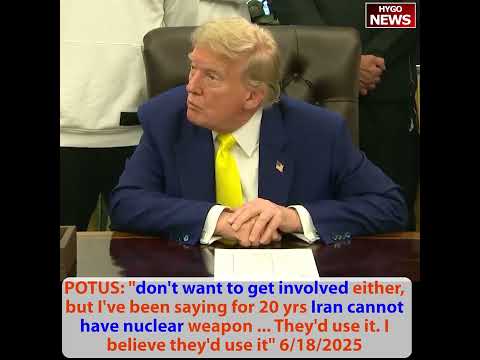
Trump: not looking for ceasefire, looking for total & complete victory; Fordow nuclear facility
Trump’s Iran posture sharpened again in a press exchange that made clear what “total and complete victory” means in his framing: no nuclear weapon, no ceasefire, no temporary pause. The president corrected a staffer who had told reporters that the administration was moving toward a ceasefire, and he articulated the distinction between a ceasefire and a victory. He addressed directly the question of whether dismantling Iran’s Fordow nuclear enrichment facility was a prerequisite for any deal — and his answer revealed a capability that no other country possesses. He restated his 20-year-old position that Iran cannot have a nuclear weapon, emphasized that Iran would use one if it had one, and noted that the deal Iran rejected is “a lot of water over the dam” and will be harder to sign now than it would have been two weeks ago. And the new American Flagpole on the South Lawn, paid for personally by the president, officially went into the ground during the same news cycle.
The Ceasefire Correction
Trump opened with a correction of his own staff. “He said I was going back home to make a ceasefire. Not a ceasefire. We’re long beyond ceasefire. And I said, why do you say that? Why would you say ceasefire? It’s a bad term to use.”
The correction is unusually public. Trump is not going to let his own team’s framing blur the administration’s posture. A ceasefire is one kind of outcome. Total victory is another. Trump is not willing to accept the ceasefire framing as equivalent.
”A Bad Term To Use”
Trump’s explanation was direct. “Because a ceasefire means like everything’s going swimmingly, we’ll take a little time off. It’s not. We’re not looking for a ceasefire. We’re looking for a total complete victory.”
The linguistic distinction is doing real work. A ceasefire is a pause. A total victory is a resolution. Trump is insisting that American policy is aimed at resolution, not pause. The difference is structural, not just rhetorical.
”Total Complete Victory”
Trump then defined what victory means in this context. “Again, you know what the victory is? No nuclear weapon.”
The definition is specific. Victory is not regime change. It is not territorial adjustment. It is not the destruction of Iran’s military capability. It is the removal of the nuclear weapons program from the equation.
That definition matters because it constrains what the administration is asking for. If victory is defined as “no nuclear weapon,” then Iran has a path to what the administration considers victory: dismantle the program. Iran does not have to abandon its theocratic governance structure, surrender territory, or make other concessions that would be politically impossible for its leadership. It has to dismantle the nuclear program.
”I Let Him Know That”
Trump’s framing of the internal correction was unambiguous. “I thought it was a very badly worded statement by him and obviously I let him know that.”
The public acknowledgment that Trump personally corrected a staffer is the kind of management detail that tells outside observers something about how the administration works. Messaging discipline is enforced from the top. Staffers who deviate from the president’s preferred framing will be corrected, and the correction will sometimes be made publicly.
The Fordow Question
The reporter’s question on Iran’s Fordow nuclear facility was pointed. “The destruction or dismantling of the Fordow Nuclear Enrichment Center, is that a prerequisite for a deal? Is that a red line for you?”
Fordow is the deeply buried uranium enrichment facility in Iran that has been a primary point of international concern because of its depth — buried under rock sufficient to make conventional bombing ineffective. Only a specific class of American munition — the GBU-57 Massive Ordnance Penetrator — is believed to have the capability to reach and disable the facility.
Trump’s answer: “No, it’s just something that people talk about having. We’re the only ones that have the capability to do it, but that doesn’t mean I’m going to do it at all."
"The Only Ones That Have The Capability”
The statement “We’re the only ones that have the capability to do it” is a public acknowledgment of what has been an open secret in defense circles. The GBU-57 is an American munition. It is designed to penetrate hardened underground facilities. Israel has extraordinary strike capabilities in general but does not have a proven capability to reach Fordow at its current depth.
This means that any action against Fordow, if Iran continues its nuclear program, would require American assets. Israel can strike Iran’s above-ground facilities. Israel can strike personnel. Israel can strike infrastructure. But Fordow, at its current depth, requires American munitions delivered by American platforms.
The implication of Trump’s statement is that the strategic leverage over Fordow sits in Washington. Tehran, considering whether the facility is safe, has to factor in the president’s willingness to authorize the strike.
”But That Doesn’t Mean I’m Going To Do It”
Trump’s caveat maintained the strategic ambiguity. “But that doesn’t mean I’m going to do it at all.”
The statement is the negotiator’s preservation of leverage. By confirming the capability exists but not committing to its use, Trump maintains the threat without executing it. Iran cannot assume safety. Iran also cannot assume strikes are imminent.
”Best Military Equipment In The World”
Trump then pivoted to the broader American military advantage. “We have the best military equipment in the world. You see that with this fight. We have planes that are undetectable, flying around like nobody’s able to see them stealth.”
The stealth reference is a nod to the F-35 and B-2 Spirit platforms, both of which are stealth-designed and both of which are operational in the Middle East theater. Iranian air defense systems have been significantly degraded in the recent exchanges, in part because they cannot detect or track stealth platforms. The administration is happy to have this fact in the public record.
”You Can Be Stealthy And Never Lose”
Trump’s aside to the reporters was classic. “You guys want to be stealthy tonight. You can be stealthy and never lose, right?”
The line is humor, but the underlying observation is serious. Strategic advantage in modern warfare depends heavily on detection asymmetry. If one side can see the other but not be seen, the one who cannot be seen has the advantage. American stealth platforms, in this context, are the reason the U.S. can operate in Iranian airspace with confidence that Iranian defensive systems will not engage them effectively.
”I Haven’t Made A Decision”
The reporter pressed on whether a strike would be authorized. “I’ve been asked about it by everybody, but I haven’t made a decision.”
The preservation of decision latitude is the president’s fundamental tool in this situation. The moment he commits publicly, he loses the ability to adjust based on evolving circumstances. By keeping the decision in the undecided column, he preserves maximum strategic flexibility.
”I’ve Been Saying For 20 Years”
Trump restated his consistency on the Iran question. “Well, I don’t want to get involved either, but I’ve been saying for 20 years, maybe longer, that Iran cannot have a nuclear weapon. I’ve been saying it for a long time.”
The 20-year anchor places Trump’s position in the early 2000s — the George W. Bush era, when Iran’s nuclear program first became a major U.S. policy focus. His consistency on this specific question is one of the through-lines of his public political career. Whether he has been consistent on every other foreign policy question is debatable; on this one, the record supports the claim.
”Few Weeks Away From Having One”
Trump then made the specific intelligence assessment. “And I think there were a few weeks away from having one. They had to sign a document. I think they wish they signed it now. It was a fair deal. And now it’s a harder thing to sign, you know. It’s a lot of water over the dam.”
The “few weeks away” assessment is the one that has driven the current American posture. If Iran was weeks away from having a weapon, the diplomatic window was closing in real time. The choice the administration faced was to accept an imminent Iranian nuclear capability or to use force to prevent it.
The reference to “a lot of water over the dam” acknowledges that the diplomatic terms available before Israeli strikes were more favorable to Iran than the terms available after. Iran’s refusal to sign has increased the cost of any subsequent settlement.
”They’d Use It”
Trump’s most chilling statement addressed Iranian intent. “Iran can’t have a nuclear weapon. Too much devastation. And they’d use it. You know, I believe they’d use it. Others won’t use it, but I believe they’d use it.”
The implicit framework is that not all nuclear-armed states are equivalent risks. Some countries — the distinction Trump is drawing — would not use a nuclear weapon even if they possessed one, because the cost of use in political, economic, or moral terms would be too high. Other countries — in Trump’s framing, Iran — would use one if it had the option, because the religious-ideological framework that motivates the regime does not include the constraints that bind other nuclear states.
Whether the judgment about Iranian intent is correct is debatable. What is clear is that the administration operates on the assumption that the judgment is correct, and that assumption shapes the entire policy posture.
”They Should Have Made The Deal”
Trump’s summary of the Iranian decision was direct. “Look, they should have made the deal. I had a great deal for them. They should have made that deal. 60 days we talked about it. And in the end they decided not to do it. And now they wish they did it. And they want to meet. But it’s a little late to meet, but they want to meet. And they want to come to the White House. They’ll even come to the White House. So we’ll see. I may do that.”
The willingness to consider an Iranian delegation visiting the White House is striking. Iran has not had a senior official visit Washington since 1979. Trump is signaling that the deal could be completed in that forum if Iran is willing to come. The conditions under which such a visit would occur are presumably strict, but the possibility is on the table.
”Not Looking For Long-Term War”
Trump addressed the concerns of his own political base. “Some of the people in the base don’t want a long-term war. They’re afraid that we’re going to get into a long-term war. We’re not looking for a long-term war. We’re looking… I only want one thing. Iran cannot have a nuclear weapon. That’s it. I’m not looking long-term for a long-term war.”
The acknowledgment of base concerns is significant. The MAGA coalition includes significant skepticism of American military engagement abroad. Trump is telling those voters that the goal is limited — denuclearization, not regime change, not long-term occupation, not nation-building.
“I only want one thing” is the compressed version of the policy. Trump is offering his coalition a policy that is ambitious in one specific area and restrained in all others. Whether Iran accepts the deal or forces further escalation, the American objective is the nuclear program, not anything else.
”Terror All Over The World”
Trump closed with the consequential framing. “Very simply, Iran cannot have a nuclear weapon. That’s it. It’s not a question of anything else. And if you did, you wouldn’t have much of a country because they would use it on us and they’d use it on other people. And there’d be a terror all over the world.”
“There’d be a terror all over the world” is the stakes as Trump describes them. An Iranian nuclear weapon, in his framing, is not a regional problem. It is a global problem — because Iran’s proxy network, its ideological reach, and its stated intentions would translate an Iranian nuclear capability into global terrorism on a scale that current terrorist organizations cannot approach.
Key Takeaways
- Trump corrects his staff: “Not a ceasefire. We’re long beyond ceasefire…We’re looking for a total complete victory. Again, you know what the victory is? No nuclear weapon.”
- On Fordow: “We’re the only ones that have the capability to do it, but that doesn’t mean I’m going to do it at all.”
- 20-year consistency claim: “I’ve been saying for 20 years, maybe longer, that Iran cannot have a nuclear weapon.”
- Trump’s assessment of Iranian intent: “Iran can’t have a nuclear weapon…And they’d use it. You know, I believe they’d use it. Others won’t use it, but I believe they’d use it.”
- Trump to his base: “We’re not looking for a long-term war…I only want one thing. Iran cannot have a nuclear weapon.”