 HYGO News
 Trump on Putin: 'I Don't Know What the Hell Happened -- He's Sending Rockets, I Don't Like It AT ALL'; US Steel 'Will Be Controlled by US, Otherwise I Wouldn't Make the Deal'; EU Tariff Extension June 1 to July 9; Harvard 31% Foreigners
Trump on Putin: “I Don’t Know What the Hell Happened — He’s Sending Rockets, I Don’t Like It AT ALL”; US Steel “Will Be Controlled by US, Otherwise I Wouldn’t Make the Deal”; EU Tariff Extension June 1 to July 9; Harvard 31% Foreigners
Multiple May 2025 stories crossed Trump’s desk. On Putin: “I don’t know what the hell happened to Putin. I’ve known him a long time. I’ve always gotten along with him, but he’s sending rockets into cities and killing people. And I don’t like it at all. We’re in the middle of talking and he’s shooting rockets into Kyiv and other cities.” On US Steel: “It’ll be controlled by the United States. Otherwise, I wouldn’t make the deal.” On Nippon Steel’s role: “An investment and partial ownership, but it’ll be controlled by the USA.” On EU tariffs: “She [Ursula von der Leyen] just called me and asked for an extension on the June 1st date. She wants to get down to serious negotiation… July 9th would be the date she requested.” On Harvard: “31% foreigners at Harvard. They refuse to tell us who the people are. It shouldn’t be 31%. We have Americans that want to go there and can’t because you have 31% foreign… They’re very anti-Semitic. Everybody knows they’re anti-Semitic and that’s got to stop immediately.” On OBBB: “John Thune and Mike Johnson have done a fantastic job."
"What the Hell Happened to Putin”
Trump opened with visible frustration about Russia.
“I don’t know what the hell happened to Putin,” Trump said. “I’ve known him a long time. I’ve always gotten along with him.”
He described the current situation: “But he’s sending rockets into cities and killing people. And I don’t like it at all. Okay?”
He identified the specific problem: “We’re in the middle of talking and he’s shooting rockets into Kyiv and other cities. I don’t like it at all.”
The Trump-Putin dynamic had become complicated in May 2025. Earlier coverage had documented:
- 2.5-hour Trump-Putin phone call
- Some “progress” reported
- Putin’s alleged preference for Melania
- Diplomatic engagement toward ceasefire
- European coordination on Russia-Ukraine
Despite this diplomatic engagement, Russia had continued and even intensified attacks on Ukrainian cities. Russian missile and drone attacks on Kyiv had reached high levels in late May 2025. Civilian casualties had mounted despite ongoing peace discussions.
Trump’s frustration reflected a specific pattern:
- Putin would engage in diplomatic discussions
- Meanwhile Russian forces continued or expanded military operations
- Trump expected that serious negotiation should include serious de-escalation
- Putin appeared to be using negotiations as cover for continued military pressure
The “I don’t like it at all” emphasis was significant. Trump was publicly signaling displeasure with Putin’s conduct. This was a departure from Trump’s earlier generally positive posture toward Putin. If Trump perceived Putin as negotiating in bad faith, American policy could shift significantly.
The US Steel Deal
Trump addressed the major US Steel announcement.
“What will the ownership structure look like?” a reporter asked.
Trump’s initial response was characteristically direct: “It’ll be controlled by the United States. Otherwise, I wouldn’t make the deal.”
He described the stakeholder process: “I went to the unions, to all of the local unions. They all wanted it. I’m doing it because all of the congressmen came in, about five of them, and the others, I understand, are in concurrence. And they ask that I do it. Everybody seems to want it.”
He described Nippon Steel’s role: “And we’ll see. I mean, you know, we’ll see what the final is. But they’re going to invest billions of dollars in steel. And it’s a good company. Nissan’s a very good company. We’ll see. But it’s an investment and it’s a partial ownership, but it’ll be controlled by the USA.”
The US Steel-Nippon Steel deal had been one of the most controversial business transactions of the early Trump second term. Background:
The underlying deal: Nippon Steel, a major Japanese steel producer, had proposed acquiring U.S. Steel Corporation, a historic American steel company dating to 1901.
Biden administration opposition: The Biden administration had blocked the acquisition in early 2025 based on national security concerns.
Trump campaign position: During the 2024 campaign, Trump had also expressed opposition to the Japanese acquisition.
Political context: US Steel was based in Pennsylvania, a critical electoral state. The United Steelworkers union had been divided on the deal.
New structure: Trump’s approach appeared to be allowing Nippon Steel investment while maintaining American control, satisfying union and political concerns while preserving some Japanese capital infusion.
The “controlled by USA” framing was legally meaningful. Even with Japanese investment and partial ownership, if governance structures ensured American control of strategic decisions, the entity would remain fundamentally American. Golden share arrangements, requirements for American CEO and board majority, and limits on Japanese board representation could all preserve American control while enabling Japanese investment.
The EU Tariff Extension
Trump described his call with European Commission President Ursula von der Leyen.
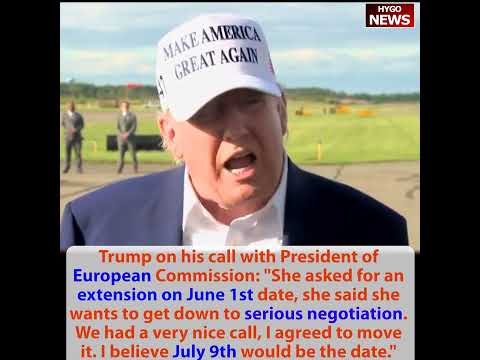
“She just called me, as you know. And she asked for an extension on the June 1st date,” Trump said.
He described her reasoning: “And she said she wants to get down to serious negotiation because I’ve told you specifically, but I told anybody that would listen, they have to do that.”
He described the outcome: “And we had a very nice call and I agreed to move it. I believe July 9th would be the date. That was the date she requested. Could we move it from June 1st to July 9th? And I agreed to do that.”
He reported her commitment: “And that she said we will rapidly get together and see if we can work something out.”
The EU tariff situation was a specific Trump trade action. Earlier in May, Trump had announced significant new tariffs on European imports, with an effective date of June 1, 2025. The EU had been pressuring for delay to allow negotiation.
The von der Leyen call represented EU recognition that:
- Trump’s tariff threats were serious
- European exports depended on American market access
- Genuine negotiation was required to reach resolution
- Political posturing without concessions would not work
The July 9 extension was modest — about six weeks of additional time. But it signaled willingness to negotiate rather than escalate. If productive talks occurred, further extensions were possible. If they failed, the tariffs could be implemented in July rather than June.
Trump’s “nice call” characterization was diplomatically significant. Von der Leyen had been sometimes-critic of Trump, and the EU’s relationship with the administration had been tense. The “nice call” signaled that personal relationships could facilitate negotiation despite policy differences.
Harvard: “31% Foreigners”
Trump made specific accusations about Harvard.
“Part of the problem with Harvard is that there are about 31%, almost 31% of foreigners coming to Harvard,” Trump said.
He made the fiscal point: “We give them billions of dollars, which is ridiculous. We do grants, which we’re probably not going to be doing much grants anymore to Harvard.”
He made the transparency demand: “But they’re 31%, but they refuse to tell us who the people are. We want to know who the people.”
He distinguished foreign students from the specific problem: “Now, a lot of the foreign students we wouldn’t have a problem with. I’m not going to have a problem with foreign students, but it shouldn’t be 31%. It’s too much because we have Americans that want to go there and other places and they can’t go there because you have 31% foreign.”
He made the funding comparison: “Now, no foreign government contributes money to Harvard. We do. So why are they doing so many?”
He articulated the specific reform demands: “We want a list of those foreign students and we’ll find out whether or not they’re okay. Many will be okay, I assume. And I assume with Harvard, many will be bad.”
He raised the antisemitism concern: “And then the other thing is they’re very anti-semitic. Everybody knows they’re anti-semitic and that’s got to stop immediately.”
The Harvard Situation
The Harvard conflict had multiple dimensions in May 2025:
Federal funding: Harvard received substantial federal grants, loans for students, and research funding. Total federal funding ran into billions annually.
Foreign student percentage: Approximately 31% of Harvard students were foreign nationals, which was high even by Ivy League standards.
Diversity questions: Trump argued that American students couldn’t access elite education because spots were going to foreign students instead.
Transparency disputes: Harvard had refused to provide the Trump administration with lists of foreign students and their backgrounds.
Post-October 7 antisemitism: Harvard had been criticized extensively for tolerating antisemitic conduct by students and faculty after the October 7, 2023 Hamas attacks.
Academic freedom concerns: Harvard had argued that federal demands for information violated academic freedom and institutional autonomy.
Administration response: The Trump administration had frozen various federal funding to Harvard pending compliance with transparency and conduct requirements.
Trump’s framing suggested several specific reforms:
- Reduced federal funding for Harvard
- Transparency requirements for foreign student information
- Reduced percentage of foreign students relative to Americans
- Enforcement action against antisemitic conduct
- Broader accountability for elite universities
The Foreign Student Economics
Trump’s economic framing was important. American universities, particularly elite ones, had relied heavily on foreign student tuition revenue:
Full-pay students: Most foreign students paid full tuition without financial aid, making them significantly more profitable than American students receiving aid.
Tuition subsidization: Foreign student tuition effectively subsidized American student financial aid packages.
International rankings: High percentages of foreign students contributed to rankings that measured international reputation.
Political pressure relief: Foreign students were less politically sensitive constituencies than American students for university administrators.
However, this business model created problems:
- Americans unable to access elite education
- Universities prioritizing foreign revenue over national service
- Potential national security concerns about sensitive research
- Political tension about subsidizing foreigners while Americans were excluded
Trump’s critique was that universities receiving billions in federal funding had obligations to American students and taxpayers that superseded their revenue optimization. If Harvard wanted to prioritize foreign students, it could do so without federal funding. But accepting federal funding should come with requirements for American student priority.
The Antisemitism Issue
The “very anti-semitic” characterization referenced ongoing patterns at Harvard:
Post-October 7 response: Harvard had initially been slow to condemn the Hamas attacks and quick to emphasize Palestinian concerns. Multiple Harvard student groups had signed a letter blaming Israel for the attacks.
Campus climate: Jewish students had reported widespread antisemitism, including verbal harassment, exclusion from student activities, and threatening behavior.
Faculty conduct: Some Harvard faculty had made statements supporting Hamas or criticizing Jewish students.
Title VI violations: Federal civil rights law prohibits antisemitic discrimination in federally funded programs. Harvard’s conduct had potentially violated these provisions.
Congressional testimony: Harvard’s president had been called to testify before Congress about campus antisemitism and had given widely criticized responses.
Subsequent leadership change: Claudine Gay had resigned as Harvard president partly due to the antisemitism controversy and related plagiarism concerns.
The administration’s demands for reform included specific antisemitism accountability, not just general transparency. This connected Harvard’s conduct to broader administration priorities around combating antisemitism and protecting Jewish Americans.
OBBB Confidence
Trump closed with expression of confidence on OBBB.
“The one big, beautiful bill. And it is a big, beautiful bill,” Trump said.
He expressed confidence: “So I think the Senate is going to get there. I hope they’re going to get there.”
He acknowledged likely modifications: “I think they’re going to have changes. Some will be minor and some will be fairly significant.”
He described the coordination: “But we’ve been working with the House all the way up. They’ve been working together. The Speaker has been working with the leader of the Senate.”
He praised both leaders: “And you know, they’ve done a great job. John Thune and Mike Johnson have done a fantastic job. They’ve been working together all the way up.”
He offered cautious optimism: “So hopefully that’ll be fine.”
The House had passed OBBB 215-214 in late May 2025. The Senate was considering the bill with potential modifications. Key Senate considerations included:
- Fiscal conservatives (like Rand Paul) with specific objections
- Moderate Republicans with various concerns
- Senate procedural requirements differing from House
- Potential amendments from both parties
- Conference committee negotiations with the House
Trump’s confidence that “the Senate is going to get there” reflected his assessment that substantive opposition was limited. Most Republicans would eventually support the bill despite specific concerns. The ultimate question was whether amendments would modify the bill substantially or whether it would pass largely as the House had approved.
The Johnson-Thune coordination Trump praised was genuine and important. Unlike some previous leadership combinations that had struggled with inter-chamber cooperation, the Johnson-Thune pair had been effective partners. Their ability to pass legislation through both chambers represented institutional competence that had been lacking in recent years.
Key Takeaways
- Trump on Putin: “I don’t know what the hell happened. He’s sending rockets into cities, killing people. I don’t like it AT ALL. Shooting rockets into Kyiv while we’re talking.”
- US Steel deal: “Controlled by the United States, otherwise I wouldn’t make the deal. Nippon invests billions, partial ownership, but USA controls.”
- EU tariffs: Von der Leyen asked for extension, agreed to move June 1 to July 9 for “serious negotiation.”
- Harvard: “31% foreigners, they refuse to tell us who they are. We give them billions. Very anti-Semitic — got to stop immediately.”
- OBBB: “I think the Senate is going to get there… John Thune and Mike Johnson have done a fantastic job.”