 HYGO News
 Trump on Nobel Prize: 'Maybe for the Abraham Accords'; 'Not Happy' About Overnight Missiles; Rubio: 'This War Is Endable'
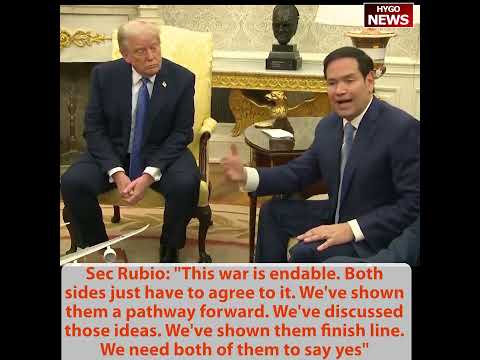
Trump on Nobel Prize: “Maybe for the Abraham Accords”; “Not Happy” About Overnight Missiles; Rubio: “This War Is Endable”
President Trump, Secretary Rubio, and Norwegian PM Store addressed peace, war, and the Nobel Prize in an Oval Office exchange in April 2025. When asked if he deserved the Nobel Peace Prize, Trump said: “Maybe for the Abraham Accords. A lot of countries want to come in — we’re going to be filling it up very rapidly.” On overnight Russian missile strikes during peace talks, Trump was blunt: “I didn’t like last night. Missiles were fired and I was not happy with it.” Rubio declared: “This war is endable. We’ve shown them the finish line. We need both of them to say yes. No leader is working harder to prevent wars or end them than President Trump.” Norway’s PM Store added: “U.S. engagement is critical. President Trump made that possible. Both parties have to feel the pressure to deliver."
"Maybe for the Abraham Accords”
When a reporter asked whether Trump deserved the Nobel Peace Prize, his answer was measured.
“Well, maybe for the Abraham Accords,” Trump said. “I don’t want to get ahead of myself on this one, but they say for the Abraham Accords.”
He announced expansion plans: “And by the way, speaking of that, we’re going to be filling it up. A lot of countries want to come into the Abraham Accords.”
He noted the stagnation under Biden: “You know we have four, and Biden did nothing on that one too. It’s the same four. But they’re great countries and they were brave doing it, and it’s worked out very well.”
He projected forward: “We’re going to be filling up the Abraham Accords. They’re going to be, I think, filling it up very rapidly.”
The Abraham Accords — the normalization agreements between Israel and Bahrain, the United Arab Emirates, Morocco, and Sudan — remained Trump’s most significant foreign policy achievement from his first term. The agreements had transformed the Middle East by creating diplomatic, economic, and security relationships between Israel and Arab nations that had been adversaries for decades.
Biden had inherited the accords with four signatories and added none. Trump was now promising rapid expansion, suggesting that additional countries were ready to normalize relations with Israel under American brokering. The “brave” characterization of the original signatories acknowledged the political risk these Arab nations had taken in making peace with Israel — and implied that subsequent signatories would receive similar presidential praise and support.
”I Wasn’t Happy with It”
A reporter asked about Trump’s public message to Putin — “Vladimir, stop” — following overnight missile strikes.
“I didn’t like last night,” Trump said. “I wasn’t happy with it. And we’re in the midst of talking peace and missiles were fired. And I was not happy with it.”
The statement was notable for its personal directness. Trump was not speaking through diplomatic channels or press secretaries. He was expressing personal displeasure with Putin’s decision to launch missile attacks while peace talks were actively underway. The message was that military escalation during negotiations was not just diplomatically counterproductive — it was personally offensive to the president who was investing time and political capital in ending the war.
The timing of the strikes — during active negotiations that included meetings with European leaders — suggested either that Putin was testing the administration’s resolve or that elements within the Russian military were operating independently of the diplomatic track. Either way, Trump’s public rebuke was designed to make clear that continued military escalation would complicate the path to the deal that both sides supposedly wanted.
Rubio: “This War Is Endable”
Secretary Rubio delivered the administration’s most comprehensive summary of the peace effort’s status.
“Of all the leaders in the world today, no leader is working harder to prevent wars or end them than President Trump is right now,” Rubio said. “That’s why we’re talking to Iran. That’s why we’re engaged with Ukraine and Russia.”
He stated the assessment: “This war is endable. Both sides just have to agree to it.”
He described the progress: “We’ve shown them a pathway forward. We’ve discussed those ideas. There was a good meeting yesterday. There’ll be good meetings over the weekend.”
He stated what was needed: “We’ve shown them the finish line. We need both of them to say yes.”
He connected the missiles to the urgency: “But what happened last night with those missile strikes should remind everybody of why this war needs to end. It’s horrible those missiles landed. What’s even worse is there are today people that were alive yesterday that are not alive today because this war continues, and the president wants to stop it.”
He framed the administration’s role: “It’s not our war. We didn’t start it. But we’re trying to end the destruction. We’ve shown the path forward. We can see the finish line, but both of them have to get there.”
He revealed the pressure: “You think we’re just in there because we’re nice people — and we are nice people — but we’re using a lot of pressure on both.”
The “shown them the finish line” formulation was the most specific Rubio had been about the state of negotiations. The administration had put a concrete proposal on the table — not vague principles but a specific framework for ending the war. Both Russia and Ukraine had seen it. The question was whether both would say yes.
The “lot of pressure on both” admission was significant. The media narrative had often portrayed the administration as pressuring only Ukraine. Rubio was making clear that Russia was under equal pressure — that the administration was not favoring one side but demanding that both accept the terms of a fair settlement.
Norway’s PM: “U.S. Engagement Is Critical”
Store provided the European perspective with notable praise for the American role.
“To move toward an end of this war, U.S. engagement is critical, and President Trump made that possible,” Store said. “That is clear. That is obvious. It’s really happening.”
He described the dynamics: “Now the important thing is that both parties have to know that they have to deliver and they have to feel the pressure to deliver.”
He acknowledged Ukraine’s position: “Ukraine is under attack. They are defending themselves. We believe very firmly that there needs to be a ceasefire.”
He praised the diplomatic cooperation: “I salute the team of President Trump for being open in that process. We had a good discussion on this today.”
He stated the urgency: “We cannot lose time because this is too much drama happening. One thing is people losing their lives. But it is a bad thing for Europe and it’s a bad thing for the world to have such a broad conflict going on. It can have ramifications far beyond Ukraine.”
Store’s statement that U.S. engagement “is really happening” was an implicit rebuke to critics who had claimed Trump was not seriously pursuing peace. The Norwegian PM — not a natural Trump ally — was confirming firsthand that the peace process was real, active, and progressing.
Key Takeaways
- Trump on the Nobel Prize: “Maybe for the Abraham Accords. A lot of countries want to come in — we’re going to fill it up very rapidly.”
- On overnight missile strikes during peace talks: “I didn’t like last night. Missiles were fired. I was not happy with it.”
- Rubio: “This war is endable. We’ve shown them the finish line. We need both to say yes. We’re using a lot of pressure on both.”
- Norway PM Store: “U.S. engagement is critical and Trump made that possible. Both parties have to feel the pressure to deliver.”
- Rubio: “No leader in the world is working harder to prevent wars or end them than President Trump right now.”