 HYGO News
 Trump: 'No Intention of Firing Jerome Powell'; On China: 'If They Don't Make a Deal, We'll Set the Deal'; Markets Up
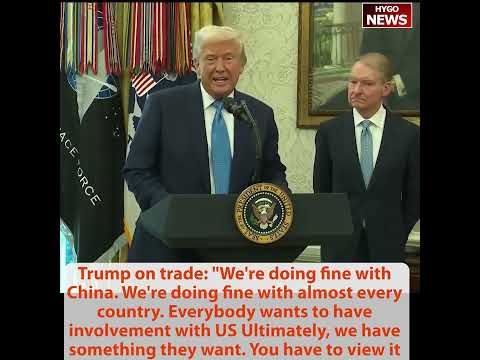
Trump: “No Intention of Firing Jerome Powell”; On China: “If They Don’t Make a Deal, We’ll Set the Deal”; Markets Up
President Trump calmed markets in April 2025 by clarifying his position on Fed Chairman Jerome Powell: “I have no intention of firing him. Never did. The press runs away with things.” He maintained his criticism — “I would like to see him be a little more active in terms of his idea to lower interest rates. It’s a perfect time” — but said Powell’s inaction wasn’t “the end.” On China, Trump was characteristically direct: “Ultimately, they have to make a deal because otherwise they’re not going to be able to deal in the United States. If they don’t make a deal, we’ll set the deal.” He noted the stock market was “up nicely,” confirmed tariff revenues of 25% on autos, steel, and aluminum plus a 10% baseline, and declared: “We were losing $5 billion a day under Biden. Those days are gone."
"No Intention of Firing Him”
A reporter set the premise: “You have no intention of firing Jerome Powell?”
Trump was definitive: “Not whatsoever. Never did. The press runs away with things. I have no intention of firing him.”
He maintained his critique: “I would like to see him be a little more active in terms of his idea to lower interest rates. It’s a perfect time to lower interest rates.”
He calibrated the stakes: “If he doesn’t, is it the end? No, it’s not. But it would be good timing. It could have taken place earlier.”
He repeated: “But no, I have no intention to fire him.”
The Powell clarification was market-moving. In the days prior, media speculation about a potential presidential firing of the Fed chairman had contributed to market volatility. Investors worried that removing Powell would undermine the perception of Fed independence, triggering a crisis of confidence in American monetary institutions.
Trump’s “never did” was a flat denial that he had ever intended to fire Powell — recharacterizing the earlier public criticism as pressure to perform, not a prelude to termination. The distinction mattered enormously to financial markets. A president who criticized the Fed chairman was operating within the bounds of normal political discourse. A president who fired the Fed chairman would be taking an action without modern precedent.
By saying Powell’s failure to cut rates wasn’t “the end,” Trump was simultaneously maintaining pressure and providing reassurance. The message was: I want rate cuts, I think they’re overdue, but I’m not going to blow up the institution to get them.
”If They Don’t Make a Deal, We’ll Set the Deal”
Trump turned to China with the confidence of a negotiator who held the stronger hand.
“Ultimately, they have to make a deal because otherwise they’re not going to be able to deal in the United States,” Trump said.
He stated the options: “So we want them involved, but they have to — and other countries have to — make a deal.”
He delivered the alternative: “And if they don’t make a deal, we’ll set the deal. Because we’re the ones that set the deal.”
He named his team: “Scott and Howard and myself and others, we’re going to be setting the deal. And it’ll be a fair deal for everybody.”
He projected the timeline: “And I think it’s a process that’s going to go pretty quickly.”
The “we’ll set the deal” formulation was a negotiating position that reframed the entire trade dynamic. Under conventional trade diplomacy, deals were negotiated — meaning both sides had veto power. Trump was saying that if China refused to negotiate, the United States would unilaterally determine the terms of trade through tariff rates, market access restrictions, and regulatory requirements. China could accept those terms or lose access to the American market.
This was not bluster; it was a structural reality. The United States was the world’s largest consumer market. China’s economy was built on exports, and a significant portion of those exports went to America. If forced to choose between accepting American-set terms and losing the American market entirely, China would accept the terms.
”Losing $5 Billion a Day”
Trump provided the fiscal context for his trade agenda.
“We were losing $5 billion a day during the Biden administration, during that last year,” Trump said. “It was a horror show, what they were doing on trade.”
He described the current tariff structure: “Now we have it down to a very low number because we’re getting 25% from the automobile industry, from autos. We’re getting 25% for steel, 25% for aluminum, and we’re getting the baseline of 10%.”
He stated the scope: “Think of it, we’re losing almost $2 trillion on trade. And those days are gone. We’re not going to do that again.”
He assigned blame: “You had no leadership. You had people that didn’t know what they were doing.”
He stated the mission: “We’re going to turn the country around. You know, we have a very nice phrase, make America great again. That’s what we’re going to do. And it’s going to start with trade.”
The $5 billion per day figure — approximately $1.8 trillion annually — represented the trade deficit that had accumulated under decades of trade agreements that prioritized corporate efficiency over national economic interest. Factories had moved overseas, jobs had disappeared, and the balance of trade had tilted catastrophically against the United States.
The tariff revenue structure Trump described — 25% on autos, steel, and aluminum plus a 10% baseline — was generating hundreds of billions in annual revenue while simultaneously creating incentives for manufacturers to relocate production to the United States to avoid the tariffs entirely.
The European Union
Trump addressed the EU’s trade practices with characteristic directness.
“We’ve spoken to many, many countries and we’re getting their views on things,” he said. “There are a lot of things. They have VAT taxes. They have everything you can have.”
He stated the structural critique: “Don’t forget, as an example, the European Union was set up to take advantage of the United States. They were set, and they’ve done that. But they’re not doing that anymore.”
The VAT reference pointed to one of the most persistent trade grievances. European countries charged value-added taxes that effectively functioned as tariffs on American exports — making American goods more expensive in European markets — while European goods entering the United States faced no equivalent barrier. The asymmetry had been tolerated for decades under the theory that the economic benefits of free trade outweighed the costs. Trump rejected that theory.
”We Have Something They Want”
Trump delivered the philosophical foundation of his trade strategy.
“Ultimately, we have something they want,” he said. “And you have to view it that way.”
He described the dynamic: “They’re coming in, they’re taking treasure, they’re taking jobs when they do that, and they have to pay.”
He offered the alternative: “And they don’t have to pay if they come in and create their own jobs. If they do their product here, if they build their product or make their product in the United States, we have absolutely no tariffs, and we welcome people.”
He noted the transition: “We’re taking in a lot of money from tariffs, and our country is getting stronger all the time because the other was not sustainable.”
The “something they want” formulation captured the fundamental leverage that Trump’s trade policy was built on: access to the American consumer market. The United States had approximately 330 million consumers with the highest per-capita purchasing power in the world. Every company and every country in the world wanted to sell to American consumers. That desire was the leverage that made tariffs effective.
The zero-tariff path — build in America, pay nothing — was the ultimate goal. The tariffs were not an end in themselves; they were a mechanism to incentivize domestic production. Companies that manufactured in the United States, employed American workers, and contributed to the American tax base would face no tariffs because their products were already American.
Key Takeaways
- Trump on Powell: “No intention of firing him. Never did. But I’d like to see him more active on lowering rates — it’s a perfect time.”
- On China: “If they don’t make a deal, we’ll set the deal. Scott and Howard and I will set it — and it’ll be fair for everybody.”
- Trade deficit: “We were losing $5 billion a day under Biden. Those days are gone.” Current tariffs: 25% autos, 25% steel/aluminum, 10% baseline.
- On the EU: “The European Union was set up to take advantage of the United States. They’re not doing that anymore.”
- Core leverage: “We have something they want. If they build their product in the United States, we have absolutely no tariffs.”