 HYGO News
 Trump: NO AMNESTY; Putin BS meaningless; 10% if BRICS; Rubio: Azerbaijan & Armenia, Syria & Lebanon
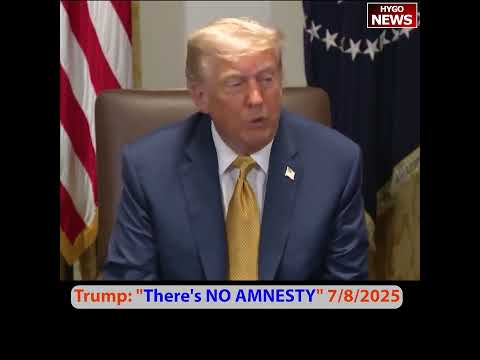
Trump: NO AMNESTY; Putin BS meaningless; 10% if BRICS; Rubio: Azerbaijan & Armenia, Syria & Lebanon
Trump addressed multiple major topics across a single press availability. He categorically denied reports that the administration was considering farmworker amnesty, characterizing what the administration is doing as a “work program” not amnesty. Secretary of State Rubio delivered an extensive accomplishment catalogue covering India-Pakistan, NATO 5%, Rwanda-Congo, the 12-Day War, Azerbaijan-Armenia, and the emerging Syria-Lebanon dynamics. Trump then expressed frustration with Russian President Putin on Ukraine — “we get a lot of bullshit thrown at us” — and committed to sending additional weapons to Ukraine. Deputy Chief of Staff Stephen Miller then delivered one of the most politically direct statements of the administration’s view of Democratic immigration policy: that Democrats want to flood the West with illegals believing that collapse will position them to “sit on top the pile of ashes."
"There’s No Amnesty”
Trump opened with an unambiguous denial. “There’s no amnesty. What we’re doing is we’re getting rid of criminals, but we are doing a work program.”
The context is reports that had been circulating about the administration’s possible farmworker amnesty policy. The reports had generated significant concern among immigration restrictionists who are part of Trump’s coalition. Trump’s direct denial addresses those concerns categorically.
The distinction is specific. Amnesty is the general forgiveness of immigration violations. A work program is a specific administrative mechanism that allows specific workers to fill specific labor needs under specific conditions. The former is political and permanent. The latter is administrative and time-limited.
The Work Program Framework
Trump invited clarification. “Do you want to explain that, please?”
The response came from an administration official. “Yeah, this morning we talked about, of course this was a top of mind question, this morning we talked about protecting the farmers in the farmland, but obviously this president’s vision of no amnesty, mass deportation continues, but in a strategic way, and then ensuring that our farmers have the labor that they need.”
The framework has three components operating simultaneously:
Mass deportation continues — The administration’s enforcement operation remains in effect. Criminal undocumented individuals continue to be targeted for removal. The overall scale of enforcement is not being reduced.
Strategic calibration — The enforcement is strategic rather than blanket. Specific categories receive specific attention. The operation targets priorities rather than applying uniform standards across all cases.
Farmer labor needs — The specific agricultural sector has specific labor requirements that the work program addresses. Farmers who need labor get labor. But through legal channels and with specific accountability, not through undocumented workforce.
”Moving Toward Automation”
The administrative official continued. “Secretary Chavez-Durimer has been a leader on this, obviously this comes out of the labor department, but moving toward automation, ensuring that our farmers have that workforce, and moving toward an American workforce.”
Three specific mechanisms. Automation — technology replaces labor in agriculture. Guest worker programs — foreign workers fill specific needs temporarily. American workforce — the long-term goal of bringing American workers back into agricultural labor.
The combination addresses the immediate labor crisis without creating permanent dependency on undocumented workers. Automation reduces total labor requirements. Guest workers fill interim needs. Americans, attracted by better wages from the reduced supply of cheap labor, return to agricultural work over time.
”We’re Not Talking Amnesty”
Trump closed the topic. “We want to give the farmers the people they need, but we’re not talking amnesty.”
The repeated emphasis — “we’re not talking amnesty” — is important. Trump is reassuring his immigration restrictionist coalition. The work program is a technical administrative mechanism. It is not a pathway to citizenship. It is not forgiveness of prior violations. It is not a de facto amnesty by another name.
Whether the distinction holds up in implementation depends on the program’s specific features. If the guest workers can eventually obtain permanent residency, the program effectively becomes amnesty. If they can only work temporarily and must return home, it is distinct from amnesty.
Rubio’s Accomplishment Catalogue
Secretary of State Rubio then delivered the foreign policy summary. “Under your leadership, we prevented an ended war between India and Pakistan. NATO is now at 5% for the first time ever, the highest numbers ever. A peace deal between the Democratic Republic of Congo and Rwanda. A 12-day war that ended with an American operation that were the only country in the world that could have done.”
The catalogue captures the major foreign policy achievements.
India-Pakistan — American mediation prevented what could have been a major regional war between two nuclear-armed states.
NATO 5% — European allies committed to defense spending levels that had been considered unachievable for decades.
DRC-Rwanda — A 30-year conflict ended through American mediation.
12-Day War — The Iran operation that destroyed the nuclear program and ended in ceasefire.
Each is a substantial diplomatic achievement. The combination, across six months, is unusual by historical standards.
Azerbaijan-Armenia
Rubio added a pending development. “Hopefully a pretty soon peace deal between Azerbaijan and Armenia.”
The Azerbaijan-Armenia conflict over Nagorno-Karabakh and related territorial disputes has been one of the most persistent post-Soviet conflicts. The two countries fought active wars in the 1990s and again in 2020. Continuing tensions have produced periodic escalations.
Rubio’s “hopefully pretty soon” suggests that American mediation is producing specific progress. If the peace deal materializes, it adds another major diplomatic achievement to the catalogue.
Syria And Lebanon
Rubio then identified the emerging regional dynamic. “The entire Middle East and the infrastructure, but it has the potential now to change because of Syria and Lebanon.”
Syria’s transition from the Assad regime to whatever follows it is reshaping regional dynamics. Lebanon’s political situation has also been transitioning. Both countries, which have been instruments of Iranian proxy influence for decades, are moving toward different alignments.
The specific changes in Syria and Lebanon, combined with the Iran operation that degraded Iranian regional capabilities, could produce the kind of regional realignment that has not been possible for a generation. The opportunity is real but fragile.
”It Hasn’t Even Been Six Months”
Rubio closed with the time framing. “It hasn’t even been six months, so it’s a straight testament to your leadership in this region.”
The six-month framing is politically significant. Most administrations’ major foreign policy achievements accumulate over years, not months. Rubio’s listing of specific accomplishments — India-Pakistan, NATO, DRC-Rwanda, 12-Day War, potentially Azerbaijan-Armenia, Syria-Lebanon emerging — represents a pace that few administrations have matched.
“A straight testament to your leadership” is Rubio’s specific credit attribution. These outcomes are not products of institutional momentum or career diplomatic staff work alone. They reflect specific presidential leadership that produced results that would not have been produced by other leaders.
Trump On Ukraine
The video pivoted to Ukraine. “That was a war that should have never happened, and a lot of people are dying, and it should end.”
Trump’s framing is consistent. The Russia-Ukraine war, in his view, could have been prevented with different diplomatic approaches before it started. The ongoing war is producing massive casualties on both sides. It should end.
”Bullshit Thrown At Us By Putin”
Trump’s sharp critique. “And I don’t know, we get a lot of bullshit thrown at us by Putin for you to want to know the truth. It’s very nice all the time, but it turns out to be meaningless.”
The language is unusual for a president. “Bullshit” is not Presidential diplomatic vocabulary. Trump’s willingness to use it captures the specific frustration he is experiencing with Putin’s diplomatic approach.
The specific critique is about Putin’s style. “Very nice all the time” — Putin, in person or on phone calls, is courteous and apparently receptive. “Turns out to be meaningless” — the niceness does not translate into actual policy movement or concession on the ground.
Why The Putin Frustration Matters
The Putin frustration is politically significant. Trump has historically been characterized by critics as personally pro-Putin or as reluctant to criticize the Russian leader. His direct “bullshit” critique contradicts that characterization.
The frustration also signals operational adjustment. If Putin’s diplomatic engagement is meaningless, the administration’s approach to Ukraine must change. Continued reliance on Putin’s stated commitments will not produce outcomes. Different leverage — including weapons flows to Ukraine — becomes necessary.
”Going To Send Some More Weapons”
Trump confirmed the weapons decision. “We’re going to send some more weapons. They have to be able to defend themselves. They’re getting hit very hard now. They’re getting hit very hard. We’re going to have to send more weapons. You have defensive weapons, primarily, but they’re getting hit very, very hard.”
The specific framing — “defensive weapons” — is important. The administration is sending weapons that help Ukraine defend against Russian attacks, not weapons that extend Ukrainian offensive reach into Russian territory. That distinction matters for escalation management.
“Getting hit very hard now” is the empirical observation. Russian strikes on Ukrainian cities, infrastructure, and military positions have been intensifying. Ukraine needs additional defensive capability to reduce the damage those strikes cause.
Stephen Miller On Democratic Immigration Strategy
Deputy Chief of Staff Stephen Miller then delivered the political framing. “The Democrat Party’s objective is to flood the West with millions upon millions of illegals from the developing world, from the poor nations of the world, the failed states of the world, the collapsing states of the world, believing that in so doing, they will collapse the West, they will collapse the middle class, they will collapse the population that has lived here before the migrants came.”
The framing is extraordinary. Miller is attributing to Democrats a specific strategic objective — collapsing the existing American population through mass immigration. That attribution goes beyond policy disagreement into the specific claim that Democrats intend to replace the existing population.
”Sit On Top The Pile Of Ashes”
Miller continued. “And in so doing, they think in the rubble of that, they can rule. They can sit on top the pile of ashes.”
The image is stark. Democrats, in Miller’s framing, want to destroy the current society so they can rule over the rubble. The existing population — specifically the middle class that Miller names — is the obstacle. Replacing that population with immigrants who will be grateful to the Democratic Party is the strategic objective.
Whether Miller’s characterization reflects actual Democratic strategy is debatable. Democrats would dispute the framing as a mischaracterization of their immigration policy preferences. Miller’s argument is that Democratic behavior — consistent opposition to enforcement, consistent support for mass immigration, consistent advocacy for amnesty — reveals the objective regardless of stated motivations.
”Why Is It That Democrats Are So Insistent”
Miller posed his rhetorical question. “Ask yourself this. Why is it that Democrats are so insistent that unlimited numbers of illegals from countries that are incapable of managing their own affairs come here? Countries like Somalia, countries like Haiti, countries that have no history of successful self-government, and they want unlimited numbers of illegals from those countries and refugees from those countries to come here with no chance at the pace, the scale, the scope of arrivals at being able to assimilate and integrate into the American way of life.”
The specific countries Miller names — Somalia and Haiti — are chosen deliberately. Both countries have been persistent sources of refugee and asylum applicants to the United States. Both have governance challenges that have persisted for decades.
Miller’s argument is that Democratic insistence on continued immigration from these specific countries, despite the countries’ demonstrated inability to produce successful societies, reveals something about Democratic strategic objectives. If the Democratic goal were to help genuinely vulnerable people, the Democratic Party would focus on policies that address the underlying problems rather than simply importing the affected populations.
”What Has It Done To Our Schools?”
Miller then invoked the specific impact questions. “What has it done to our schools? What has it done to our hospitals? What has it done to just traffic in our cities? Every issue that affects our quality of life, Jesse, public safety, drugs, crime, education, healthcare, waiting in the emergency room, are all exacerbated, worsened and undermined by mass illegal immigration.”
The list captures the specific quality-of-life impacts. Schools that must educate students who do not speak English. Hospitals that provide emergency care to patients who cannot pay. Traffic congested by population growth that infrastructure cannot accommodate. Public safety affected by higher crime rates. Drugs flowing through communities where enforcement has been compromised.
Each impact is debated in policy literature. Academic studies have produced various findings about the specific effects of immigration on specific measures. Miller’s framing is that the cumulative negative effect across all measures is clear regardless of specific study results.
Why Miller’s Framing Matters Politically
Miller’s framing is politically significant because it articulates a position that is widely held among Trump voters but rarely expressed publicly by administration officials. Most officials in most administrations frame immigration concerns in carefully calibrated terms. Miller is willing to frame them in direct terms that match how many voters actually experience the issue.
That direct framing serves multiple purposes. It reassures Trump’s coalition that the administration understands the issue the way they understand it. It creates political pressure on Democrats to engage with the specific characterization rather than with softer framings. It establishes the terms of the debate in ways that advantage administration messaging.
The Combined Political Framework
The day’s multiple threads — no amnesty, accomplishment catalogue, Putin frustration, weapons for Ukraine, Miller’s Democratic immigration framing — fit together as a coherent political presentation.
The no amnesty commitment reassures the coalition. The accomplishment catalogue demonstrates delivery. The Putin frustration shows realistic engagement with difficult partners. The weapons commitment to Ukraine signals continued American support. The Miller framing provides the ideological architecture connecting specific policies to broader strategic purposes.
Each element contributes to the overall administration presentation. Voters who engage with any specific element encounter the others through the interconnection. The cumulative effect is a political framework that addresses multiple voter concerns simultaneously.
Key Takeaways
- Trump on amnesty: “There’s no amnesty. What we’re doing is we’re getting rid of criminals, but we are doing a work program…we’re not talking amnesty.”
- Rubio’s six-month catalogue: India-Pakistan prevented war, NATO 5% for the first time, DRC-Rwanda peace, 12-Day War, Azerbaijan-Armenia pending, Syria-Lebanon emerging changes.
- Trump on Putin: “We get a lot of bullshit thrown at us by Putin…It’s very nice all the time, but it turns out to be meaningless.”
- On Ukraine weapons: “We’re going to send some more weapons. They have to be able to defend themselves. They’re getting hit very hard.”
- Miller on Democratic immigration strategy: “Flood the West with millions upon millions of illegals from the failed states of the world to collapse the population that has lived here before the migrants came…believing that in so doing, in the rubble of that, they can rule. They can sit on top the pile of ashes.”