 HYGO News
 Trump and Modi Announce Sweeping Deals: Energy, Nuclear, AI, Stealth Fighters, and India-to-America Trade Route
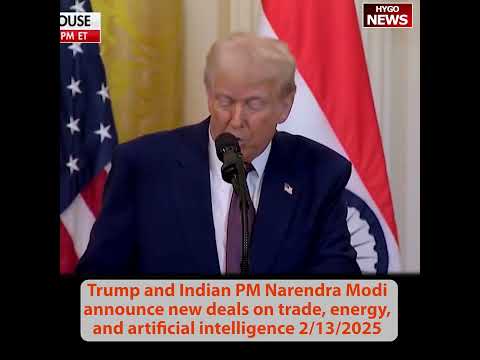
Trump and Modi Announce Sweeping Deals: Energy, Nuclear, AI, Stealth Fighters, and India-to-America Trade Route
President Trump and Indian Prime Minister Narendra Modi announced a series of landmark agreements on February 14, 2025, covering energy, nuclear technology, artificial intelligence, military sales, and a new trade route connecting India to the United States through Israel and Italy. Trump revealed that India had begun reducing its tariffs as “a signal of good faith,” that the two countries had agreed to make the United States India’s leading supplier of oil and gas, and that India was “reforming its laws to welcome U.S. nuclear technology.” The agreements also included increased military sales “by many billions of dollars,” a plan to provide India with stealth fighters, and a joint commitment to lead the global AI race.
India Begins Reducing Tariffs
Trump opened with what he characterized as a concession from Modi on the trade front. “As a signal of good faith, Prime Minister Modi recently announced the reductions to India’s unfair, very strong tariffs that limit U.S. access into the Indian market very strongly,” Trump said.
He then laid out the scope of the tariff problem. “India imposes a 30 to 40 to 60 and even 70 percent tariff on so many of the goods,” Trump said. “And in some cases, far more than that. And as an example, a 70 percent tariff on U.S. cars going into India, which makes it pretty much impossible to sell those cars.”
Trump quantified the trade imbalance: “Today, the U.S. trade deficit with India is almost $100 billion.” The figure underscored why India had been a primary target of the reciprocal tariff policy Trump had announced the day before. A $100 billion deficit with a single country represented one of the largest bilateral trade gaps in the American economy.
Despite the tough language on tariffs, Trump signaled that the two leaders had agreed to negotiate. “Prime Minister Modi and I have agreed that we’ll be getting negotiations to address the long-running disparities that should have been taken care of over the last four years, but they didn’t do that,” Trump said. “We want a certain level playing field, which we really think we’re entitled to. And he does also. So we’re going to work on that very hard.”
Energy: America as India’s Leading Supplier
The energy agreement was potentially the most economically significant of the announcements. Trump described an arrangement that would position the United States as India’s primary energy supplier.
“The Prime Minister and I also reached an important agreement on energy that will restore the United States as a leading supplier of oil and gas to India,” Trump said. “It will be, hopefully, their number one supplier.”
He suggested that energy exports could help close the trade deficit. “We can make up the difference very easily with the deficit, with the sale of oil and gas, LNG, of which we have more than anybody in the world,” Trump said.
For India, which imports approximately 85 percent of its crude oil needs, securing a reliable American supply would diversify its energy sources away from dependence on Middle Eastern and Russian oil. For the United States, becoming India’s leading energy supplier would create a massive new export market for American oil and gas producers, supporting the “energy dominance” agenda that Trump had made a centerpiece of his second term.
Nuclear Technology: “Tens of Billions of Dollars”
In what Trump described as a “groundbreaking development,” India agreed to reform its laws to allow American nuclear technology into the Indian market.
“India is also reforming its laws to welcome U.S. nuclear technology, which is at the highest level, into the Indian market,” Trump announced. “This will bring safe, clean, and affordable electricity to millions of Indians and tens of billions of dollars to the U.S. civilian nuclear industry in India.”
The nuclear agreement was significant for both countries. India has ambitious plans to expand its nuclear power capacity to reduce its carbon footprint and meet growing electricity demand. The United States possesses advanced nuclear reactor technology but has seen its domestic nuclear industry shrink as other countries — particularly China and Russia — have expanded their nuclear exports. Opening the Indian market to American nuclear companies would revitalize a sector that had been languishing and create a new revenue stream worth “tens of billions of dollars.”
The agreement also had strategic dimensions. By welcoming American nuclear technology rather than Russian or Chinese alternatives, India was signaling its alignment with the Western technological ecosystem on one of the most sensitive categories of dual-use technology.
Artificial Intelligence: “We’re the Leader by Quite a Bit”
Trump and Modi also committed to a joint artificial intelligence partnership, positioning the two countries as global leaders in the field.
“Under the framework we are announcing today, the United States and India are also joining forces to ensure that artificial intelligence and other advanced technologies are developed by two of the most, really true, of the most advanced nations intellectually and otherwise technologically, anywhere in the world,” Trump said.
He emphasized American dominance in the AI race. “We’re leading right now by a lot, but other people will try to catch us. I don’t know if they’re going to be able to,” Trump said. The confidence was backed by the administration’s aggressive moves to expand AI infrastructure, including declaring AI energy needs a “national emergency” to expedite power plant construction.
Trump tied the AI effort directly to energy policy. “We’re going to make tremendous amounts of electricity available. We’re going to let the people that are buying the electricity make their own electric generation plants, and we’ve never done this in our country, but we’re going to get it done very quickly,” he said. He noted that EPA Administrator Lee Zeldin would fast-track the environmental approvals needed to build new power generation.
The India-AI partnership was strategically important because India possesses one of the world’s largest pools of technology talent. By partnering with India on AI development rather than allowing that talent to be captured by Chinese tech firms, the United States was securing a critical advantage in the global competition for AI supremacy.
”One of the Greatest Trade Routes in All of History”
The most ambitious announcement was the plan for a new trade corridor connecting India to the United States through the Middle East and Europe.
“We agreed to work together to help build one of the greatest trade routes in all of history,” Trump said. “It will run from India to Israel to Italy and onward to the United States, connecting our partners by ports, railways, and undersea cables — many, many undersea cables.”
The proposed route — India to Israel to Italy to the United States — would create a physical infrastructure network linking four allied nations across two continents and an ocean. The inclusion of ports, railways, and undersea cables meant the corridor would handle both physical goods and digital communications, creating a comprehensive trade and technology backbone outside of Chinese-influenced trade networks.
Trump acknowledged the scale of the investment. “It’s a big development. It’s a lot of money going to be spent and we’ve already spent some, but we’re going to be spending a lot more in order to stay advanced and stay the leader,” he said.
The trade route concept built on the India-Middle East-Europe Economic Corridor (IMEC) that had been announced at the G20 summit in New Delhi in September 2023. However, progress on the corridor had stalled during the final year of the Biden administration. Trump’s revival of the project, with specific mention of undersea cables and the India-Israel-Italy-America route, represented a concrete commitment to what had been largely aspirational under Biden.
Key Takeaways
- Trump announced India had begun reducing tariffs as “a signal of good faith,” while noting India imposed 30-70% tariffs on American goods and maintained a nearly $100 billion trade deficit with the U.S.
- The two leaders agreed to make the United States India’s leading supplier of oil and gas, with Trump saying energy exports could “make up the difference very easily” on the trade deficit.
- India agreed to reform its laws to accept U.S. nuclear technology, which Trump said would bring “tens of billions of dollars to the U.S. civilian nuclear industry” and clean electricity to millions of Indians.
- Trump and Modi committed to a joint AI partnership, with Trump calling the U.S. the global leader “by quite a bit” and declaring AI energy needs a “national emergency” to expedite power plant approvals.
- The two leaders announced plans to build a trade route “from India to Israel to Italy and onward to the United States, connecting our partners by ports, railways, and undersea cables.”