 HYGO News
 Trump: Deduct Auto Loan Interest on American-Made Cars -- 'Never Done Before'; 'Very Good Talk' With Canadian PM Carney
Trump: Deduct Auto Loan Interest on American-Made Cars — “Never Done Before”; “Very Good Talk” With Canadian PM Carney
President Trump announced in March 2025 a proposal he called “something that has never been done in this country before”: allowing Americans to deduct auto loan interest payments from their income taxes if the car was manufactured in the United States. “People that are middle-income people that buy a car and actually have to borrow money — they’re going to now get an interest deduction on their car, if it’s made in the United States,” Trump said. “If it’s made someplace else, that won’t take place.” He also revealed a “very, very good talk” with new Canadian Prime Minister Mark Carney and previewed April 2 “Liberation Day” reciprocal tariffs.
”Never Done in This Country Before”
Trump described the policy with evident pride in its origin.
“And one thing that we just — I just spoke with John Thune about, I just spoke to Mike Johnson about, Speaker — we’re going to do something that has never been done in this country before,” Trump said. “I’m very proud to say it was my idea.”
He acknowledged the simplicity: “And so sometimes a simple idea — they say, ‘How’d you think of that one?’ It’s so simple. It was never done.”
The policy: “If you buy a car in the United States that’s made in the United States, if it’s manufactured here, when you borrow money — if you borrow money, you have interest payments — we’re going to let you deduct the interest payment for income tax reasons.”
Trump predicted the fiscal impact: “And I think that’s going to more than pay for itself.”
The proposal was elegant in its design. American tax law already allowed deductions for mortgage interest, creating an incentive for homeownership. Trump was extending the same principle to auto loans — but only for American-made vehicles. The deduction would reduce the effective cost of financing an American-made car, making domestic vehicles more affordable relative to imports without requiring any direct subsidy from the government.
”Deductions for Middle-Income People”
Trump framed the proposal as a democratization of a tax benefit that had traditionally been associated with wealth.
“I think people are going to be — they’ve never had a deduction,” he said. “You know, deductions are supposed to be for rich people. And it’s unfair to have that.”
He offered a self-aware aside: “Rich people are — I think I know more about deductions than any human being on earth.”
Then the populist substance: “But you know, the truth is that people that are middle-income people that buy a car and actually have to borrow money — they’re going to now get an interest deduction on their car, if it’s made in the United States.”
The critical condition: “If it’s made someplace else, that won’t take place.”
The proposal worked on multiple levels simultaneously. For consumers, it reduced the cost of buying American. For manufacturers, it increased demand for domestically produced vehicles. For the economy, it incentivized both domestic production (supply side) and domestic purchasing (demand side). And for the tax code, it introduced a populist deduction that benefited the middle class — the people who actually borrowed money to buy cars — rather than the wealthy who could pay cash.
The “if it’s made someplace else, that won’t take place” clause was the enforcement mechanism. Unlike the tariff, which penalized foreign manufacturers, the interest deduction rewarded American consumers for choosing American products. The combination of tariff (stick) and deduction (carrot) created a two-pronged incentive that was far more powerful than either alone.
Call with Canadian PM Mark Carney
Trump revealed that he had spoken with Canada’s new Prime Minister.
“Mark called me today at 10 o’clock,” Trump said. “We put out a statement. We had a very, very good talk. He’s going through an election now and we’ll see what happens.”
Trump expressed optimism: “We’re going to end up with a very good relationship with Canada.”
He then broadened the context: “And a lot of the other countries — some we probably won’t, it won’t be so pleasant.”
The Carney call was significant because it was the first public confirmation of direct communication between Trump and the new Canadian PM. Mark Carney, the former Governor of the Bank of Canada and the Bank of England, had recently taken over as Liberal leader and Prime Minister. The U.S.-Canada relationship had been strained by tariffs, and the call suggested that the diplomatic reset was underway.
Trump’s distinction between countries that would have “very good relationships” and those where interactions “won’t be so pleasant” previewed the April 2 tariff announcements, where reciprocal rates would reflect each country’s trade practices with the United States.
Liberation Day: April 2
Trump previewed the imminent tariff announcement.
“We have Liberation Day, as you know, on April 2nd,” he said. “And I’m not referring to Canada, but many countries have taken advantage of us — the likes of which nobody even thought was possible — for many, many decades, for decades.”
He stated the principle: “And you know, that has to stop.”
Trump then offered a surprisingly conciliatory note: “Many of them have actually apologized. They said, ‘Look, we have taken advantage.’”
He redirected blame from foreign leaders to their American counterparts: “And I don’t blame them as much as I blame the people that stood in this case — I can say the men, because so far they’ve been all men, haven’t they? — but the men that sat right there and behind the Resolute Desk.”
The acknowledgment that foreign leaders had “actually apologized” suggested that private diplomatic conversations were more productive than the public posturing suggested. Countries that recognized they had benefited from asymmetric trade arrangements were, behind closed doors, conceding the point and negotiating adjustments.
Trump’s decision to blame previous American presidents rather than foreign leaders was both politically shrewd and analytically sound. Foreign nations had acted in their own interest by securing favorable trade terms — that was expected behavior. The failure was on the American side: presidents who had accepted trade arrangements that disadvantaged American workers, either because they prioritized other diplomatic goals or because they lacked the expertise or willingness to negotiate better deals.
Vance Arrives in Greenland
The compilation noted that VP JD Vance and Second Lady Usha Vance had arrived in Greenland, fulfilling the visit Vance had announced earlier in the week. The Arctic trip to inspect Space Force facilities and assess Greenland’s security situation was proceeding as planned.
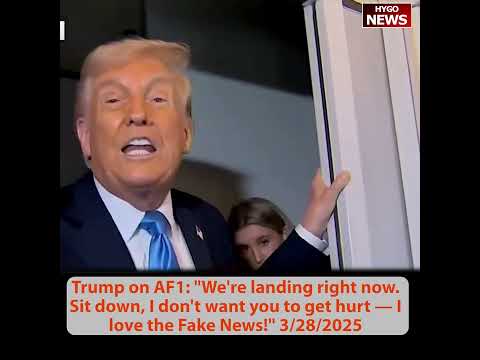
Trump also provided a lighter moment aboard Air Force One: “We’re landing right now. Sit down, I don’t want you to get hurt — I love the Fake News!” The quip, delivered to reporters as the plane descended, captured the casual relationship between Trump and the press corps that existed beneath the adversarial exchanges during formal briefings.
Key Takeaways
- Trump proposed allowing Americans to deduct auto loan interest on U.S.-made cars: “Something that has never been done in this country before — my idea.”
- The deduction targets middle-income buyers: “People that actually have to borrow money — they’re going to get an interest deduction, if it’s made in the United States.”
- He had a “very, very good talk” with new Canadian PM Mark Carney, predicting “a very good relationship with Canada.”
- On April 2 “Liberation Day”: “Many countries have taken advantage of us for decades. Many have actually apologized.”
- Trump blamed previous U.S. presidents more than foreign leaders: “I don’t blame them as much as I blame the men that sat behind the Resolute Desk.”