 HYGO News
 Trump: NEVER Communist in any way, shape, form NYC; pray next 250 yrs; strongest border/economy
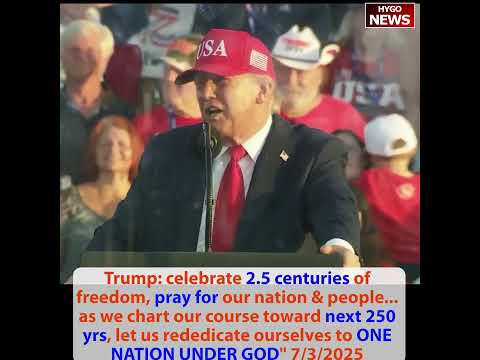
Trump: NEVER Communist in any way, shape, form NYC; pray next 250 yrs; strongest border/economy
Trump continued his Iowa rally with one of the more historically significant declarations of the second term — proclaiming that America would “never” become communist “in any way, shape, form,” and explicitly extending the declaration to New York City and Mamdani’s mayoral candidacy. The president invited America’s religious communities to “pray for our nation” through the America 250 celebration, calling for civic rededication to “One Nation Under God.” He described the One Big Beautiful Bill as producing “the strongest border on earth, the strongest economy on earth, the strongest military on earth.” Vice President Vance, visiting Mount Rushmore with wife Usha and their children, reflected on the bill’s passage as “the beginning of the Golden Age of the United States of America."
"The Most Noxious Ideas In Human History”
Trump opened with the historical framing. “And as you know recently, we’ve seen some of our political system attempting to overthrow the timeless American principles and other pillars of our liberty and replace them with some of the most noxious ideas in human history, ideas that have been proven false.”
“The most noxious ideas in human history” is sweeping language. Trump is characterizing the ideas being advocated by specific political figures as being among the most harmful ideologies humans have produced. The framing places his political opponents in the same category as the architects of 20th-century totalitarianism.
“Ideas that have been proven false” is the empirical framing. Trump is arguing that the relevant ideologies — socialism, communism, Marxism — have been tested in actual historical experience and have produced specific observable failures. The Soviet Union, Maoist China, Castro’s Cuba, Venezuela under Chavez and Maduro — each, in Trump’s framing, demonstrates that these ideologies do not work.
”Socialism, Marxism, And Straight-Up Communism”
Trump named the specific ideologies. “Members of Congress and even former presidents have been openly embracing vile creeds such as socialism, Marxism, and straight-up communism.”
The three-part progression is not accidental. Socialism is the broadest category. Marxism is the specific philosophical tradition. “Straight-up communism” is the sharpest application. Trump is arguing that the progression represents what specific political figures are advocating — starting with socialism and extending, in his framing, all the way to communism.
“Members of Congress and even former presidents” is the specific accusation. The “former presidents” reference is almost certainly to Barack Obama. The “members of Congress” reference covers a broader group — Bernie Sanders, AOC, the Squad, and others who have publicly identified as democratic socialists or who have advocated policies the administration characterizes as socialist.
Mamdani As The Test Case
Trump then pivoted to the specific current case. “In New York, they’re trying to elect a communist, Zoran Mamdani, the guy who wants to defund the police, take over the stores and run the stores and have the people hand out goods.”
Mamdani’s specific platform elements — police defunding, government-operated retail, state-managed distribution — match the theoretical elements of the ideologies Trump is criticizing. Whether Mamdani himself accepts the “communist” label is a separate question from whether his specific policy positions fit within the communist tradition.
“Hand out goods” is Trump’s characterization of what happens when the state takes over retail. Rather than markets determining what is produced and distributed, the state determines those outcomes. The practical result, historically, has included shortages, queues, and the deterioration of consumer choice.
”When Everything Falls Apart”
Trump’s historical framing. “And when everything falls apart, it always does. It always works that way. It never has worked any other way. Anarchy and dictatorships prevail.”
“Anarchy and dictatorships prevail” is the predicted outcome of socialist experiments. The observation matches the historical pattern in countries that have pursued extensive state control of economic activity. Initial disruption produces social chaos. Social chaos typically produces authoritarian response. The authoritarian response typically becomes permanent dictatorship.
Cuba, Venezuela, Nicaragua, the Soviet Union, North Korea — each, in Trump’s reading, follows this pattern. Whether New York under Mamdani would follow the same pattern is debated, but Trump is placing Mamdani’s candidacy in that historical tradition.
”A Communist At The Highest Level”
Trump’s specific characterization. “This guy is a communist at the highest level, and he wants to destroy New York. I live in New York, and we’re not going to let him do that.”
The personal framing — “I live in New York” — is interesting. Trump is characterizing his relationship to New York City as personal stake, not just political concern. The administration’s resources will be deployed to prevent what Trump views as destruction of his home city.
“Destroy New York” is the predicted outcome. New York City’s function as a global financial, cultural, and commercial center depends on capitalist market structures. Replacing those structures with the state-managed alternatives Mamdani advocates would, in Trump’s analysis, destroy what makes New York New York.
”Marxist Lunatics On The Eve Of Our 250th Year”
Trump’s temporal framing. “Generations of Americans before us did not shed their blood only so that we could surrender our country to Marxist lunatics on the eve of our 250th year.”
The framing ties the current political moment to American history. Generations of Americans fought and died in American wars. The country’s 250th anniversary is the culmination of their sacrifice. Surrendering the country to “Marxist lunatics” at that precise moment would be a betrayal of those who sacrificed.
The framing is rhetorically powerful. It positions opposition to Mamdani not as ordinary political disagreement but as honoring American veterans and the broader American inheritance.
”America Is Never Going To Be Communist”
Trump delivered the formal declaration. “As president of the United States, I’m proclaiming here and now that America is never going to be communist in any way, shape, form, and that includes New York.”
The “I’m proclaiming here and now” framing is important. A presidential proclamation carries specific weight. Trump is not merely expressing an opinion — he is making a presidential commitment on behalf of the American government.
“In any way, shape, form, and that includes New York” is comprehensive. The proclamation does not exempt any region of the country. Even a single major city — even New York — cannot become communist under the administration’s watch.
Whether a presidential proclamation of this kind can actually prevent a city from electing a particular mayor is a separate question. Presidents cannot determine municipal election outcomes. But Trump’s proclamation signals that federal resources and attention will be deployed against any city that elects leadership pursuing communist-framed policies.
The America 250 Religious Invitation
Trump then pivoted to the civic-religious framing. “As we prepare to celebrate two and a half centuries of freedom, I’m inviting America’s great religious communities to pray for our nation and for our people. From the beginning, this has always been a country sustained and strengthened by prayer.”
The religious invitation is broad. Trump is not specifying Christian prayer or any specific denominational approach. “America’s great religious communities” covers Christian, Jewish, Muslim, Hindu, Buddhist, and other American religious traditions.
“This has always been a country sustained and strengthened by prayer” reflects the historically accurate observation that religious practice has been central to American civic life across the country’s history. From the Mayflower Compact through contemporary presidential traditions of inaugural prayer services, American civic life has included religious dimensions.
”Bring Religion Back Stronger”
Trump extended the framing. “So important if we bring religion back stronger, you’re going to see everything get better and better and better. You’re going to see it get better and better.”
“Bring religion back” suggests that religion has been in relative decline in American public life. The observation is consistent with various indicators — declining church membership, declining religious identification in Pew surveys, declining weekly religious attendance. Americans are, by various measures, less religiously engaged than they were 50 years ago.
Trump’s claim is that reversing that decline would produce specific social benefits. “Everything get better and better and better” is expansive. Religious engagement, in Trump’s framing, correlates with various positive social outcomes that would flow from its revival.
”One Nation Under God”
Trump closed the religious framing. “So as we chart our course for the next 250 years, let us rededicate ourselves to one nation under God.”
“One Nation Under God” is the phrase from the Pledge of Allegiance. The specific phrase was added to the pledge in 1954. Its invocation by Trump ties America 250 programming to that specific civic tradition.
The “rededicate ourselves” framing is temporal. America’s next 250 years will require the same civic foundations that made the first 250 years successful. Those foundations, in Trump’s framing, include the religious commitments that the pledge references.
”The Strongest Border, Economy, Military”
Trump then returned to the bill. “Very simply, the one big beautiful bill will deliver the strongest border on earth, the strongest economy on earth, the strongest military on earth, and ensure the United States of America will remain the strongest country anywhere on this beautiful planet of ours.”
The three “strongests” — border, economy, military — capture the bill’s three major domains. Border security provisions. Tax and spending reforms that drive economic growth. Defense funding.
“The strongest country anywhere on this beautiful planet of ours” is the aggregate claim. The United States, through the bill, will remain the global leader. Rivals — China, Russia, others — will not displace American preeminence.
”165 Days Into The Trump Administration”
Trump offered the temporal framing. “165 days into the Trump administration, America is on a winning streak like frankly nobody’s ever seen before in the history of the presidency.”
“165 days” corresponds to early July from the January 20 inauguration. That period has produced, by Trump’s accounting, an extraordinary sequence of accomplishments: the bill, the Iran strikes, NATO 5%, Rwanda-Congo peace, Supreme Court rulings, record economic indicators, border enforcement outcomes.
“A winning streak like frankly nobody’s ever seen before” is hyperbolic framing. American political history includes many productive administrations and many compressed periods of activity. Whether the current 165 days exceed all prior such periods is debatable. But the density of activity is unusual by historical standards.
Vance At Mount Rushmore
The video then pivoted to the Vice President at Mount Rushmore. “Hey guys, JD Vance here in beautiful Mount Rushmore. I’ve actually never been here. I brought my kids with us. Usha and I are having a great time visiting one of America’s great national landmarks.”
Mount Rushmore is the sculpted monument to Washington, Jefferson, Lincoln, and Theodore Roosevelt carved into the Black Hills of South Dakota. It is one of America’s iconic civic monuments.
Vance’s first visit, with his wife Usha and their children, captures the family-friendly dimension of his public image. The Vice President is not merely a political figure — he is a husband and father visiting an American landmark with his family during a patriotic holiday.
Independence Day From Mount Rushmore
Vance’s framing. “We see this as a great occasion to celebrate Independence Day. Of course, tomorrow is the 249th birthday of our country and we in the Trump administration were also celebrating the passing of the great big beautiful bill which lowers taxes on Americans and gives us the critical resources we need to secure that southern border into the future.”
“The 249th birthday of our country” — July 4, 2025 — is the penultimate anniversary before the 250th in 2026. The timing positions the current year as the direct lead-in to the commemorative year. Americans who engage with Independence Day activities this year will soon be engaging with the much more substantial activities of the 250th year.
”Happy Independence Day”
Vance closed the field segment. “So however you’re celebrating, wherever you’re celebrating, happy Independence Day. Make it a great one.”
The bipartisan message — “however you’re celebrating, wherever you’re celebrating” — is the kind of framing Vice Presidents typically use on holidays. Independence Day is not a partisan holiday. Americans of all political views celebrate it. Vance’s message acknowledges that universality.
”The Beginning Of The Golden Age”
Vance’s substantive remarks then made the administration’s aggregate claim. “This bill is going to be very popular. We’re going to look back on this. I really do think as the beginning of the golden age of the United States of America.”
“Golden age” is ambitious framing. Historians describe “golden ages” in retrospect — periods of unusual prosperity, cultural achievement, and civic coherence. Ancient Greece had its golden age. Renaissance Italy had its golden age. The American golden age, according to Vance’s framing, begins now.
Whether the framing survives historical judgment depends on what the bill actually produces. If the bill’s provisions generate sustained economic growth, widespread prosperity, and improved civic conditions, the golden age framing will be validated. If the provisions produce less, the framing will look like political positioning.
”Not Just The Bill”
Vance extended the framework. “Remember, it’s not just the bill. It’s all of the Trump administration policies that form a coherent whole where we’re trying to make it easier to invest and build in the United States of America. We’re trying to make it harder to invest outside of the United States of America. We want to build a future for our own people.”
“A coherent whole” is the key claim. The bill, the tariffs, the energy policies, the regulatory adjustments, the immigration enforcement — each is an individual policy. Together, they form what Vance characterizes as an integrated framework.
“Make it easier to invest and build in the United States of America…make it harder to invest outside of the United States of America” captures the cumulative effect. Capital flows that had been leaving the country are being reversed. Capital flows into the country are being accelerated.
”An Inflection Point”
Vance used the technical framing. “We’re going to look back on this, I think, as an inflection point where for too long, America’s been going in the wrong direction. Now we’re going to the right direction.”
“Inflection point” is the mathematical term for where a curve changes direction. American economic trajectory, in Vance’s framing, has been going one way for a long time. The current moment is where the curve bends the other way. Subsequent years will reflect the reversal.
“For too long, America’s been going in the wrong direction” is Vance’s characterization of the pre-Trump trajectory. The specific measures of “wrong direction” include declining manufacturing employment, persistent trade deficits, stagnant real wages for many workers, and growing fiscal debt.
”Rome Wasn’t Built In A Day”
Vance closed with the implementation realism. “Rome wasn’t built in a day, but I think you’re going to see a lot of great progress very quickly now that this bill, well, in a few hours, is going to get signed into the law.”
The Rome reference acknowledges that major political and economic transformations take time. Individual policy decisions, even good ones, produce their full effects over years or decades. Americans should not expect overnight transformation.
“A lot of great progress very quickly” is the specific timeline claim. Not all benefits will materialize immediately, but substantial progress should be visible within months rather than years. That progress will compound over time.
The Dual Framework
The video captures the administration operating on two timescales simultaneously. The immediate — 165 days of intensive activity producing specific accomplishments. The long-term — the beginning of a “Golden Age” that will extend across decades.
Voters can engage with either framework. Those who want to see immediate results can point to the compressed 165 days. Those who are willing to accept longer-term implementation can engage with the Golden Age framing.
The combination provides political flexibility. The administration’s supporters can defend it on both short-term and long-term grounds. Critics must either dispute the immediate accomplishments or dispute the long-term projection, each of which requires specific evidence that the critic may not have.
Key Takeaways
- Trump’s formal declaration: “As president of the United States, I’m proclaiming here and now that America is never going to be communist in any way, shape, form, and that includes New York.”
- On Mamdani: “Zoran Mamdani, the guy who wants to defund the police, take over the stores and run the stores and have the people hand out goods…This guy is a communist at the highest level.”
- The America 250 religious invitation: “As we chart our course for the next 250 years, let us rededicate ourselves to one nation under God.”
- VP Vance at Mount Rushmore: “We’re going to look back on this, I really do think as the beginning of the golden age of the United States of America.”
- The integrated policy framework: “We’re trying to make it easier to invest and build in the United States of America. We’re trying to make it harder to invest outside of the United States of America.”