 HYGO News
 Trump: Native-Born Job Gains Exceed Foreign-Born for First Time in 15 Months; 10K Manufacturing Jobs Created
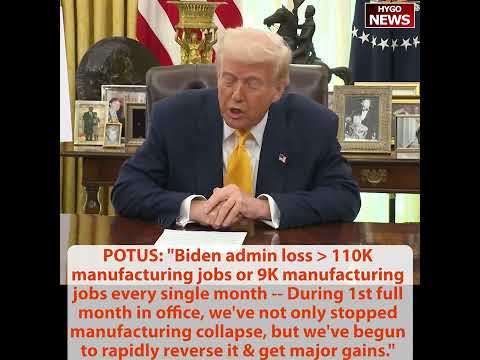
Trump: Native-Born Job Gains Exceed Foreign-Born for First Time in 15 Months; 10K Manufacturing Jobs Created
President Trump highlighted February 2025 jobs data that showed a fundamental shift in the American labor market. For the first time in 15 months, job gains for native-born Americans exceeded those for foreign-born workers: “Employment for native-born workers went up by 284,000, while foreign-born workers went down by 87,000.” Trump also reported that his first full month reversed the Biden-era manufacturing collapse, creating 10,000 manufacturing jobs in February after Biden had lost “more than 110,000 manufacturing jobs” in his final year — averaging “9,000 manufacturing jobs every single month.” Auto production alone added nearly 9,000 jobs, which Trump attributed to tariffs encouraging companies to build domestically.
Native-Born Workers First: “First Time in 15 Months”
Trump opened by celebrating a data point that vindicated his core economic argument about immigration and employment.
“Big gains for native-born Americans,” Trump said. “For the first time in 15 months, the job gains for native-born Americans — for American people, people born in America — exceeded job gains for migrant and foreign-born workers.”
He provided the specific numbers: “Employment for native-born workers went up by 284,000, while foreign-born workers went down by 87,000.”
Trump connected the reversal to the pattern that had defined the Biden era. “You’ve heard the same stat where foreign workers were taking up all the jobs, or almost all the jobs. In some cases, literally all of the jobs,” he said. “And now it’s 284,000 native-born jobs — people born in our country, 284,000. While foreign-born workers went down by 87,000. First time that’s happened in a long time.”
The statistic was significant because it addressed one of the most politically potent criticisms of the Biden economy. Throughout 2023 and 2024, multiple analyses had shown that the majority of new jobs created under Biden were going to foreign-born workers rather than native-born Americans. The Biden White House had dismissed these analyses, but voters understood the implication: mass immigration was depressing wages and displacing American workers from the labor market.
Trump’s border enforcement and deportation operations had begun to reverse that dynamic within weeks. With illegal crossings at 50-year lows and deportations at historic highs, the labor market was tightening in favor of American workers. The 284,000 native-born job gains versus 87,000 foreign-born job losses demonstrated the mechanism in real time: fewer immigrant workers competing for jobs meant more opportunities and higher wages for Americans.
Manufacturing: “Stopped the Collapse”
Trump then addressed the manufacturing data, which told an equally dramatic story.
“During the last year, the Biden administration saw a loss of more than 110,000 manufacturing jobs, or 9,000 manufacturing jobs every single month,” Trump said. “It averaged about 9,000 a month — 110,000 manufacturing jobs.”
He contrasted the Biden record with his first month’s results: “During the first full month in office, we’ve not only stopped that manufacturing collapse, but we’ve begun to rapidly reverse it and get major gains.”
The specific number: “We created 10,000 manufacturing jobs in February alone. That hasn’t happened in a long time.”
Trump emphasized the quality of the jobs: “And these aren’t government jobs, which actually we cut. These are private-sector manufacturing jobs.”
The distinction between government and private-sector jobs was an important rebuttal to critics who might argue that DOGE’s government workforce reductions offset any private-sector gains. Trump was saying the two trends were moving in the right directions simultaneously: private-sector manufacturing was expanding while the bloated federal workforce was shrinking. That was the textbook definition of a healthy economic rebalancing.
“We gained all of those jobs — 10,000 jobs — and we barely started yet,” Trump said. “That’s a very unusual number. People are surprised by it. I’m even a little surprised.”
Auto Jobs: 9,000 in One Month
Trump highlighted the automotive sector specifically, where the tariff policy was producing the fastest results.
“On auto jobs, we created almost 9,000 new jobs in the auto production field,” Trump said.
He explained why the gains had come so quickly: “The reason for that is largely they think things are happening. So they’re already geared up.”
Trump described the practical mechanics of reshoring. “In some cases, they had rooms in their plants, or they had empty plants that they were able to put into use quickly, because they see — because of the tariffs — they don’t want to be dealing with other places,” he said.
The tariff effect was straightforward: “They don’t want to go back and forth and around and through the borders and across Mexico border and Canada border. They want to have the jobs in one location.”
For companies with existing capacity, the expansion was nearly instantaneous. “If they had space, they were able to create the jobs almost immediately,” Trump said. “In some cases, they’ll be building plants.”
He emphasized the timeline: “It all took place in a single month. 9,000 new auto jobs. You haven’t heard that in a long time.”
The automotive sector was the most politically significant manufacturing category because of its concentration in swing states like Michigan, Ohio, Pennsylvania, and Wisconsin. The creation of 9,000 auto jobs in a single month — driven by tariffs that made domestic production more competitive than Mexican or Canadian alternatives — validated the central promise of Trump’s trade policy in the states that had elected him.
”Gearing Up Since November”
Trump offered an important temporal clarification. While he had been in office only five weeks, the economic effects he was describing reflected a longer preparation period.
“These are incredible numbers, and they’re very early. I mean, we’re here for five weeks,” Trump said. “But we have been talking about it since the big win in November, November 5th.”
He described the anticipatory effect: “A lot of these people, they listen to speeches and they say, ‘Well, I’m going to gear up,’ and they’re gearing up. So they’ve been gearing up. They’ve had a little time. It’s not just five weeks. It’s five weeks plus a few months.”
The observation was economically sound. Business decisions about hiring, facility expansion, and supply chain relocation do not happen overnight. Companies that anticipated Trump’s tariff and deregulation policies in November had been making plans and investments for months before they showed up in the February employment data. The job gains Trump was celebrating were the result of decisions made during the transition period, executed in the first weeks of the new administration.
This also explained why the manufacturing gains could accelerate further. The companies that had filled existing capacity quickly would soon begin building new facilities. The 10,000 manufacturing jobs and 9,000 auto jobs of February were the first wave; the second wave — from new plant construction — would produce even larger numbers in the months ahead.
The Biden Comparison
The contrast with the Biden record was the framework that gave all the numbers their political meaning. Under Biden’s final year: 110,000 manufacturing jobs lost. Under Trump’s first month: 10,000 manufacturing jobs gained. Under Biden: foreign-born workers taking all the job gains. Under Trump: native-born workers gaining 284,000 while foreign-born employment declined.
Every data point reinforced the same narrative: Biden’s policies had been systematically destroying the American worker’s position in the labor market, and Trump’s policies were systematically restoring it. The border enforcement reduced labor supply, tightening the market in favor of Americans. The tariffs reduced foreign manufacturing competition, directing investment and hiring to domestic facilities. The deregulation reduced business costs, making expansion more attractive. The three policies worked together to produce the results the February data showed.
Key Takeaways
- For the first time in 15 months, native-born American job gains (284,000) exceeded foreign-born gains, with foreign-born employment declining by 87,000.
- Trump created 10,000 private-sector manufacturing jobs in February alone, reversing Biden’s loss of 110,000 manufacturing jobs (9,000/month) in his final year.
- Auto production added nearly 9,000 jobs in one month as tariffs drove companies to use existing domestic plant capacity rather than cross-border supply chains.
- Trump attributed the speed of gains to companies “gearing up since November,” saying the economic effects reflected “five weeks plus a few months” of anticipation.
- He emphasized the jobs were “private-sector manufacturing jobs, not government jobs, which we actually cut” — showing the federal workforce was shrinking while private employment expanded.