 HYGO News
 Trump: Nancy Pelosi became rich inside trading, disgraceful, investigated; loan veterans foreclosure
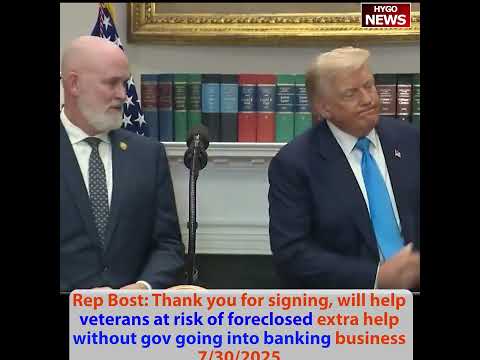
Trump: Nancy Pelosi became rich inside trading, disgraceful, investigated; loan veterans foreclosure
Two threads in a single news cycle, each politically consequential. Trump accused Nancy Pelosi directly of insider trading: “Nancy Pelosi became rich by having inside information. She made a fortune with her husband and I think that’s disgraceful … she ought to be investigated. So Nancy Pelosi became rich.” Pelosi, confronted by reporters, deflected: “That’s ridiculous … I very much support the stop the trading of members of Congress. Not that I think anybody’s doing anything wrong if they are” — with the disclaimer “my husband is [investing]. But it isn’t anything to do with anything insider.” On veterans policy, Trump signed a bill that will allow the VA to prevent foreclosures on veterans in distress: “An estimated 61,000 American veterans are in danger of losing their homes … the Department of Veterans Affairs will be empowered to pay loan holders the necessary amount to prevent foreclosures.” Rep. Mike Bost thanked Trump and praised VA Secretary Doug Collins for keeping the department focused on veterans rather than bureaucracy.
”Nancy Pelosi Became Rich”
Trump’s direct accusation. “You know Nancy Pelosi became rich by having inside information. She made a fortune with her husband and I think that’s disgraceful.”
The context appears to be the ongoing debate about congressional stock trading. Pelosi and her husband Paul Pelosi, through a portfolio of investments largely in technology companies, have achieved returns that have been the subject of years of public scrutiny.
“So in that sense I’d like it but I’d have to really see the, I’d have, you know, I studied these things very carefully and this just happened. So I’ll take a look at it but conceptually I like it.”
Trump is referring to something that just happened — likely a proposed legislative measure to restrict congressional stock trading. Trump is signaling conceptual support while reserving final judgment.
“And what I do think is Nancy Pelosi should be investigated because what she has the highest return of anybody practically in the history of Wall Street save a few and how did that happen?”
“Highest return of anybody practically in the history of Wall Street save a few.” That is Trump’s characterization. Pelosi’s portfolio returns have been analyzed publicly. Her returns have indeed been unusually strong — consistently outperforming the market for years.
”It Happened by She Knows”
“It happened by she knows exactly what’s going to happen, what’s going to be announced, she buys stock and then the stock goes up after the announcement’s made and she ought to be investigated.”
That is Trump’s theory of how Pelosi has generated the returns. She has access, as Speaker and senior member of Congress, to information about forthcoming legislation, regulatory decisions, and government procurement. She or her husband invests ahead of those announcements. The stocks rise when the announcements are made.
That pattern, if it exists, would constitute insider trading under existing securities law. Congressional members are subject to the STOCK Act of 2012, which explicitly prohibits using non-public information for trading advantage. The STOCK Act’s enforcement mechanisms have been weak — relying primarily on self-reporting rather than active investigation.
“So Nancy Pelosi became rich.”
Trump’s repetition is for emphasis. Not as a personal success story. As an accusation of specific misconduct.
“I might have to read that.”
Trump concluding the Pelosi segment. He will examine the specific proposal (likely the Stop Trading on Congressional Knowledge Act or similar legislation). His support in principle is clear.
Pelosi’s Dodge
Pelosi’s response to the reporter was captured. “We’re here to talk about the 60th anniversary of Medicaid. That’s what I agreed to come to talk about.”
That is the first dodge. Pelosi is at an event ostensibly about Medicaid’s 60th anniversary. She is using the event’s subject to avoid engaging Trump’s specific accusation.
“Yeah but I want that means in the election. I wanted to give you a chance to respond. You accused you of insider trading. What’s your response to that?”
The reporter pressing.
“That’s ridiculous. In fact I very much support the stop the trading of members of Congress. Not that I think anybody’s doing anything wrong if they are. They are prosecuted and they go to jail but because of the confidence in it stills in the American people don’t worry about this.”
“That’s ridiculous” — the flat denial.
Then the framing. Pelosi is claiming she supports the STOCK Act reforms. But she is also disclaiming that anyone is doing anything wrong. The logical structure: anyone doing anything wrong is prosecuted. Therefore anyone not prosecuted is not doing anything wrong.
That framing assumes perfect enforcement. In practice, insider trading investigations involving members of Congress face significant obstacles — jurisdictional complexity, political sensitivity, evidentiary difficulty. Pelosi’s framing excludes the possibility that misconduct could persist without prosecution.
“But I have no concern about the obvious investment so it had been made over time. I’m not into it. My husband is but it isn’t anything to do with anything insider.”
The delegation. Pelosi herself is not directly trading. Her husband Paul Pelosi is trading. The returns are his, in her framing, not hers.
That distinction is technically accurate under current law. Spouses are permitted to trade. But the distinction has been extensively critiqued as a fig leaf — married couples with joint households and joint financial interests are economically unified regardless of which name appears on the brokerage account.
Veterans Foreclosure Prevention
The segment pivoted to Trump signing the veterans foreclosure-prevention bill. Rep. Mike Bost, House VA Committee chair, delivered the thanks.
“Thank you Mr. President for signing this bill today. Let me tell you that not only this bill which will help make sure that those veterans have got that have got themselves in a situation where maybe they were before closed on it gives them just a little bit extra help without the government going into a banking business like what we had with the previous administration.”
“Government going into a banking business like what we had with the previous administration.” That is Bost’s critique of the Biden-era VA loan program. The prior administration had, in Bost’s framing, effectively converted VA lending into a government banking operation.
The new bill addresses foreclosure prevention without expanding the government’s banking role. Veterans who are behind on their VA loans — 61,000 of them at risk of foreclosure — can receive specific assistance to prevent the foreclosures. The assistance flows through existing loan servicing mechanisms rather than government direct lending.
Doug Collins at VA
“I also want to say thank you too though for appointing Doug Collins as our secretary for the VA. As chairman of the VA having the opportunity to work with Doug one because we worked together before but he has the right attitude and the attitude is the VA is not about bureaucracy. It’s about the veterans and we want to keep it that way.”
Doug Collins as VA Secretary receives specific praise from Bost. Collins — a former congressman from Georgia and Trump loyalist — has brought a specific orientation to the VA: treating the department as a veterans-service organization rather than a self-sustaining bureaucracy.
“That doesn’t mean we don’t have a good workforce. What it means is that workforce is focused on the veterans not on making sure that the VA grows but making sure that the VA does the job it’s supposed to do.”
Mission focus. The VA exists to serve veterans. Not to grow its own bureaucracy. Not to expand its own reach. To deliver services to the veterans.
That is a specific cultural choice. Many federal agencies, over decades, develop institutional interests in expansion — more staff, more budget, more programs, more contractors. The expansion is often at the expense of the core mission. Collins’s posture, per Bost, is to reverse that pattern. The VA’s workforce should be sized to its mission, not to its institutional ambitions.
“And thank you Mr. President for your leadership that allows that to happen."
"61,000 Veterans”
Trump’s summary of the bill’s effect. “An estimated 61,000 American veterans are in danger of losing their homes as you know but thanks to this bill the Department of Veterans Affairs will be empowered to pay loan holders the necessary amount to prevent foreclosures on our veterans so our veterans won’t be foreclosed and put out onto the streets.”
61,000 veterans at risk. That is a specific number. Of VA loan borrowers who are behind on payments to the point where foreclosure is imminent, 61,000 specifically would be protected by the new bill’s mechanism.
“It’s very important this bill also creates a five-year partial claim program that could benefit up to 3.7 million veterans that’s the kind of numbers you’re talking about speak stuff.”
3.7 million veterans in the five-year partial claim program’s potential beneficiary pool. That is a massive scale of potential impact.
“The costs of the program are fully offset and we’ll add nothing at all to debt. It’s common sense legislation at overwhelming support and passed unanimously in the House and the Senate. Wow.”
“Fully offset … unanimously in the House and Senate.” Both political-economic signals. Fiscal responsibility: the program does not add to federal debt because the costs are offset elsewhere. Political unanimity: no members of either party voted against it.
A unanimous vote on a meaningful piece of legislation is rare in the current Congress. The Veterans Affairs Home Loan Program Reform Act (or whatever the specific bill is titled) produced that unanimity — a combination of veterans-policy popularity and careful fiscal design.
The Two Threads Together
Nancy Pelosi’s trading questions and the veterans foreclosure bill look like separate threads. But they are connected. Both reflect accountability.
The Pelosi thread is accountability for congressional conduct. Insider trading by sitting members of Congress is a specific form of institutional corruption. Trump’s willingness to publicly accuse and call for investigation is an escalation of the accountability pressure.
The veterans thread is accountability for government services. Veterans Affairs has been the subject of scandal and criticism for decades — poor care, bureaucratic delay, mission drift. Collins’s orientation, backed by Trump’s signature on the foreclosure-prevention bill, reflects renewed commitment to veterans as the service recipients.
Both threads push against what the administration characterizes as institutional capture — elites capturing government processes for personal benefit, bureaucracies capturing government services for self-perpetuation. The counter-posture: restore services to beneficiaries, impose consequences on those who profit from inside information.
Key Takeaways
- Trump directly accused Nancy Pelosi of insider trading: “Nancy Pelosi became rich by having inside information … she ought to be investigated.”
- Trump: Pelosi has “the highest return of anybody practically in the history of Wall Street save a few … she knows exactly what’s going to happen … buys stock and then the stock goes up after the announcement’s made.”
- Pelosi’s response: “That’s ridiculous … I have no concern about the obvious investment so it had been made over time. I’m not into it. My husband is but it isn’t anything to do with anything insider.”
- Trump signed veterans foreclosure-prevention bill covering 61,000 American veterans at immediate risk, with 3.7 million eligible for the five-year partial claim program.
- Rep. Mike Bost praised VA Secretary Doug Collins: “The VA is not about bureaucracy. It’s about the veterans … that workforce is focused on the veterans not on making sure that the VA grows.”