 HYGO News
 Trump Lifts Syria Sanctions After MBS/Erdogan Talks: 'Give Them a Chance at Greatness'; $142B Saudi Military Deal; 1,100 Houthi Strikes
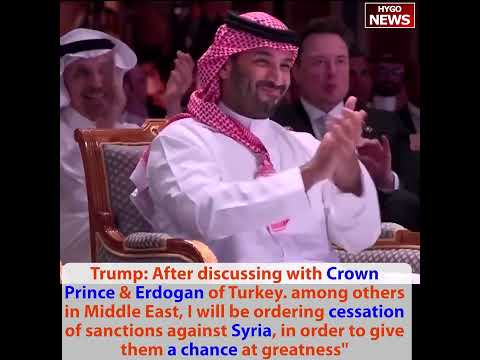
Trump Lifts Syria Sanctions After MBS/Erdogan Talks: “Give Them a Chance at Greatness”; $142B Saudi Military Deal; 1,100 Houthi Strikes
President Trump delivered sweeping announcements at the Saudi-U.S. Investment Forum in Riyadh in May 2025. “My preference will always be for peace and partnership. Only a fool would think otherwise,” Trump said. He announced lifting sanctions on Syria: “After discussing with the Crown Prince and President Erdogan of Turkey, I will be ordering the cessation of sanctions against Syria to give them a chance at greatness.” On the Houthi campaign: “The U.S. military launched more than 1,100 strikes. As a result, the Houthis agreed to stop — we hit them hard, got what we came for, and got out.” He announced $142 billion in Saudi military purchases — “the largest ever” — plus multi-billion commercial deals with Amazon, Oracle, AMD, Uber, Qualcomm, and Johnson & Johnson. On the investment climate: “There’s an explosion of investment and jobs. Never seen anything like it."
"Only a Fool Would Think Otherwise”
Trump opened with a statement of philosophical principle.
“My preference will always be for peace and partnership whenever those outcomes can be achieved,” Trump said. “Always. It’s always going to be that way. Only a fool would think otherwise.”
He stated the optimistic vision: “If the responsible nations of this region seize this moment, put aside your differences and focus on the interests that unite you, then all of humanity will soon be amazed at what they will see right here in this geographic center of the world.”
He elevated the importance of the region: “It really is. It’s like a center of the world and the spiritual heart of its greatest faiths.”
The “only a fool would think otherwise” line was both a personal statement and a policy declaration. Critics had characterized Trump as a warmonger who preferred confrontation to diplomacy. Trump’s record told a different story — no new wars during his first term, ceasefires between India-Pakistan and U.S.-Houthis during his second term, and now potential normalization with Syria. The actual pattern was that Trump preferred peace but would not accept peace at any price.
Syria Sanctions Lifted
Trump announced the most dramatic policy shift of the trip.
“My administration has already taken the first steps toward restoring normal relations between the United States and Syria for the first time in more than a decade,” Trump said.
He revealed the diplomacy: “I’m very pleased to announce that Secretary Marco Rubio will be meeting with the new Syrian foreign minister in Turkey later this week.”
He revealed the consultation: “Very importantly, after discussing the situation in Syria with the Crown Prince — your Crown Prince — and also with President Erdogan of Turkey, who called me the other day and asked for a very similar thing.”
He extended the characterization: “Among others, and friends of mine, people that I have a lot of respect for in the Middle East, I will be ordering the cessation of sanctions against Syria in order to give them a chance at greatness.”
The Syria sanctions removal was a remarkable policy reversal. Syria had been under American sanctions for decades, with additional punitive measures imposed after the Assad regime’s brutal response to the 2011-2012 uprising. The sanctions had contributed to Syria’s economic collapse while doing little to change regime behavior.
The new Syrian government — formed after the fall of Assad in December 2024 — represented a different political reality. Whatever complaints remained about the transitional leadership, they did not include the atrocities committed by the Assad regime. Lifting sanctions gave the new government the economic breathing room to rebuild a country devastated by 14 years of civil war.
The consultation process was strategically important. By making the sanctions decision after discussion with Saudi Arabia and Turkey — the two most influential regional powers on Syria — Trump ensured that the move had regional buy-in. The Saudis and Turks had been calling for sanctions relief for months; by complying with their request, Trump was building political capital that would help with future negotiations on other issues.
1,100 Houthi Strikes
Trump described the military campaign with specific numbers.
“Following repeated attacks on American ships and freedom of navigation in the Red Sea, the United States military launched more than 1,100 strikes on the Houthis in Yemen,” Trump said.
He described the result: “As a result, the Houthis agreed to stop. They said, ‘We don’t want this anymore.’”
He credited Houthi toughness: “It’s the first time you’ve heard that from them, too. They’re tough. They’re fighters.”
He described the resolution: “Just days ago, we were asked to cease targeting commercial. They were not going to be targeting commercial ships in any way, shape, or form, or anything American.”
He characterized the campaign: “We had 52 days of thunder and lightning, like they’ve never seen before. This was a swift, ferocious, decisive, and extremely successful use of military force.”
He explained the necessity: “Not that we wanted to do it, but they were shooting down ships. They were shooting at you. They were shooting at Saudi Arabia. We don’t want them shooting at Saudi Arabia.”
He summarized: “So we hit them hard. We got what we came for. And then we got out.”
The 1,100 strikes figure was the most specific public accounting of the campaign’s scale. For context, the total U.S. air strikes against ISIS in some years had been in the thousands — but typically spread over 12 months. Conducting 1,100 strikes in 52 days meant roughly 21 strikes per day on average, a pace of operations that reflected the intensity of the response.
The “got in, got out” formulation was classic Trump doctrine. The operation had a specific military objective (stop the attacks on shipping), achieved that objective through decisive force, and then concluded when the objective was met. This contrasted sharply with the previous era of “forever wars” in which initial objectives were quickly replaced by mission creep that extended operations for years or decades.
$142 Billion Saudi Military Deal
Trump announced the largest arms deal in American history.
“In addition to purchases of $142 billion of American-made military equipment by our great Saudi partners, the largest ever,” Trump said.
He continued with the commercial deals: “This week, there are multi-billion dollar commercial deals with Amazon, Oracle, AMD — they’re all here — Uber, Qualcomm, Johnson & Johnson, and many, many more.”
He offered congratulations: “I want to congratulate everybody. So many great business executives, many of you, most of you I know.”
He described the turnaround: “They’re coming in, you know, about a month ago, they weren’t that happy when they saw me. And now they’re saying, ‘Sir, you’re doing a great job. Thank you very much.’ It’s amazing what a rising market will do.”
He projected further gains: “Oh, it’s going to get a lot higher. Like I told people five weeks ago, it’s a great time to buy. I got criticized for that. Now they don’t criticize me anymore. People should have listened. It’s going to go a lot higher.”
He characterized the overall environment: “We’ve never had anything like this happen. It’s an explosion of investment and jobs, and great companies are coming in. Never seen anything like it. There’s no better place to make a future or make a fortune, do anything, frankly, than what we have in the United States of America under a certain President, Donald J. Trump.”
The $142 billion Saudi military purchase was the centerpiece economic announcement. The deal would generate American manufacturing jobs for years, strengthen the U.S.-Saudi security partnership, and recycle Saudi oil revenues back into the American economy. It was also a strategic statement — Saudi Arabia was definitively choosing American weapons over Russian or Chinese alternatives, binding its defense architecture to the American ecosystem for decades.
The commercial deal roster reflected the breadth of American corporate presence at the event. Amazon, Oracle, AMD, Uber, Qualcomm, and Johnson & Johnson represented cloud computing, semiconductors, transportation, telecommunications, and pharmaceuticals. Each was signing substantial contracts with Saudi partners, collectively representing the economic partnership that Trump’s foreign policy was building.
The “five weeks ago” reference — when Trump had reportedly told people it was a great time to buy stocks — was a victory lap. Markets had declined sharply in the early April Liberation Day period and had recovered dramatically since. Trump had called the bottom correctly, and investors who followed his advice had made significant gains.
Key Takeaways
- Trump: “My preference will always be for peace and partnership. Only a fool would think otherwise.”
- Syria sanctions lifted after consultation with MBS and Erdogan: “Give them a chance at greatness.” Rubio meeting Syrian FM in Turkey.
- Houthi campaign: 1,100 strikes in 52 days. “Swift, ferocious, decisive. We hit them hard, got what we came for, and got out.”
- $142 billion Saudi military deal — “the largest ever.” Plus commercial deals with Amazon, Oracle, AMD, Uber, Qualcomm, J&J.
- “Five weeks ago, I told people it was a great time to buy. I got criticized. Now they don’t criticize me anymore. Going to go a lot higher.”