 HYGO News
 Trump mother from Isle of Lewis 18-yrs young girl; two grandchildren; Hillary/Deep State Russia Hoax
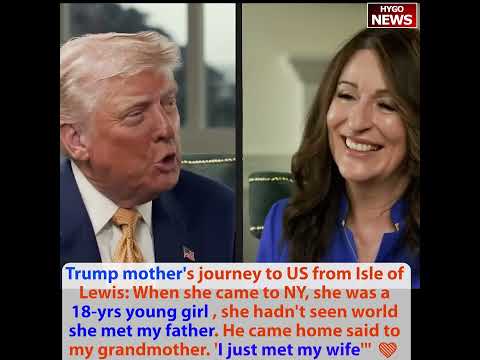
Trump mother from Isle of Lewis 18-yrs young girl; two grandchildren; Hillary/Deep State Russia Hoax
Two personal dimensions and a pivot to accountability. Trump told the story of his mother Mary MacLeod’s arrival in New York from the Isle of Lewis at 18 and her meeting with Fred Trump — “He came home that night. He said to my grandmother, who’s a fantastic person, my father’s mother … ‘Well, I just met my wife.’” Trump boarded Air Force One with two of his grandchildren for the return to Washington. And on the Russia Hoax accountability: after winning in 2016, “We had Hillary Clinton down to whatever we wanted to do with her. And I felt it was inappropriate … we don’t want to be doing that.” But after the sustained attack: “They did it to me. So I feel differently … Obama, what he did was terrible. What Brennan did and Clapper and Comey and all these lightweights … they’re stupid people, actually. But what they did and so unnecessary.”
The Isle of Lewis
Trump’s personal story. “The Isle of Lewis, I looked. It’s in a remote section. Yeah. You know, when she came to New York, she was a young girl of about 18 years old, and she came to New York. Didn’t see in the world.”
Mary Anne MacLeod was born in Tong, a small village on the Isle of Lewis in the Outer Hebrides. The Outer Hebrides are remote islands off Scotland’s western coast — historically part of the Scottish Highlands’ cultural-linguistic heritage, with Gaelic as the native language. Coming to New York in 1930 at 18, MacLeod would have experienced the dramatic difference between her rural, Gaelic-speaking home community and the cosmopolitan world of New York City.
“And she met my father. He was, you know, a successful guy. He was a young guy, but he was a successful guy doing well. He was building houses and homes.”
Fred Trump, the president’s father, was a New York real estate developer. At the time he met Mary MacLeod, he was approximately 32, already established in the real estate business, building homes in Brooklyn and Queens.
“And she was beautiful. And she was beautiful. She really was beautiful. She was a beautiful woman.”
That repetition — “she was beautiful … she was beautiful … she really was beautiful” — is the president remembering his mother. The emotional weight of the repetition is the signal. Trump is not just narrating biographical facts. He is recalling his mother.
”I Just Met My Wife”
“He came home that night. He said to my grandmother, who’s a fantastic person, my father’s mother. Yeah. He said, well, I just met my wife. Really? Yeah.”
That is a defining family anecdote. Fred Trump, after meeting Mary MacLeod for the first time, returned home and told his mother: “I just met my wife.” Before proposing. Before any formal dating. Before either family had been formally introduced. The decision had been made on first meeting.
“And he was about 32. So he was a little older. She said, you know, when are you going to get married? But he was a great guy.”
Fred Trump’s mother apparently accepted the declaration and followed up with timing questions. Not skepticism. Not caution. Just acceptance of her son’s certainty.
”The Scottish People Are Really Amazing”
“But he immediately knew this is a great, you know, the the Scottish people are really amazing. And the great fighters too. You know, that’s why England sort of never.”
“Scottish people are really amazing. And great fighters too.” That is Trump’s characterization of Scottish heritage. The historical context: Scotland’s long resistance to English domination, including the Wars of Scottish Independence (the period depicted in Braveheart), produced a cultural identity built around independence and fighting capability.
“Yeah. Braveheart. Braveheart, one of the great movies of all time.”
Trump citing Braveheart as “one of the great movies of all time” is cultural framing. The Mel Gibson 1995 film about William Wallace is foundational to modern American awareness of Scottish history. For Trump, whose mother came from Scotland, the film resonates with personal heritage alongside its dramatic and cinematic qualities.
“But England had a hard time with Scotland. Yeah. They just they couldn’t quite tame them.”
Historical accuracy. Scotland’s resistance to English domination produced centuries of border wars before the 1707 Acts of Union created Great Britain. Even after political union, Scottish cultural identity remained distinct. That historical resistance is part of what Trump is invoking when he describes Scottish people as “great fighters.”
The Grandchildren on Air Force One
The visual moment. “POTUS Trump — joined by two of his grandchildren — board Air Force One to head home from Scotland.”
That is the family dimension of the visit. Trump brought grandchildren to Scotland. The trip was not purely diplomatic. It was also a family opportunity — introducing grandchildren to the ancestral homeland, to Turnberry property, to the Aberdeen property, to Scottish culture generally.
For a president, bringing family on international travel serves multiple purposes. The grandchildren learn about their heritage. The president experiences the trip alongside family rather than exclusively through state-visit protocol. And the visible presence of grandchildren at official events softens the sometimes impersonal nature of diplomatic work.
”We Had Hillary Clinton Down”
Trump pivoted to the 2016-17 period and the Hillary Clinton accountability question. “We had Hillary Clinton down to whatever we wanted to do with her. And I felt it was inappropriate. She’s the wife of a president. She was a secretary of state. We could have done a very big number. Yeah.”
“We had Hillary Clinton down” — meaning, after winning the 2016 election, Trump and his team had the leverage to pursue various forms of accountability against Clinton. Investigations. Indictments. Prosecutions. The Clinton email server investigation was still open. The Clinton Foundation practices were under scrutiny. The decisions about how aggressively to pursue those matters were decisions the incoming administration could make.
“I felt it was inappropriate.” That is Trump’s retrospective explanation for his 2016-17 decision. Clinton had lost. She was the wife of a former president. She was a former Secretary of State. Political vengeance against a defeated opponent, especially one with those institutional credentials, struck Trump at the time as inappropriate.
”We Don’t Want to Do That”
“And I said, we don’t want to be doing that. The concept of putting her in jail, inditing her all the things that you have to do, you know, stuff, stuff, we don’t want to do that.”
Trump explicitly declined to pursue prosecution. The political infrastructure existed. The legal case — at least for investigating some matters — had evidence. The political will within the Republican coalition to see Clinton accountability was strong. Trump said no.
“In fact, you remember I made speeches when I mentioned her name. They started to block her. Block her up. Yeah. And I said, no, no, this is after we won. We won.”
“Lock her up” chants at 2016 Trump rallies were the signature. After winning, Trump’s posture shifted. He stopped inciting the chants. The rallies he held post-election explicitly moved past the 2016 grievances.
“And I said, no, no, this is after we won. We just won."
"Because You Wanted the Country to Heal”
“Because you wanted the country to heal. We have to get back to it. We want to heal. And yet they did it to me. Yeah.”
That is the pivot. Trump wanted the country to heal. He chose not to pursue Clinton. In return, the subsequent years produced the Russia collusion investigation, the first impeachment, the Mueller investigation, and related pursuits against him.
“So I feel differently. I mean, I’m a human being. I have my feelings too. So I feel differently about it.”
“I’m a human being. I have my feelings too.” That is Trump’s acknowledgment of the psychological cost of the sustained attacks. Years of investigations, prosecutions, public accusations, character assassination. The restraint Trump had shown toward Clinton in 2016-17 was not reciprocated.
“So I feel differently.” That is the policy implication. In 2016-17, Trump declined to pursue accountability against his defeated opponents. In 2025, his calculation has changed. The current declassification campaign against Obama-era officials, the DOJ strike force on the Russia hoax, the ongoing investigations — those reflect the different calculation.
Obama, Brennan, Clapper, Comey
“Obama, what he did was terrible. What Brennan did and Clapper and Comey and all these lightweights and I mean, they’re stupid people, actually. But what they did and so unnecessary.”
The four names: Obama (former president), Brennan (former CIA director), Clapper (former DNI), Comey (former FBI director). All four have been central figures in the Gabbard-led declassifications about the manufactured Russia-collusion narrative.
“Lightweights” and “stupid people” are Trump’s characterizations. Whether the former senior officials were as unsophisticated as Trump describes is a question of judgment. What matters is Trump’s political positioning — he is not treating them as worthy adversaries whose misconduct is regrettable. He is treating them as incompetent actors whose misconduct was also unnecessary and unsupportable.
“But what they did and so unnecessary.”
“Unnecessary” is an important word. Trump is not arguing the Russia-collusion narrative was a reasonable misjudgment that went wrong. He is arguing it was unnecessary in its entirety — that none of the investigations, manufactured intelligence, and political pursuits served any legitimate purpose.
”They Toughen You Up”
“And they made it really hard. But ultimately, I don’t know, they toughen you up. You either learn that you can do that.”
That is the psychological framing. The years of attacks, in Trump’s account, produced a tougher political actor. He developed the capacity to withstand investigations, criticism, and specific personal attacks. That toughness is part of how he won in 2024 despite the ongoing legal and political pressure.
“How many people could handle that? Yeah. I’ve had so many people said, how did you handle that? Every day.”
“Every day.” That is the specific characterization. Not a single crisis to navigate. A sustained, daily grind of attacks across multiple fronts. For most political figures, a single criminal prosecution would be career-ending. Trump navigated multiple simultaneous prosecutions, a civil fraud trial, the Russia investigation, the first impeachment, the second impeachment, and the 2020 election aftermath.
“And they come up with these different scams. They’re all scams. And they’re still doing it. You know, they’re doing it now.”
“They’re still doing it now.” The campaign against Trump has not ended. The investigations continue in some form. The political attacks continue. The media narratives continue. Trump is acknowledging that his presidency, even in its second term, is operating under sustained institutional pressure.
The Transformation
The arc of the segment is striking. It opens with Trump remembering his beautiful mother coming to New York from a remote Scottish island at 18. It passes through Fred Trump’s love-at-first-sight moment. It honors Scottish heritage through Braveheart. It shows grandchildren on Air Force One. Then it pivots to Trump’s 2016 decision not to prosecute Clinton because “we want to heal.”
And it ends with “they did it to me. So I feel differently.”
That arc captures the psychological and political transformation of a presidency. The personal warmth of family memories coexists with the institutional pressure that has produced the current accountability campaign. The restraint Trump showed in 2016-17 has been replaced by a willingness to pursue specific accountability in 2025.
Whether that shift is vindication, vengeance, or both depends on perspective. But it is an observed reality in the current political environment.
Key Takeaways
- Trump told the story of his Scottish mother Mary MacLeod coming to New York from the Isle of Lewis at 18 and his father Fred Trump’s immediate recognition: “Well, I just met my wife.”
- On Scottish heritage: “The Scottish people are really amazing. And the great fighters too … But England had a hard time with Scotland. They couldn’t quite tame them” — citing Braveheart as “one of the great movies of all time.”
- Trump brought grandchildren on Air Force One for the Scotland trip — personal family dimension to the diplomatic schedule.
- On declining to prosecute Clinton in 2016: “We could have done a very big number. I felt it was inappropriate … ‘lock her up’ … after we won … We want to heal.”
- Trump’s 2025 shift: “They did it to me. So I feel differently. I mean, I’m a human being” — naming Obama, Brennan, Clapper, Comey as “lightweights … stupid people … but what they did and so unnecessary.”