 HYGO News
 Trump: 'More Difficult to Deal with Ukraine Than Russia'; EU Commits €800B for Defense; 93% Private-Sector Jobs
Trump: “More Difficult to Deal with Ukraine Than Russia”; EU Commits €800B for Defense; 93% Private-Sector Jobs
A compilation from March 7, 2025, captured four significant developments. Trump said he was “finding it more difficult, frankly, to deal with Ukraine” than Russia, noting “they don’t have the cards” yet remained resistant. The European Commission announced plans to mobilize “close to €800 billion euros of defense expenditures.” NSA Mike Waltz confirmed that “Secretary Rubio, myself, and the Ukrainian delegation will be meeting in Saudi Arabia next week” to restart peace talks. And NEC Director Hassett highlighted that “93% of all job gains were in the private sector” under Trump’s first month, compared to Biden’s final two years when “one in every four jobs created was a government job."
"More Difficult to Deal with Ukraine”
Trump provided his most candid comparative assessment of the two warring parties’ negotiating postures.
“I’m finding it more difficult, frankly, to deal with Ukraine,” Trump said. “And they don’t have the cards. They don’t have the cards.”
He then offered the surprising contrast: “I find that in terms of getting a final settlement, it may be easier dealing with Russia, which is surprising because they have all the cards. And they’re bombing the hell out of them right now.”
The observation that Russia — the party with military momentum — was easier to negotiate with than Ukraine — the party depending on American support — was a diplomatic bombshell. It suggested that Putin was engaging more constructively with the peace process than Zelensky, despite holding the stronger battlefield position.
Trump had issued a warning to Russia about its continued military operations. “I put out a very strong statement — you can’t do that, you can’t do that,” he said of Russian bombing. But his frustration was directed primarily at Ukraine: “We’re trying to help them. And Ukraine has to get on the ball and get a job done.”
The phrase “get on the ball” conveyed the exasperation of a dealmaker who was offering favorable terms to a party that kept sabotaging its own interests. Trump was extending American leverage, American investment (through the minerals deal), and American diplomatic effort to a country that he believed was squandering the opportunity through intransigence and public posturing.
EU: €800 Billion for European Defense
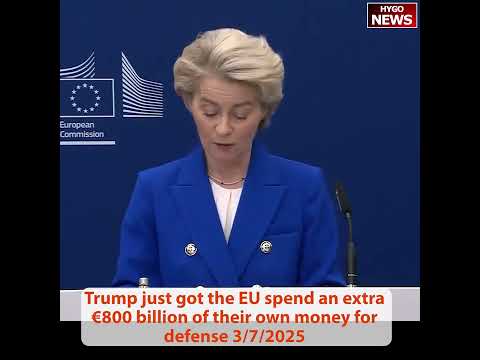
European Commission President Ursula von der Leyen announced what amounted to the most significant European defense commitment since the Cold War.
“Europe is ready to assume its responsibilities,” she said. “ReArm Europe could mobilize close to €800 billion euros of defense expenditures for a safe and resilient Europe.”
She added the institutional framework: “We will, of course, continue working closely with our partners in NATO. This is a moment for Europe. And we are ready to step up.”
The €800 billion figure was staggering. It represented a fundamental reorientation of European fiscal priorities, redirecting hundreds of billions from social programs and other domestic spending toward military capabilities that Europe had underfunded for decades. The announcement was a direct response to Trump’s relentless pressure on European defense spending — pressure that had begun during his first term and had intensified dramatically in the second.
Trump’s demand that Europeans “do the heavy lifting” on their own defense was producing results on a scale that no previous diplomatic approach had achieved. The combination of tariff threats, burden-sharing rhetoric, and the Zelensky confrontation had created a political environment in which European leaders could no longer defer defense spending increases. The voters who had watched Trump expel Zelensky from the White House understood that American patience was finite, and European politicians were responding accordingly.
Waltz: Saudi Arabia Meeting Next Week
NSA Mike Waltz provided the diplomatic update that showed the peace process was continuing despite the Zelensky blowup.
“The President has been crystal clear, and he’s been clear to all sides: the fighting has to stop. Both sides need to get to the table,” Waltz said. “Both leaders have said only President Trump could do so, and only he has been able to do so.”
He recapped the recent diplomatic history: “We had a great official engagement with the Russians. The Ukrainians had a great opportunity to bind our economies together through that mineral deal. Unfortunately, that didn’t go so well.”
Waltz then announced the next step: “But we think we’re going to get things back on track. Secretary Rubio, myself, and the Ukrainian delegation will be meeting in Saudi Arabia next week to get these talks back on track, get the ceasefire in place, and drive peace home.”
The confirmation that the Ukrainian delegation would participate in Saudi Arabia talks — despite the Oval Office confrontation and Zelensky’s expulsion — indicated that the diplomatic channel remained open. Zelensky’s letter expressing readiness to negotiate, combined with the Saudi Arabia meeting, suggested that the public drama had not derailed the underlying process.
Hassett: “93% Private Sector” vs. Biden’s Government Jobs
NEC Director Hassett delivered the jobs data analysis that provided the starkest contrast between the two administrations’ economic philosophies.
“The bottom line is that the Biden administration created a lot of jobs, and they tended to be government jobs,” Hassett said. “About 25% of the job creation was government jobs.”
He contrasted that with the Trump approach: “We actually, as President Trump intended, reduced government jobs by about 10,000. And then the other thing we’re trying to do is increase manufacturing jobs. Manufacturing jobs were up about 10,000, with about 9,000 of those being new jobs for auto workers, which are very sticky and high-paying jobs.”
Hassett assessed: “I think it’s a fantastic report. It’s showing exactly what President Trump intends to do: reduce government spending, get rid of wasteful government jobs, and create manufacturing jobs.”
Trump provided the headline comparison: “Under the final two years of Biden, one in every four jobs created in America was a government job. That’s a tremendous percentage. But under the first full month of President Trump — which we haven’t even gotten started yet — an incredible 93% of all job gains were in the private sector.”
The 93% versus 25% comparison told the story of two fundamentally different economic models. Biden’s economy grew government at the expense of the private sector. Trump’s economy was shrinking government while expanding private manufacturing. The former produced jobs that cost taxpayers money; the latter produced jobs that generated tax revenue.
Hassett noted that the flu season may have depressed the numbers further: “People who account for flu in the jobs data were saying this number was going to be maybe even about 100,000 lower than what we saw,” suggesting the underlying momentum was even stronger than the headline figure showed.
Key Takeaways
- Trump said he was “finding it more difficult to deal with Ukraine” than Russia, noting Ukraine “doesn’t have the cards” yet remained resistant while Russia was engaging more constructively.
- The EU announced plans to mobilize “close to €800 billion euros” for European defense, the largest rearmament commitment since the Cold War, in direct response to Trump’s burden-sharing demands.
- NSA Waltz confirmed “Secretary Rubio, myself, and the Ukrainian delegation will be meeting in Saudi Arabia next week” to restart peace talks and “drive peace home.”
- Under Trump’s first month, 93% of job gains were in the private sector, compared to Biden’s final two years when 25% of all jobs created were government positions.
- Manufacturing added 10,000 jobs including 9,000 in auto production, while government employment was reduced by 10,000 — the inverse of the Biden pattern.