 HYGO News
 Trump: momentous breakthrough in Middle East; Israeli: Trump brilliant; RFK: 95% drugs lowest price
Trump: momentous breakthrough in Middle East; Israeli: Trump brilliant; RFK: 95% drugs lowest price
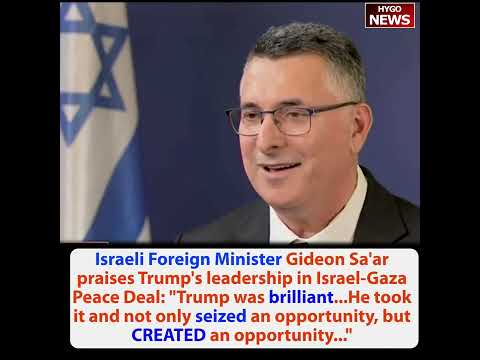
President Trump announced a “momentous breakthrough” in the Middle East — the war in Gaza ended, hostages to be released Monday or Tuesday, a trip to Egypt planned for an official signing ceremony. Israeli Foreign Minister Gideon Sa’ar credited Trump’s tactical handling of Hamas’s initial response: Trump chose to read Hamas’s qualified reply as acceptance rather than rejection, “created an opportunity by saying, well, it’s positive. Let’s build from there.” The framing choice unlocked the final phase. Separately, HHS Secretary Robert F. Kennedy Jr. delivered a striking prediction on drug pricing: by the end of the Trump administration, the U.S. will have “95% of the drugs in this country … the lowest price in the world,” achieved through tariff leverage rather than the IRA’s Biden-era price negotiations. Kennedy called out the Biden-era 22% claim as a lie — real Medicare and Medicaid costs went up on 8 of 10 drugs. Trump: “Last night we reached a momentous breakthrough in the Middle East … We ended the war in Gaza and really on a much bigger basis created peace. And I think it’s going to be a lasting peace.” Sa’ar: “President Trump was brilliant taking Hamas’s answer … he took it and like not only sees an opportunity, but created an opportunity by saying, well, it’s positive.” Kennedy: “95% of the drugs in this country. We will be the lowest price in the world."
"Momentous Breakthrough”
Trump opened with the announcement. “You know, last night we reached a momentous breakthrough in the Middle East, something that people said was never going to be done. We ended the war in Gaza and really on a much bigger basis created peace.”
The Gaza deal reached its pivotal phase the previous night. Trump’s framework: not just ceasefire but the end of the war, with broader Middle East peace implications.
“And I think it’s going to be a lasting peace, hopefully an everlasting peace. Peace in the Middle East.”
“Everlasting peace” framing is deliberately ambitious. Prior Middle East deals — Oslo, Camp David, Clinton-era frameworks — achieved temporary quiet but collapsed under renewed conflict cycles.
Hostages Monday or Tuesday
“We secured the release of all of the remaining hostages and they should be released on Monday or Tuesday. Getting them is a complicated process. I’d rather not tell you what they have to do to get them. There are places you don’t want to be.”
The logistical complexity: hostages were distributed across Hamas tunnel networks, some held by Hamas directly, others by Islamic Jihad and various Gaza factions. Coordinating release required physical retrieval from multiple hostile environments.
“But we are getting the hostages back on Tuesday, Monday or Tuesday. That’ll be a day of joy.”
Trump confirmed the expected window. The day-of-joy framing emphasized the human dimension over the policy achievement.
Egypt Signing Trip
“I’m going to try and make a trip over. We’re going to try and get over there. We’re working on the timing, the exact timing.”
Trump personal travel to the region was being planned. Exact date and location working-level details were still being finalized.
“We’re going to go to Egypt where we’ll have a signing, an additional signing. We’ve already had a signing representing me, but we’re going to have an official signing.”
Egypt — a longtime mediator in Gaza conflicts through its Rafah border control — hosted the formal signing. Trump’s administration had already signed documents through representatives, but the presidential-level signing ceremony would be in Egypt.
Sa’ar: “Trump Was Brilliant”
Israeli Foreign Minister Gideon Sa’ar credited Trump’s tactical decision. “I think that President Trump was brilliant taking Hamas’s answer. When I read it for the first time, I thought, well, it’s not really an acceptance.”
Sa’ar’s reaction to Hamas’s reply: ambiguous, qualified, potentially a rejection.
“But he took it and like not only sees an opportunity, but created an opportunity by saying, well, it’s positive. Let’s build from there and eventually it works. So I really think he made a huge…”
The critical tactical choice: Trump read an ambiguous response as acceptance. Hamas — not wanting to reject outright what the president publicly characterized as their agreement — found it harder to back away. The framing locked in the progress.
”Last Friday”
The reporter pressed on timing: “They’re talking about last Friday. Last Friday. When Hamas agreed and it sounded like it was Hamas saying yes.”
The Friday reference was to Hamas’s qualified reply to Trump’s 20-point framework. The reply could have been read multiple ways.
“But what did President Trump do at that point? I think the fact that he looked at it as a positive response. Okay. And let’s see how we implement. Brought us to this point. So I think it was brilliant.”
Sa’ar’s analytical conclusion: Trump’s choice to treat Hamas’s response as positive, then implement as if agreement was final, forced the deal into completion rather than prolonged back-and-forth negotiation that would have given opponents on all sides time to collapse the framework.
RFK on Drug Pricing
HHS Secretary RFK Jr. pivoted to domestic drug pricing policy. “By the time this administration is over, we will have 95% of the drugs in this country. We will be the lowest price in the world.”
The 95% framework: not all drugs, but the vast majority. U.S. drug prices currently are among the highest globally — often 2-4x what the same drugs cost in Canada, UK, or Western Europe.
“It immediately begins to affect Medicaid, Medicare, Social Security, the other government programs.”
The cascade effect: federal healthcare programs — Medicare Part D, Medicaid, VA — spend hundreds of billions annually on pharmaceuticals. Cutting drug prices cuts federal spending dramatically.
IRA Negotiations
“I remember when I went through the confirmation process, principal preoccupation of the Democrats during that process was whether I would continue the IRA negotiations on drugs.”
The Inflation Reduction Act (IRA), passed in 2022, included drug price negotiation authority for Medicare. Biden’s administration negotiated 10 drug prices in 2024, with more rounds scheduled annually.
Democrats during Kennedy’s confirmation hearings demanded assurance he would continue the IRA negotiations. Kennedy confirmed he would.
“The Democrats negotiated 10 drugs. I’m supposed to negotiate it every year, 15.”
The schedule: 15 additional drugs per year.
”22% Was a Lie”
“The 10 that they negotiated, they claimed to get a 22% reduction, but it was a lie.”
The Biden administration’s 22% price reduction claim on the first 10 IRA-negotiated drugs was widely reported as a major victory. Kennedy’s framework: the claim was misleading.
“It was 22% under the list price, which was actually higher than the price we were getting. Medicaid, Medicare ended up paying more for those drugs and they were ground beforehand.”
The accounting trick: the 22% was measured against the published list price (AWP — average wholesale price), not the net price Medicare and Medicaid actually pay after rebates, which is typically 30-50% below list. The “negotiated price” ended up higher than what the federal government had been paying.
“They only got a benefit on one drug. One was tied. Eight of them were low.”
Real outcome on the 10 drugs:
- 1 drug: genuine price reduction
- 1 drug: tied (no change)
- 8 drugs: the negotiated price was higher than pre-IRA net price
”Democrats Used to Applaud”
“They used to be applauding what we’re doing now.”
Kennedy’s framework: the Trump administration’s current drug pricing approach — tariff leverage, trade deals, reshoring requirements — would have been applauded by Democrats when Democrats were not in power. Under Biden they pursued the IRA route which largely failed.
“We’re doing something that every administration Democrat and Republican has been saying that it was going to do for decades.”
The cross-party promise: lower drug prices has been a campaign commitment of every administration back to Clinton. None actually delivered. Trump’s tariff-based approach is the mechanism that’s finally working.
Tariff Power
The speaker continued: “And you got it done because you understood the power of the tariffs. We had leverage over these companies.”
The mechanism: Trump’s threats of pharmaceutical tariffs gave the administration leverage over drug companies, which then agreed to pricing reforms and production reshoring in exchange for tariff protection.
“And you did it in a way which you asked us to do, to negotiate in a way that was not going to stifle innovation, that was going to make sure that those companies could bring their production home and they’re doing that.”
Trump’s directive: reduce drug prices without killing pharmaceutical R&D. The compromise: lower prices + bring production home + preserve innovation incentives through other levers.
“It was a profound success. It will affect every American for 100 years.”
Key Takeaways
- Trump on Middle East: “Last night we reached a momentous breakthrough in the Middle East, something that people said was never going to be done. We ended the war in Gaza and really on a much bigger basis created peace. And I think it’s going to be a lasting peace, hopefully an everlasting peace.”
- Trump on hostages: “We secured the release of all of the remaining hostages and they should be released on Monday or Tuesday … That’ll be a day of joy … We’re going to go to Egypt where we’ll have a signing, an additional signing.”
- Sa’ar on Trump’s tactical choice: “President Trump was brilliant taking Hamas’s answer … he took it and like not only sees an opportunity, but created an opportunity by saying, well, it’s positive. Let’s build from there and eventually it works.”
- Kennedy on drug pricing: “By the time this administration is over, we will have 95% of the drugs in this country. We will be the lowest price in the world.”
- Kennedy on IRA deception: “The 10 that they negotiated, they claimed to get a 22% reduction, but it was a lie. It was 22% under the list price … They only got a benefit on one drug. One was tied. Eight of them were low.”