 HYGO News
 Trump: Millions Who Didn't Respond 'Maybe Don't Exist'; Balanced Budget 'Maybe by Next Year'; April 2 Tariffs Confirmed
Trump: Millions Who Didn’t Respond “Maybe Don’t Exist”; Balanced Budget “Maybe by Next Year”; April 2 Tariffs Confirmed
President Trump addressed the DOGE email controversy directly in February 2025, telling Elon Musk that the millions of federal employees who had not responded to the work-accountability email were “on the bubble” and suggesting “maybe they don’t exist — maybe we’re paying people that don’t exist.” He confirmed that 25% tariffs on Canada and Mexico would take effect on April 2nd, set a timeline for a balanced budget of “maybe by next year or the year after, but maybe even sooner,” cited EPA Administrator Lee Zeldin’s plan to cut approximately 65% of EPA staff, and noted that consumer and business confidence had reached “an all-time high” since the election.
”Those People Are on the Bubble”
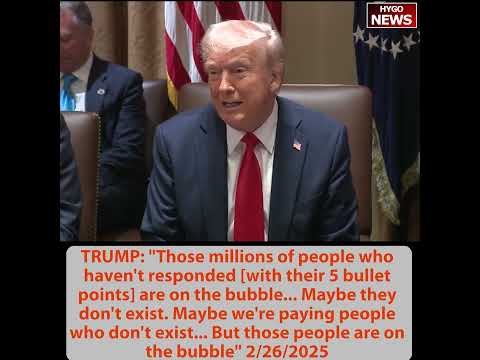
Trump addressed the DOGE email directly to Musk, who was apparently in the room. “I’d like to add that those million people that haven’t responded, though, Elon — they are on the bubble,” Trump said. “You know, I wouldn’t say that we’re thrilled about it. They haven’t responded.”
He then floated the explanation that had emerged from DOGE’s preliminary findings. “Now, maybe they don’t exist. Maybe we’re paying people that don’t exist,” Trump said. “Don’t forget, we just got here. This group just got here.”
Trump described the range of possibilities for the non-respondents. “Those people are on the bubble, as they say. They may be — they’re going to be gone,” he said. “Maybe they’re not around. Maybe they have other jobs. Maybe they moved and they’re not where they’re supposed to be. A lot of things could have happened.”
He tied the issue to the Biden administration’s management. “I wouldn’t say that Biden ran a very tight administration,” Trump said. “They spent money like nobody’s ever spent money before. Wasted money. The Green New Scam, all of the different things they spent money on.”
Trump referenced the specific waste examples he had been reading at public events. “You’ve seen that with some of the things that I read in speeches. I read them and people can’t believe when I read them,” he said. “Twenty million here, 30 million here for, you know, a little educational cost — circumcision, right? Twenty million dollars to inform the people of such and such a country.”
The “ghost employee” theory — that the federal payroll included people who did not actually exist — was one of the most dramatic implications of the DOGE email. If millions of federal workers could not or would not confirm their existence by sending five bullet points about their weekly work, the federal government might be operating with a payroll inflated by fictitious positions, deceased workers who were never removed from the rolls, or employees who had taken other jobs while continuing to collect federal paychecks.
Agency-Specific Approaches
Trump acknowledged that the email approach needed to be tailored for agencies handling classified work. “There’ll be some agencies like Marco has people within State that are right now doing very classified, very confidential work. And we understand that,” Trump said.
He described the solution: rather than DOGE conducting the review externally, agency heads would conduct their own audits. “We’re going to be going to them. We’re going to be talking about it today. We’re going to ask them to do their own audits,” Trump said. “In other words, they’ll look in their group.”
He then cited a specific example that illustrated the scale of potential cuts. “Lee Zeldin — I spoke with him — and he thinks he’s going to be cutting 65 or so percent of the people from environmental,” Trump said.
The 65% figure at the EPA was staggering. If Zeldin followed through on cutting roughly two-thirds of the agency’s workforce, it would represent the most dramatic downsizing of a federal agency in modern history. Trump described Zeldin’s findings: “He had a lot of people that weren’t doing their job. They were just obstructionists. And a lot of people that didn’t exist, I guess, Lee too. He found a lot of empty spots and the people weren’t there. They didn’t exist.”
The pattern — agencies discovering that significant portions of their workforces were either non-functional or non-existent — was emerging as a recurring theme across the government. The SBA’s 90% telework rate, the EPA’s potential 65% cut, and the millions of DOGE email non-respondents all pointed to a federal government that was significantly overstaffed relative to its actual productive capacity.
Balanced Budget: “Maybe by Next Year”
Trump then made his most aggressive fiscal commitment to date. “We want to balance the budget. We want to have a balanced budget within a reasonably short period of time,” he said.
He provided the timeline: “Meaning maybe by next year or the year after, but maybe even sooner than that.”
A balanced federal budget within one to two years would be an extraordinary achievement given the approximately $2 trillion annual deficit the administration had inherited. Achieving balance would require a combination of massive spending cuts (through DOGE and Congressional action), revenue increases (through tariffs and the Gold Card program), and economic growth that expanded the tax base.
The fact that Trump was publicly setting this timeline suggested either supreme confidence in the administration’s fiscal strategy or a deliberate effort to establish expectations that would drive the intensity of spending reduction efforts across the government.
April 2nd: 25% on Canada and Mexico
A reporter asked Trump to clarify the tariff situation with Canada and Mexico, and the president confirmed the details in characteristically blunt terms.
“25 percent,” Trump said when asked about the tariff rate.
“When does it go into effect?” the reporter followed up.
“April 2nd,” Trump confirmed.
“April 2nd for Canada and Mexico?” the reporter pressed.
“Correct. And for everything,” Trump said.
The “for everything” clarification meant the 25% tariff would apply across all product categories, not just specific sectors. This was a significant escalation from the targeted tariffs that had been discussed earlier in the transition. A blanket 25% tariff on all Canadian and Mexican imports would affect billions of dollars in trade and fundamentally alter the economic dynamics of the North American trading relationship.
”Confidence Has Reached an All-Time High”
Trump cited economic sentiment data to bolster his case that the administration’s aggressive approach was working.
“Since the election, the confidence in our nation — including right track, wrong track — the first time it’s ever happened where we were on the right track, because this country has been on the wrong track for a long time,” Trump said.
He expanded the point: “Confidence in business, confidence in the country has reached an all-time high. We have never reached levels like we are right now.”
The “right track/wrong track” metric was one of the most closely watched indicators of public sentiment. For the country to shift to “right track” territory was significant because the metric had been negative for years, reflecting broad public dissatisfaction with the direction of the nation under Biden.
”Bloated, Sloppy”
Trump concluded with a blunt assessment of the federal government’s condition. “We’re cutting down government. We’re cutting down the size of government. We have to,” he said. “We’re bloated. We’re sloppy. We have a lot of people that aren’t doing their job. We have a lot of people that don’t exist.”
The four-word description — “bloated, sloppy, not working, don’t exist” — served as a comprehensive indictment of the federal workforce’s condition as the administration found it. Each word captured a different dimension of the problem: overstaffing (bloated), poor management (sloppy), low productivity (not doing their job), and outright fraud (don’t exist).
Key Takeaways
- Trump said the millions of federal employees who didn’t respond to the DOGE email were “on the bubble,” suggesting “maybe they don’t exist — maybe we’re paying people that don’t exist.”
- EPA Administrator Lee Zeldin was planning to cut approximately 65% of EPA staff after finding “a lot of people that weren’t doing their job” and “a lot of empty spots.”
- Trump set a balanced budget timeline of “maybe by next year or the year after, but maybe even sooner,” his most aggressive fiscal commitment yet.
- He confirmed 25% tariffs on Canada and Mexico would take effect April 2nd “for everything,” covering all product categories.
- Consumer and business confidence had reached “an all-time high” since the election, with the “right track/wrong track” metric turning positive “for the first time.”