 HYGO News
 Trump message: I will make my decision within next 2 weeks; Leavitt: Iran has all it needs nuclear
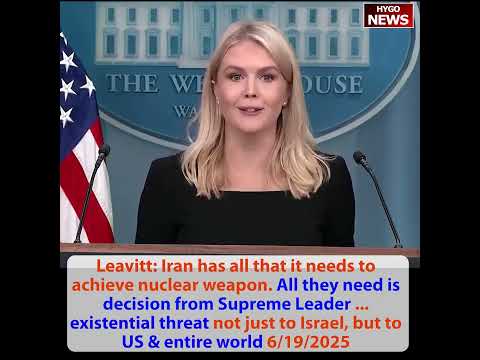
Trump message: I will make my decision within next 2 weeks; Leavitt: Iran has all it needs nuclear
Press Secretary Karoline Leavitt delivered the most consequential procedural statement of the Iran crisis to date. Speaking from the White House Briefing Room, she read a direct message from the president: the decision on whether the United States will directly engage militarily in the Iran situation will be made within the next two weeks. Leavitt also clarified — in what she described as a correction to media misreporting — that Iran currently has “all that it needs to achieve a nuclear weapon.” The only remaining barrier is a political decision by the Supreme Leader. The clarification is significant because it reframes the question from “how soon could Iran get there” to “what is Iran waiting for.” And Trump used the press briefing to raise the new White House flag for the first time and to dismiss a CNN reporter with his signature “Fake news. Fortunately, nobody watches” line.
”I Will Make My Decision Within The Next Two Weeks”
Leavitt’s opening was procedural. “Regarding the ongoing situation in Iran, I know there has been a lot of speculation amongst all of you in the media regarding the president’s decision making and whether or not the United States will be directly involved. In light of that news, I have a message directly from the president and I quote, Based on the fact that there is a substantial chance of negotiations that may or may not take place with Iran in the near future, I will make my decision whether or not to go within the next two weeks.”
The message is a formal statement of decision timeline. Trump is not committing to a specific action. He is committing to making a decision within a specific window. That window — two weeks — is designed to serve multiple purposes.
Why The Two-Week Window Matters
The two-week window accomplishes three things simultaneously.
First, it creates pressure on Iran. The Iranian Supreme Leader now knows that a definitive American decision will be made within 14 days. Any strategic benefit Iran was deriving from open-ended uncertainty is, by that announcement, converted into a ticking clock.
Second, it preserves American flexibility. If Iran comes to the table within the two weeks, the deal can be signed before the window closes. If Iran does not, the decision about military action can be made with the benefit of whatever developments occur during the window.
Third, it preserves domestic political room. Some members of Trump’s coalition are concerned about an expanded Middle East conflict. The two-week window allows Trump to be seen as making a deliberate, carefully considered decision rather than an impulsive one. That deliberation matters for the political sustainability of whatever decision is made.
”That’s A Quote Directly From The President”
Leavitt emphasized the authenticity of the message. “That’s a quote directly from the president for all of you today.”
The specificity matters because in an information environment where statements get paraphrased, misquoted, and reinterpreted, the president’s direct words carry more weight than characterizations of his thinking. By delivering the message as a direct quote, Leavitt is establishing the record that cannot be easily spun.
”Peacemaker In Chief”
Leavitt then laid out the underlying doctrine. “So the president is always interested in a diplomatic solution to the problems and the global conflicts in this world. Again, he is a peacemaker in chief. He is the peace through strength president. And so if there’s a chance for diplomacy, the president is always going to grab it, but he’s not afraid to use strength as well.”
“Peacemaker in chief” is the administration’s preferred framing. Trump does not see himself as a war president. He sees himself as a deal-maker whose deals — when successful — preserve or create peace. The Iran situation is, in his framing, one that admits of a deal, and his preference is to find that deal.
”He’s Not Afraid To Use Strength”
The counterbalance is the closing phrase. If diplomacy fails, force is an option. The administration is pursuing diplomacy because diplomacy is preferable. The administration is preparing for force because preparation for force is what gives diplomacy its leverage.
”Correspondence Has Continued”
Leavitt then made a significant operational confirmation. “As for correspondence between the United States and the Iranians, I can confirm that correspondence has continued. As you know, we were engaged with six rounds of negotiations with them in both indirect and direct ways.”
Six rounds of negotiations is a substantial diplomatic engagement. The “indirect and direct ways” acknowledgment is the way diplomats describe communications that have occurred both through intermediaries (indirect) and through direct engagement between U.S. and Iranian representatives (direct).
The fact that correspondence has continued even during the active hostilities is the kind of detail that reveals the underlying posture. Both sides are communicating. Both sides have lines open. Neither side has unilaterally shut down the diplomatic channel. That suggests both sides believe a deal is at least theoretically available, even as military actions continue.
The Media Clarification
A reporter then asked the question that Leavitt used to make the day’s most important substantive clarification. “When the president said a few weeks away, did he mean obtaining enough enriched uranium to start building a weapon? Or did he mean Iran is a few weeks away from completing the production of a weapon?”
Leavitt’s response: “I’m glad you asked that, Weija. It’s an important question and it’s one, frankly, the media has been getting wrong."
"Iran Has All That It Needs”
Leavitt then delivered the clarification. “Let’s be very clear. Iran has all that it needs to achieve a nuclear weapon. All they need is a decision from the supreme leader to do that. And it would take a couple of weeks to complete the production of that weapon, which would, of course, pose an existential threat not just to Israel, but to the United States and to the entire world.”
The clarification is important. The debate in media has often been framed as “how close is Iran to having a weapon” — implying that Iran is still acquiring capabilities needed for weaponization. Leavitt’s statement is that Iran already has those capabilities. The question is not whether Iran can build a weapon. The question is whether Iran has decided to build one.
That framing shifts the urgency. If the question were “can Iran build a weapon?” the answer would be “yes, but not tomorrow.” If the question is “has Iran decided to build a weapon?” the answer could change day to day. A decision made on a Tuesday could produce a weapon by the end of the same month.
”A Couple Of Weeks To Complete The Production”
The timeline is specific. Once the decision is made, production takes “a couple of weeks.” That is the window in which American intelligence would need to detect the decision, the administration would need to decide on a response, and any action would need to be taken.
The compressed timeline is why the administration is acting now rather than later. Waiting for Iran to begin production leaves insufficient time for an effective response. Acting now — either through successful negotiation or through preemptive action — is the only option that prevents the weapon from being built.
”Even Russia Is In Agreement”
Leavitt made the geopolitical point. “And that is something that the entire world, including countries like Russia, is in agreement with that Iran should not and cannot obtain a nuclear weapon.”
The reference to Russia is deliberate. Russia has been Iran’s diplomatic protector for years. It has vetoed sanctions in the UN Security Council, provided weapons and defense cooperation, and supported Iranian positions on various regional questions. But Russia — like every other country — has a fundamental interest in nuclear nonproliferation. An Iranian weapon would be a major strategic adjustment that would, among other things, encourage other Middle Eastern states to consider nuclear weapons of their own. That would not serve Russian interests.
The administration is noting that Russia’s agreement with the “Iran cannot have a nuclear weapon” position is a meaningful data point. Russian cooperation — or even Russian non-obstruction — is the kind of diplomatic support that the administration could build on.
”He’s Believed That His Entire Life”
Leavitt’s close on the substantive argument was biographical. “And that’s why the president believes that and he’s believed that again, not just his political career, but frankly, his entire life.”
Trump’s public statements opposing Iranian nuclear weapons extend back decades, not just to his political career. The consistency is the political argument for trusting his judgment on this specific question. He is not, in his supporters’ framing, improvising a policy to suit the current moment. He is executing a policy he has advocated for decades.
The Flag Raising
The briefing also captured the raising of the new American flag on the South Lawn flagpole. The ceremony was, as Trump had announced, at 11 AM with a second lifting on the North Lawn a few minutes later. The video of the flag raising is the kind of imagery that future historians will pair with the current moment — a presidency installing new flagpoles on the White House grounds during a Middle East crisis.
The CNN Exchange
The briefing also captured the moment Trump turned a routine press interaction into vintage Trump. “POTUS: ‘Who are you with?’ Reporter: ‘CNN.’ POTUS: ‘Oh. Fake news. Fortunately, nobody watches. Is anybody watching CNN nowadays? I haven’t seen it in a long time.’”
The exchange is the kind of informal dismissal that Trump has deployed against media outlets he views as unfair. “Fake news” is the label. “Fortunately, nobody watches” is the compounding insult. The rhetorical move is to treat the outlet as both unreliable and unimportant.
Why The CNN Line Matters
The CNN dismissal is more than showmanship. It is the administration signaling to other outlets that coverage that fails the administration’s fairness test will be treated dismissively. Reporters who want favorable engagement from the White House will need to frame their questions in ways that the administration considers fair. Reporters who frame their questions in ways the administration views as hostile can expect similar dismissals.
The practical consequence is that the press corps self-regulates. Reporters who want access adjust their framing. Reporters who do not care about access ask whatever questions they want. The administration ends up talking primarily to the former group.
”My Supporters Are More In Love With Me Today”
Trump’s response to a CNN reporter’s question about his base’s concerns about foreign wars was characteristic. “Do you ever ask a positive question? My supporters are more in love with me today and I’m in love with them more than they were even at election time where we had a total landslide. You know we won all seven swing states and see and then report that. We won all seven, seven out of seven, which everyone said would be almost impossible. We won by millions of votes. We won 2,750 districts versus 505 districts. We figure that 2,750 versus 505.”
The claim about electoral strength is a familiar Trump move. When asked about a concern among his supporters, he pivots to electoral statistics. The numbers he cites — seven swing states, 2,750 counties vs. 505 — are factually accurate as characterizations of the 2024 county-level result.
Key Takeaways
- Trump’s decision timeline, delivered verbatim through Leavitt: “I will make my decision whether or not to go within the next two weeks.”
- Leavitt’s significant clarification: “Iran has all that it needs to achieve a nuclear weapon. All they need is a decision from the supreme leader…it would take a couple of weeks to complete the production.”
- “The entire world, including countries like Russia, is in agreement…that Iran should not and cannot obtain a nuclear weapon.”
- Six rounds of U.S.-Iran negotiations in “indirect and direct ways” — correspondence has continued even during active hostilities.
- Trump to CNN: “Fake news. Fortunately, nobody watches. Is anybody watching CNN nowadays?”