 HYGO News
 Trump: meeting Putin in 1st 2 minutes deal or not, call up Zelensky & European; Def: National Guard
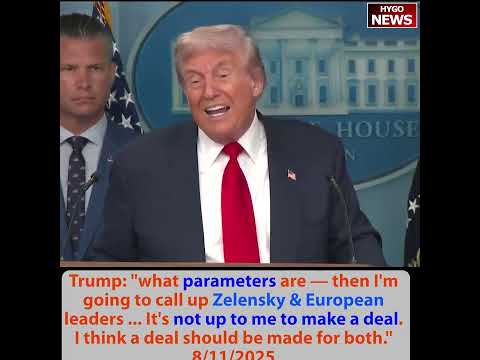
Trump: meeting Putin in 1st 2 minutes deal or not, call up Zelensky & European; Def: National Guard
Trump described his approach to the forthcoming Putin meeting: “Probably in the first two minutes, I’ll know exactly whether or not a deal can be made. Because that’s what I do, I make deals.” After the Putin meeting, he will call Zelensky and European leaders. “It’s not up to me to make a deal … I think Russia has to get back into building their country. It’s a massive country … 11 time zones.” Trump revealed the secondary-tariff pressure mechanism: “It doesn’t help when the President of the United States tells their largest or second largest oil buyer that we’re putting a 50% tariff on you if you buy oil from Russia. That was a big blow.” Defense Secretary Hegseth: “This morning, we’ve mobilized the DC National Guard … You will see them flowing into the streets of Washington in the coming week.” Hegseth reminded: “We’ve been protecting other people’s borders for 20 years, it’s about time we protect our own.” And Abigail Spanberger characterized ICE-local cooperation as “a distraction of resources."
"First Two Minutes”
Trump’s framing of the Putin meeting. “Well, we’re going to have a meeting with Vladimir Putin, and at the end of that meeting, probably in the first two minutes, I’ll know exactly whether or not a deal can be made.”
“First two minutes.” That is Trump’s negotiator framework. Not the entire meeting. Not the full diplomatic exchange. The first two minutes — the initial posture, tone, and signals — reveal whether a deal is possible.
“Because that’s what I do, I make deals.”
Trump’s self-confident framing of his own deal-making expertise. The detail is that specific. In two minutes — less time than a coffee break — Trump claims he can read Putin well enough to know if a deal will emerge.
That framing may sound overconfident, but it is consistent with Trump’s general negotiating style. He treats negotiations as personal interactions where read of the counterpart matters more than documents or detailed preparation. Whether Putin is serious about a deal. Whether Putin is stalling. Whether Putin is positioning for escalation. All of that, per Trump’s framework, can be determined from direct personal interaction.
The Sequence
“I’m going to meet with him, we’re going to see what the parameters are, I’m then going to call up President Zelensky and the European leaders. Right after the meeting, yeah.”
Specific sequence:
- Trump meets with Putin
- Trump assesses the deal parameters
- Trump calls Zelensky
- Trump calls European leaders
- Trump relays the deal framework
“Right after the meeting” is the timing. Not days later. Not after consultation with the U.S. diplomatic apparatus. Immediately after Putin meeting, the calls to Zelensky and Europeans begin.
That sequence positions Trump as the direct interlocutor between Russia and the other parties. Not State Department. Not diplomats. Trump personally.
”It’s Not Up to Me to Make a Deal”
“And I’m going to tell him what kind of a deal, I’m not going to make a deal, it’s not up to me to make a deal. I think a deal should be made for both.”
Important distinction. Trump is not negotiating on behalf of either Russia or Ukraine. He is brokering between them. Ukraine must agree to any territorial arrangements. Russia must agree to any security frameworks. Trump’s role is facilitating the agreement they both can accept.
“I think a deal should be made for both.” That is the bilateral-benefit framing. Not an agreement imposed on one party. An agreement that both Russia and Ukraine can accept because both benefit.
”11 Time Zones”
Trump’s observation about Russia. “I think Russia has to get back into building their country, it’s a massive country, I think they have 11 time zones, if you can believe it. It’s a massive, it’s by far, from the standpoint of land, it’s by far the largest.”
11 time zones. Russia’s geographic span from Kaliningrad to Kamchatka covers 11 time zones. That is the physical scale of the country Trump is describing.
“They have tremendous potential in Russia to do well, they’re not doing well, their economy is not doing well right now because it’s been very well disturbed by this.”
“Disturbed by this” — by the war. Russian economy suffering from:
- Sanctions on major sectors (energy, banking, technology)
- Military expenditure diverting resources from economic development
- Brain drain of skilled workers
- Reduced foreign investment
- Specific trade disruption with Western economies
Russia’s “tremendous potential” is real. The country has massive natural resources, substantial industrial capacity, and a skilled population. That potential is being squandered on a war that is not producing the outcomes Russia wanted.
Trump’s framing: Russia should “get back into building their country.” Exit the war. Rebuild the economy. Resume productive international relationships. That is the rational path for Russia.
”50% Tariff on Their Largest Oil Buyer”
The specific pressure point Trump cited. “It doesn’t help when the President of the United States tells their largest or second largest oil buyer that we’re putting a 50% tariff on you if you buy oil from Russia.”
That is the secondary-tariff mechanism. Russia’s oil exports are its primary source of hard currency. The U.S. cannot easily block Russian oil sales directly — the oil moves through various jurisdictions and buyers. But the U.S. can pressure Russian oil buyers with tariffs.
“Largest or second largest oil buyer” is likely India (which has become a major Russian oil buyer since Western sanctions) or China (which remains a major Russian energy customer). A 50% U.S. tariff on Indian or Chinese goods if they continue buying Russian oil creates specific pressure. India’s and China’s exports to the U.S. are substantial. 50% tariff risk forces Indian or Chinese reassessment.
“That was a big blow.”
Trump’s characterization of the secondary-tariff effect. When a major Russian oil customer reduces purchases due to U.S. tariff pressure, Russian oil revenues decline. Russian hard-currency supply constricts. The war becomes more economically unsustainable.
“And then they say, gee, he wasn’t so tough, nobody else would have done that.”
Trump acknowledging that his critics have sometimes characterized him as insufficiently tough on Russia. That characterization is being rebutted by the actual secondary-tariff action — which, as Trump notes, “nobody else would have done."
"Far Bigger Than That”
“And I haven’t stopped there, I mean, look, I was all set to do things far bigger than that, but I got a call that they’d like to meet and I’m going to see what they want to meet about.”
“Far bigger than that.” Trump was preparing additional pressure beyond the secondary tariffs. The specific escalation is not disclosed. But it was serious enough that Putin decided to request a meeting rather than face further escalation.
“I got a call that they’d like to meet.” Russia-initiated. Putin requesting the meeting. Not Trump seeking Putin. The diplomatic request is from the Russian side.
That positioning matters. When the Russian side requests the meeting, Russia is signaling interest in de-escalation. When the U.S. side would have initiated, it could be interpreted as weakness. Trump made his position clear (secondary tariffs plus more coming). Russia responded with meeting request. Trump will meet.
“I’d like to see a ceasefire, I’d like to see the best deal that could be made for both parties. You know, it takes two to tango, right?”
“It takes two to tango.” Classic diplomatic framing. A deal requires both sides. Russia has to want to end the war. Ukraine has to want to accept some terms. Trump can broker if both sides are ready. He cannot impose if either side refuses.
Hegseth on National Guard
Defense Secretary Pete Hegseth’s operational update. “At your direction this morning, we’ve mobilized the DC National Guard, it’ll be operationalized by the Secretary of the Army, Dan Driscoll, through the DC Guard. You will see them flowing into the streets of Washington in the coming week.”
DC National Guard mobilized. Army Secretary Dan Driscoll operationalizing. “Flowing into the streets of Washington in the coming week.” The deployment is starting.
“At your direction as well, sir, there are other units we are prepared to bring in. Other National Guard units, other specialized units, they will be strong, they will be tough, and they will stand with their law enforcement partners.”
Additional units available. DC Guard is the first deployment. Other National Guard units from other states can be activated. Specialized military units can be brought in. The escalation capacity is substantial.
“This is nothing new for DOD, as the President noted, at the border. We’ve got 10,000 troops down there who’ve been operating in defense cooperation areas, defense zones, where there’s zero, zero illegal crossings because of troops on strikers scanning the border.”
10,000 troops at the border. “Defense cooperation areas.” “Defense zones.” “Zero illegal crossings.” That is the specific result of military presence on the border. The deployment produces enforcement that civilian Border Patrol alone cannot provide.
“Strikers scanning the border” refers to military equipment — Stryker combat vehicles with surveillance capabilities. Mobile, armored, with sensor suites, deployed along the border.
”Other People’s Borders for 20 Years”
“We’ve been protecting other people’s borders for 20 years, it’s about time we protect our own.”
That is a specific framing. U.S. military deployed to Iraq (20+ years), Afghanistan (20 years), other nations’ borders. The contrast: American military resources defending foreign borders while American borders went unprotected.
“About time we protect our own.” The shift in priority. American military resources now deployed to American borders. Foreign deployments reduced. Domestic security elevated.
LA Partnership
“And we’re working with ICE and CBP in Los Angeles. We did the same thing, working with the California National Guard, working with ICE officers.”
Los Angeles pattern — military support for ICE operations — is being extended to DC. The specific model: military presence provides area security while ICE officers conduct enforcement operations.
“ICE officers deserve to do their job and not be attacked.”
That is the operational concern. ICE officers have been physically attacked, harassed, and doxxed. Federal military presence provides security for ICE operations — making attacks on ICE officers more difficult and more consequential.
“We will work alongside all DC police and federal law enforcement to ensure this city is safe, this city is beautiful, and as I always say about President Trump to the troops, he has their back. And my message to the National Guard and federal law enforcement in Washington is, we have your back as well. Be tough, be strong, we’re right behind you.”
Hegseth’s direct message to deployed personnel. The Defense Department provides full support. Political backup. Resource availability. Institutional protection. Troops deployed to DC do not need to worry about political second-guessing or institutional abandonment.
Spanberger’s Contrast
The segment closed with a contrast from Abigail Spanberger, the Democratic gubernatorial candidate in Virginia. “The use of local police and state police resources to enforce civil immigration infractions, not only is it not actually doing the work of ensuring that those who have committed crimes are out of our communities or held accountable, but it’s actually a distraction of resources, both in terms of personnel hours and money. From actually keeping our communities safe by ensuring any type of community policing, let alone any sort of law enforcement action.”
Spanberger’s framing. Local police cooperation with ICE is a “distraction of resources.” Community policing is what matters. Immigration enforcement draws resources away from community-safety work.
That framing has specific problems:
- Civil immigration violations are often committed by individuals with other criminal records. Enforcement of immigration violations identifies and removes specific criminal populations.
- Many crimes committed by unauthorized immigrants have local victims. Removing those offenders protects local community safety.
- The framing that immigration is separate from “community safety” ignores that immigration enforcement is community-safety work when applied to criminal aliens.
Spanberger’s position — characterizing immigration enforcement as unrelated to community safety — is ideological positioning rather than neutral assessment.
Three Threads
Trump’s Putin meeting framework. Hegseth’s DC National Guard deployment. Spanberger’s anti-ICE-cooperation framing.
Each thread reflects specific current political realities. Trump engaging directly in Russia diplomacy. Military resources being deployed to DC for public safety. Democratic gubernatorial candidates positioning against federal immigration cooperation.
The 2026 Virginia governor’s race is a specific test for Spanberger’s framing. If Virginia voters accept that immigration enforcement is a “distraction of resources,” she may win. If they believe immigration enforcement is essential to community safety, her framing backfires.
Key Takeaways
- Trump on the forthcoming Putin meeting: “Probably in the first two minutes, I’ll know exactly whether or not a deal can be made. Because that’s what I do — I make deals.”
- “I’m not going to make a deal, it’s not up to me to make a deal. I think a deal should be made for both … It takes two to tango.”
- Trump’s secondary-tariff pressure: “We’re putting a 50% tariff on you if you buy oil from Russia. That was a big blow … I haven’t stopped there, I was all set to do things far bigger than that, but I got a call that they’d like to meet.”
- Defense Secretary Pete Hegseth: “We’ve mobilized the DC National Guard … You will see them flowing into the streets of Washington in the coming week” — with 10,000 troops already producing “zero illegal crossings” at the border.
- Abigail Spanberger characterized local-ICE cooperation as “a distraction of resources” from “community policing.”