 HYGO News
 Trump to Governors: 'Maximum Deregulation, Maximum Jobs'; Lincoln Bedroom Tour; Driscoll Sworn In as Army Sec
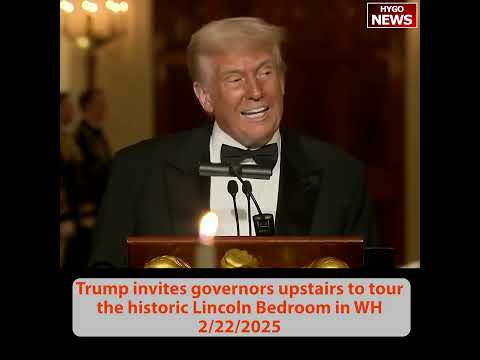
Trump to Governors: “Maximum Deregulation, Maximum Jobs”; Lincoln Bedroom Tour; Driscoll Sworn In as Army Sec
At the National Governors Association dinner on February 26, 2025, President Trump called on governors to assist with removing “foreign terrorist organizations from America,” promised “maximum deregulation and maximum numbers of jobs,” and then surprised the assembled governors by offering a personal tour of the Lincoln Bedroom and the Treaty Room upstairs at the White House. In a separate ceremony, Vice President Vance swore in Daniel Driscoll as the 26th Secretary of the Army, with Driscoll pledging to “honor the Army’s 250th-year legacy of service and sacrifice."
"We’re Going to Get Them Out for You”
Trump opened his remarks to the governors with a direct appeal for state-level cooperation on immigration enforcement, specifically targeting foreign terrorist organizations operating within the United States.
“We also want your assistance on public safety, especially removing foreign terrorist organizations from America, removing some really bad, bad guys and bad people from America,” Trump said. “And we’re going to get them out for you. We’ll be doing you a big service.”
He described the operational logistics. “We’ll bring them back to the states where they came from,” Trump said, referencing the countries of origin rather than the states within the U.S.
Trump then addressed the diplomatic aspect of deportations, noting that initial resistance from receiving countries had been swiftly overcome. “We don’t have one country that says no,” he said. “We had a lot of them that said no, but that lasted about two hours, and all of a sudden they were all saying yes.”
The “two hours” timeframe was characteristically Trumpian hyperbole, but it conveyed a genuine reality: countries that had refused to accept deportees under the Biden administration had reversed their positions almost immediately under Trump. The leverage — whether through tariff threats, diplomatic pressure, or the simple credibility of a president willing to act — had produced compliance across the board.
“And we’ll get them back and we’ll get them out and we’ll make your state a lot safer,” Trump concluded.
”Maximum Deregulation and Maximum Jobs”
Trump then pivoted to the economic message, linking deregulation directly to employment.
“On deregulation, we’ll be creating maximum deregulation and maximum numbers of jobs,” Trump said. “And I think it has a lot to do — one has a lot to do with the other.”
The connection Trump drew between deregulation and job creation was the central thesis of his economic philosophy. Regulations imposed costs on businesses that were ultimately borne by workers (through lower wages), consumers (through higher prices), or both (through fewer jobs). By removing regulatory barriers, the administration was freeing businesses to hire, expand, and invest. The “maximum” framing suggested the administration would push deregulation further than any previous effort.
For the governors in the room, the message was both a promise and an invitation. States that cooperated with the federal deregulation agenda would benefit from the resulting job creation. States that maintained their own regulatory burdens would see investment flow to more business-friendly jurisdictions.
The Lincoln Bedroom Tour
Trump then made an offer that transformed a standard dinner into an unforgettable experience for the assembled governors.
“We have a room called the Lincoln Bedroom,” Trump said with evident reverence. “I think it’s like maybe to me the most important room in the whole country. The most important bedroom, definitely.”
He described the historical significance. “It’s incredible, just the way he left it. And he was Abraham Lincoln, after all,” Trump said.
Trump offered the tour with characteristic generosity. “We have it upstairs. And right after we’re finished with the meal, I’m going to take whatever group wants to go up,” he said. “We can handle quite a few. We walk up the stairway, the big, beautiful grand stairway. And at the top of that stairway is the Lincoln Bedroom and the Treaty Room, where we signed virtually every land acquisition.”
He then dropped a tantalizing hint that connected history to current events. “And we are looking at a few of them, by the way, just in case you don’t,” Trump said of land acquisitions. “We’re looking at a few. I won’t name them tonight, but I think we know what we’re talking about. Maybe more than we even think.”
The reference to new “land acquisitions” — delivered while describing the Treaty Room where historic territorial agreements had been signed — was a playful allusion to Trump’s public discussions about Greenland, the Panama Canal, and Canada. By connecting those contemporary ambitions to the historical precedent of American territorial expansion, Trump was framing his proposals not as radical departures but as continuations of a long American tradition.
“We’ll meet here right after the end of the meal,” Trump told the governors. “And we’ll walk up together, and you’ll see something that actually is really amazing and real history.”
The offer to personally lead a tour of the Lincoln Bedroom and Treaty Room was a gesture that transcended partisan politics. Whether Republican or Democrat, every governor in the room recognized the extraordinary nature of the invitation. It was the kind of access that money could not buy and status alone did not guarantee.
Daniel Driscoll Sworn In as 26th Army Secretary
In a separate ceremony, Vice President JD Vance administered the oath of office to Daniel Driscoll as the 26th Secretary of the United States Army.
“I, Daniel Driscoll, do solemnly swear that I will support and defend the Constitution of the United States against all enemies, foreign and domestic, that I will bear true faith and allegiance to the same, that I take this obligation freely, without any mental reservation or purpose of evasion, and that I will well and faithfully discharge the duties of the office on which I am about to enter. So help me God,” Driscoll recited.
“Congratulations, Mr. Secretary,” Vance said.
Driscoll then delivered brief remarks, constrained by the tight schedule. “They gave us five minutes total for all of this, so this is going to be very fast,” he said with a laugh.
He opened with gratitude. “It is a privilege to stand before you today as the 26th Secretary of the United States Army,” Driscoll said. “First, I want to thank the President of the United States for his confidence and his trust.”
He acknowledged his relationship with Vance. “I am forever grateful to the Vice President and the Second Lady. This friendship has been the adventure of a lifetime. I cannot imagine where it goes from here,” Driscoll said.
He thanked his family — wife Cassie, children Daniel and Lila, both sets of parents, and his brother — before closing with the commitment that framed his tenure.
“My commitment to this role, as the Vice President mentioned, is rooted in my family’s long lineage of military history,” Driscoll said. “We are a family that is grateful to have had the privilege of wearing the United States Army uniform. We’re going to fight hard for it.”
The emphasis on family military tradition positioned Driscoll as someone who would lead the Army not just as a civilian administrator but as someone with a personal, generational stake in the institution’s success. His pledge to “fight hard for it” echoed the administration’s broader military reform agenda, which included removing DEI programs, restoring readiness as the top priority, and reestablishing a warrior culture within the armed forces.
Key Takeaways
- Trump asked governors for “assistance on public safety, especially removing foreign terrorist organizations from America,” saying “we don’t have one country that says no” to accepting deportees.
- He promised “maximum deregulation and maximum numbers of jobs,” connecting the two as interdependent.
- Trump offered governors a personal tour of the Lincoln Bedroom and Treaty Room, hinting at new “land acquisitions” by saying “we’re looking at a few — I won’t name them tonight.”
- VP Vance swore in Daniel Driscoll as the 26th Secretary of the Army, with Driscoll citing his “family’s long lineage of military history” and pledging to “fight hard” for the institution.
- The governors’ dinner combined policy substance (deportations, deregulation) with personal hospitality (the Lincoln Bedroom tour), illustrating Trump’s approach to intergovernmental relations.