 HYGO News
 Trump MASSIVE Japan trade deal, largest in history, Alaska LNG joint venture; Harvard got $7B, $52B
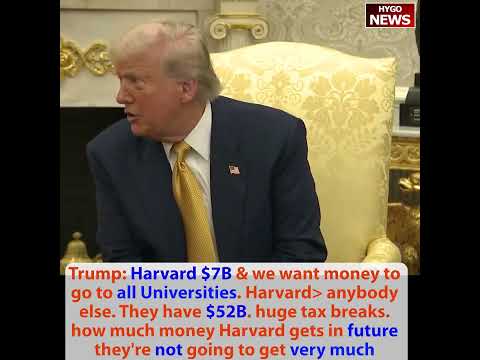
Trump MASSIVE Japan trade deal, largest in history, Alaska LNG joint venture; Harvard got $7B, $52B
President Trump announced what he described as “the largest trade deal in history” with Japan, plus a separate joint venture for Alaska LNG, framed as a major second-front win. “They had their top people here, and we worked on it long and hard, and it’s a great deal for everybody.” On Harvard: “$7 billion” federal funding, plus a $52 billion endowment with “huge tax incentives and tax breaks” — with a federal case pending before “a very hostile judge appointed by Barack Hussein Obama” expected to constrain Harvard’s future federal receipts. On China: “We’re getting along with China very well. In fact, the magnets … they’re sending them in record numbers.” And Trump addressed Filipino President Bongbong Marcos’s China posture with rare deference: “I don’t mind if the president dealt with China … I’ve always said, make the Philippines great again. Do whatever you need to do.” New York AG Letitia James’s anti-ICE rhetoric closed the segment.
”The Largest Trade Deal in History”
Trump opened by teeing up the second Japan deal even as he celebrated the first. “And I said to the Japanese trade representatives, and these were the top people, we concluded the one deal, Doug, and now we’re gonna conclude another one because they’re forming a joint venture with us in Alaska, as you know, for the LNG.”
“Doug” is Trump’s Interior Secretary Doug Burgum. The Alaska LNG reference is to the Alaska Liquefied Natural Gas project — a long-pending proposal to monetize North Slope gas via a pipeline to tidewater in south-central Alaska, then liquefy it for Asian export. The project has faced economic and logistical challenges for decades. Japanese partnership — with explicit joint-venture terms — would provide the financing, technical expertise, and guaranteed purchase commitments that the project has needed.
“So I said, we’ll all do that together with Chris. Is Chris here? I don’t know. Chris, right? If you could set that up, Doug, it would be great, but they’re all set to make that deal now, so I think it’s good.”
“Chris” is almost certainly Energy Secretary Chris Wright. Trump is instructing his cabinet, on camera, to coordinate on the Alaska LNG deal. The casualness of the instruction — “if you could set that up” — captures the operational texture of a presidency where major deals are negotiated and announced at the cabinet level with the president’s approval.
”I Just Signed the Largest Trade Deal in History”
“This was really the one they had to make, and we’re gonna make a deal with Japan on the LNG in Alaska, right? Okay, thank you very much. But I just signed the largest trade deal in history, I think maybe the largest deal in history with Japan.”
“The largest trade deal in history” — that is Trump’s characterization of the primary Japan deal. The economic package includes tariff terms, Japanese investment commitments in U.S. manufacturing, Japanese agricultural and technology market access for U.S. exporters, and related provisions. Whether the deal genuinely qualifies as “largest in history” depends on how the metric is calculated — but it is, by any measure, among the largest bilateral trade packages the U.S. has signed in decades.
“And that was done with Japan. They had their top people here, and we worked on it long and hard, and it’s a great deal for everybody. I always say it has to be great for everybody. It’s a great deal.”
“It has to be great for everybody” is Trump’s operating premise. His framing of trade deals has always emphasized mutual benefit — not zero-sum extraction from the other side, but win-win structures that keep the counterparty invested in follow-through. “Great for everybody” is the negotiating principle.
“A lot different from the deals in the past, I can tell you that.”
The contrast with past deals is Trump’s consistent theme — NAFTA, TPP (which the U.S. never joined), trade with China pre-2018 — which Trump has characterized as fundamentally unequal arrangements that the U.S. tolerated for decades.
”Thank You … Howard and Scott”
Trump thanked his key trade negotiators. “We’re doing really well as a country with strong. We have a lot of money flowing in. The tariffs are kicked in better than anybody, other than me and a few of the people in the room. Thought could happen, Howard and Scott. Just wanna thank you, and you’ve been unbelievable allies, because you’re really allies. That’s what you’ve been, and we appreciate it.”
“Howard and Scott” — Commerce Secretary Howard Lutnick and Treasury Secretary Scott Bessent. The credit to both by first name, in public, is the kind of recognition that reinforces their standing. Both have been central to the trade-deal pipeline, and Trump’s explicit acknowledgment validates their work.
“Some were very difficult, but you got there. They had a little confidence, and they came in earlier, we appreciate it.”
Harvard: “$7 Billion … $52 Billion”
Trump pivoted to the Harvard funding fight. “But Harvard’s been given $7 billion. Can you believe it by the fact? $7 billion. We want money to go to all universities, not Harvard.”
That is the core Trump argument on Harvard. Federal research and program funding flowing disproportionately to Harvard — Trump’s $7 billion figure is a shorthand for cumulative recent federal grants, contracts, and subsidies — while Harvard operates an enormous tax-advantaged endowment.
“Harvard got more than anybody else. They have $52 billion. They get huge tax incentives and tax breaks on that $52 billion, but they have $52 billion.”
$52 billion endowment. Tax-advantaged growth. Tax-deductible contributions. Trump’s framing: Harvard is the wealthiest university in the world by endowment, it is the beneficiary of extraordinary federal tax treatment, and it is also receiving large federal grants on top of all that. The case for directing that federal money to less-endowed institutions is straightforward.
”A Very Hostile Judge Appointed by Barack Hussein Obama”
Trump then addressed the pending Harvard litigation. “We have a very hostile judge appointed by Barack Hussein Obama, a very, very hostile judge, who knows exactly right from wrong, but we expect to win it on a P.O. She hasn’t given a decision yet, but she’s very hostile.”
“P.O.” likely refers to “procedural order” or, more specifically, an initial legal posture. Trump is anticipating an adverse ruling from an Obama-appointed federal judge but expressing confidence that the administration will prevail through subsequent appeals.
“She was put by Barack Hussein Obama. Generally speaking, anybody that does that, we’re gonna have problems with.”
That is Trump’s generalized assessment of Obama-appointed federal judges. It is not uniformly accurate — many Obama appointees have ruled in ways consistent with administration priorities, and judicial appointees across administrations have ruled against the administration that appointed them. But the pattern Trump is describing — that Obama-era appointees in particular districts have been consistently adverse to his administration’s priorities — is observable in specific case dockets.
”We Easily Won the Case”
“We won the case yesterday. Anybody that was there that was a neutral would say we easily won the case.”
That is Trump’s characterization of the hearing. “We easily won” is political framing; the case’s outcome depends on the judge’s actual written ruling, not on the hearing dynamics.
“Big part of it’s gonna be how much money Harvard gets in the future. That’s not part of the case, and they’re not gonna get very much.”
That is the broader threat. Regardless of how the specific case is decided, the administration’s future federal funding decisions — agency-by-agency, program-by-program — will be shaped by the Harvard posture. Harvard will not receive what it has historically received. Other universities will benefit from the redirection.
China: “Magnets Are Coming Out Very Well”
Trump addressed the China relationship with an unusual level of optimism. “I don’t mind if he gets along with China, because we’re getting along with China very well. We have a very good relationship. In fact, the magnets, which is a little complex piece of material, but the magnets are coming out very well, they’re sending them in record numbers. We’re getting along with China very well.”
Rare earth magnets — specifically the neodymium-iron-boron and samarium-cobalt magnets that are essential inputs for electric motors, wind turbines, missiles, and many other technologies — have been a strategic vulnerability for the U.S. supply chain. China produces and refines the overwhelming majority of the world’s rare earth magnets. Any friction in the U.S.-China relationship creates risk for American manufacturers dependent on those inputs.
Trump is saying the magnet flow is strong — record numbers. That indicates the U.S.-China trade relationship has not collapsed despite the tariff escalations. Production and shipment of critical industrial inputs continues at a pace the administration describes as record-setting.
”Make the Philippines Great Again”
“And I don’t mind if the president dealt with China, that’s meant because I think he has to do what’s right for his country. I’ve always said, make the Philippines great again. Do whatever you need to do, but you’re dealing with China wouldn’t bother me at all.”
That is Trump addressing Filipino President Ferdinand “Bongbong” Marcos Jr.’s China-relationship decisions. The context: the Philippines has been caught between U.S. security partnership (including the Enhanced Defense Cooperation Agreement) and Chinese economic influence (Belt and Road projects, agricultural imports, infrastructure loans). The Marcos government has tilted toward the U.S. on security while maintaining Chinese economic ties.
Trump’s framing — “do whatever you need to do” — acknowledges the Philippines’ sovereign prerogative to manage its own relationships. That is a notably deferential posture from an American president toward a treaty ally’s China policy. In the Biden administration’s approach, the assumption was that U.S. partners should align more uniformly against Chinese influence. Trump’s framing is that Philippines’ interests are paramount, even if they include China dealings the U.S. would not directly prefer.
”Make the Philippines Great Again”
The phrase itself — “Make the Philippines Great Again” — is the Trump-brand rhetorical extension applied to an ally. Trump is not making this the Philippines’ motto. He is signaling that the United States supports the Philippines’ national project, and that national project includes China dealings as the Philippines’ leadership sees fit.
That is unusual diplomatic register from an American president. Deferential. Sovereignty-respecting. Not the kind of assumed-hegemon posture that has defined much post-WWII American foreign policy rhetoric.
Letitia James Returns
The segment closed with another clip from New York Attorney General Letitia James. “The state of New York and other democratic attorneys general are standing up for those families and for those individuals who unfortunately are being kidnapped in the middle of the night by masked agents with no insignia, no identification, and taken away from their families.”
The “masked agents with no insignia” framing is repeated. James is pressing the same narrative — that ICE operations constitute kidnapping of innocent families by unidentified federal agents.
The administration’s allies’ editorial framing: this is a state AG demonizing lawful federal enforcement activity while pretending to defend families, when her actual operational choice — municipal non-cooperation with ICE — is what enables repeat-offender illegal aliens like Mora Nunes to stay in the country and eventually shoot Border Patrol agents.
Four Wins and a Provocation
Japan trade deal. Alaska LNG joint venture. Harvard litigation advancing. China magnet supply stable. Plus Trump’s diplomatic deference to the Philippines. And James’s continued provocation providing counter-evidence against her own state’s sanctuary posture.
Five items, one news cycle. The texture of a working administration.
Key Takeaways
- Trump announced “the largest trade deal in history” with Japan — plus a planned separate Alaska LNG joint venture: “they’re all set to make that deal now, so I think it’s good.”
- Trump thanked Commerce Secretary Howard Lutnick and Treasury Secretary Scott Bessent as “unbelievable allies” on the deal negotiation.
- On Harvard: “$7 billion” federal funding plus a “$52 billion” tax-advantaged endowment — Trump expects a hostile Obama-appointed federal judge to rule against the administration but says “we expect to win it” on appeal, and Harvard “are not gonna get very much” in future funding.
- On China, Trump expressed rare optimism: “We’re getting along with China very well. In fact, the magnets … they’re sending them in record numbers.”
- Trump told Filipino President Marcos, unusually deferentially: “Make the Philippines great again. Do whatever you need to do, but you’re dealing with China wouldn’t bother me at all.”