 HYGO News
 Trump on Powell: 'A Lot of Debt Coming Due Because Biden Had All Short-Term Debt -- This Guy Would Get Us Lower Rates, Save Country Money'; 'If Inflation Comes Back, Raise Rates'; Trump on Abrego Garcia: 'Whole Disaster -- Not This Wonderful Father from Maryland, a Pretty Bad Guy'; Hawley Catches Liberal Professor Flip-Flopping on Nationwide Injunctions
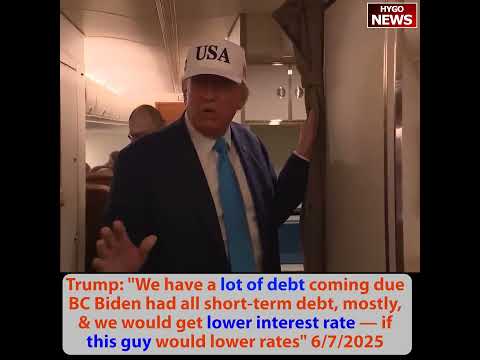
Trump on Powell: “A Lot of Debt Coming Due Because Biden Had All Short-Term Debt — This Guy Would Get Us Lower Rates, Save Country Money”; “If Inflation Comes Back, Raise Rates”; Trump on Abrego Garcia: “Whole Disaster — Not This Wonderful Father from Maryland, a Pretty Bad Guy”; Hawley Catches Liberal Professor Flip-Flopping on Nationwide Injunctions
Multiple significant exchanges marked June 2025. Trump on Fed Chair Jerome Powell’s rate policy: “We have a lot of debt coming due because Biden had all short-term debt, mostly. We would get a lower rate and a lower interest rate if this guy would lower rates. It’s unbelievable. And he’s worried about inflation. All he has to do is get the lower rate. Let us go out and borrow at a much lower rate. You could go down a point or two. And if in two years inflation comes back, he raises rates. But he keeps them the same. It’s insane. Either way, it’s a disaster.” Trump on Kilmar Abrego Garcia: “He’s a whole disaster. Look at him with his antics. Not good. And for the Democrats who have backed him, this was not the man from Maryland, this wonderful father from Maryland. This is a pretty bad guy.” Trump on the economy: “We have the hottest country anywhere in the world — the hottest country. If you think about it, six months ago, we had the coldest country.” Sen. Josh Hawley caught liberal professor Kate Shaw flip-flopping on nationwide injunctions: “So long as it is a Democrat president in office, then we should have no nationwide injunctions. If it’s a Republican president, then this is absolutely fine, warranted and called for. How can our system of law survive on those principles, Professor?”
Trump on the Fed Debt Situation
Trump laid out a specific fiscal problem.
“And by the way, we have no inflation now,” Trump said. “And if we had a good Fed chairman, you would lower rates.”
He described the Biden debt legacy: “And you know what? If inflation happened in a year from now, or two years, let him raise rates.”
He explained the urgency: “But we’re going out for long-term debt or short-term debt. We have a lot of debt coming due because Biden had all short-term debt, mostly.”
He described the policy gain: “We would get a lower rate and a lower interest rate if this guy would lower rates. We get a lower interest rate. It’s unbelievable.”
He framed Powell’s obstinance: “And he’s worried about inflation. All he has to do is get the lower rate. Let us go out and borrow at a much lower rate. Much lower. You could go down a point or two.”
The Debt Rollover Problem
Trump was identifying a specific fiscal challenge.
The Biden debt legacy:
- Biden administration financed government with short-term debt
- Bills maturing in months or 1-2 years
- Vast amounts rolling over regularly
- Each rollover at current rates
- Sustained high interest costs
The specific problem:
- Short-term debt at 5%+ rates
- $1+ trillion rolling over annually
- If rates stayed at 5%, massive interest costs
- If rates dropped 2 points, massive savings
- Fed decision directly impacts fiscal picture
The Trump argument:
- Inflation low, rates should be low
- Current high rates inefficient
- Treasury refinancing opportunity
- Strategic interest rate management
- Billions in potential savings
The Powell position:
- Maintain rates to prevent inflation resurgence
- Err on side of caution
- Data-dependent approach
- Independence from fiscal pressures
- Long-term inflation control
The Policy Trade-off
Trump’s argument had substantive economic basis.
If Fed lowered rates:
- Treasury saves on debt service
- Billions in annual savings
- Mortgage rates drop (housing market)
- Business borrowing cheaper
- Economic activity accelerates
If Fed maintained rates:
- Inflation risk managed
- Potential economic slowdown
- Treasury continues high debt costs
- Fiscal pressures maintain
- Economic expansion limited
Trump’s specific framework:
- Cut rates now while inflation low
- Save money on refinancing
- If inflation returns in 1-2 years, raise rates then
- Flexible response to conditions
- Opportunistic rate management
”It’s Insane. Either Way, It’s a Disaster”
Trump’s framing was dramatic but substantive.
What “either way” meant:
- If inflation rises: Powell should have been raising rates
- If inflation falls: Powell should be cutting rates
- Powell is doing neither
- Holding steady when either direction is called for
- Not responding to data properly
The fundamental criticism:
- Fed should be responsive to conditions
- Holding constant when conditions change is wrong
- Preference for action regardless of direction
- Powell’s caution excessive
- Economic costs accumulating
The political context:
- Trump wanted lower rates politically
- Stronger economy pre-midterms
- Consumer relief
- Business expansion
- Electoral benefits
Trump on Abrego Garcia
Trump delivered a sharp assessment.
“He’s a whole disaster,” Trump said. “Look at him with his antics. Not good.”
He made the political indictment: “And for the Democrats who have backed him, this was not the man from Maryland, this wonderful father from Maryland. This is a pretty bad guy.”
The “Whole Disaster” Framing
Trump’s assessment captured the situation clearly.
What “whole disaster” referred to:
- Kilmar Abrego Garcia’s recent conduct
- MS-13 gang affiliations
- Alien smuggling indictment
- Criminal enterprise membership
- Multiple serious offenses
The Democratic framing collapse:
- “Maryland Man” narrative
- “Wonderful father” characterization
- “Abducted” story
- Sympathetic portrayal
- All contradicted by facts
Trump’s direct response:
- Not the character Democrats claimed
- “Pretty bad guy”
- Criminal pattern established
- Democratic defense embarrassing
- Political blowback inevitable
The Antics
Trump specifically noted Abrego Garcia’s “antics.”
What Abrego Garcia had been doing:
- Public statements from custody
- Defending himself against charges
- Framing himself as victim
- Asking for media attention
- Dramatic legal filings
Why this hurt Democrats:
- More Abrego Garcia spoke, more he revealed
- Sympathetic framing undermined by his own words
- Could not maintain “innocent father” narrative
- Fact pattern increasingly damaging
- Political support increasingly embarrassing
Trump’s specific point:
- Abrego Garcia’s behavior self-destructive
- Confirmed Republican framing
- Undermined Democratic defense
- Made Democratic support look ridiculous
- Political cost rising
”Hottest Country Anywhere in the World”
Trump pivoted to economic success.
“The country is doing really well,” Trump said. “Almost, I think, in a very short period of time, you’re going to be saying, doing better than it’s ever done before.”
He cited specific data: “We have hundreds of plants coming in, plants. A lot of jobs are being created. That’s what happened this morning. You saw the jobs.”
He emphasized private sector: “And the nice part, they’re not government jobs. They’re jobs of people coming in and doing other things, including the leisure hotel and leisure. Good stuff.”
He summarized: “A lot of good things are happening with our country. We’re taking in billions of dollars of tariff money. The money is pouring in.”
He made the broader claim: “It hasn’t even started yet, really, relatively. We’re going to have a very successful country very soon.”
He delivered the memorable phrasing: “And the stock market is seeing that we have the hottest country anywhere in the world, the hottest country.”
He made the comparative historical claim: “If you think about it, six months ago, we had the coldest country. We had a country that was a disaster. And we’ve done it very quickly.”
The “Hottest Country” Framing
Trump’s “hottest country” was substantive political communication.
What “hottest” captured:
- Economic dynamism
- Investment attraction
- Job creation momentum
- Business confidence
- Cultural vitality
The comparative data:
- Six months ago: “coldest country”
- Economic malaise
- Business uncertainty
- Declining investment
- Cultural pessimism
Now:
- Record investment announcements
- Hundreds of new plants
- Strong job growth
- Tariff revenue
- Economic momentum
The speed of transformation:
- “We’ve done it very quickly”
- Just six months
- Dramatic reversal
- Not gradual change
- Policy-driven transformation
The Specific Achievements
Trump’s claims were backed by data:
Investment announcements:
- Massive FDI commitments
- Apple, TSMC, NVIDIA, Samsung
- Major manufacturing investments
- Pharmaceutical manufacturing
- Energy sector expansion
Job creation:
- 139K jobs in May
- Third month beating expectations
- Private sector driven
- Manufacturing growth
- Service sector robust
Tariff revenue:
- Billions flowing to Treasury
- CBO estimates $2.8T over 10 years
- Substantial fiscal impact
- Not from American consumers
- From foreign producers
Economic momentum:
- Consumer confidence surging
- Trade deficit cut in half
- Wages up significantly
- Business confidence high
- Forward expectations positive
The Hawley Confrontation
Senator Josh Hawley engaged with a liberal professor on nationwide injunctions.
The professor (appears to be Kate Shaw again) was presented with an anomaly chart.
Hawley: “Now, you don’t think this is a little bit anomalous? You don’t think that’s a little bit strange?”
Professor’s response: “A very plausible explanation, Senator, you have to consider is that he is engaged in much more lawless activity than other presidents.”
Hawley countered: “You don’t think this was never used before the 1960s. And suddenly, Democrat judges decide, we love the nationwide injunction. And then when Biden comes to office, no, no action.”
The Nationwide Injunction History
The specific legal history was important.
What “nationwide injunction” means:
- Federal court ruling applying nationwide
- Beyond specific plaintiffs
- Universal application
- Policy-blocking power
- Recent innovation
Historical practice:
- Courts historically ruled for specific cases
- Ruling applied to plaintiffs
- Not universal application
- Required separate challenges elsewhere
- Traditional judicial modesty
The recent shift:
- 1960s some scholars identify as start
- Expanded dramatically in recent decades
- Used more against Republican presidents
- Biden rarely faced this
- Trump frequently blocked
The Professor’s Dodging
The professor attempted evasion.
Hawley: “It’s Republican appointees as well, Senator.”
Hawley: “And the 1960s is where some scholars begin sort of locate the beginning of this. Can you identify one before then?”
Professor: “Mila Sohoni, who’s another scholar of universal injunction, suggests 1913 is actually the first of others in the 20s.”
Hawley: “The Republican endured for 150 years before the nationwide injunction.”
Professor: “Well, the federal government was doing a lot less until 100 years ago. So I’m, you know, there’s many things that have changed in the last 100 or the last 50 years.”
The “Federal Government Was Doing a Lot Less”
The professor’s argument was revealing.
What she was claiming:
- Nationwide injunctions needed because federal government bigger
- Different tool for different circumstances
- Modern complexity justifies modern techniques
- Republic survived with less government
- Requires more judicial intervention
Why this was problematic:
- Federal government expansion doesn’t require judicial expansion
- Courts have specific constitutional role
- Size of government not justification for judicial overreach
- Would legitimize unlimited judicial activism
- Confuses cause and effect
The better analysis:
- Federal government expansion (justified or not)
- Judicial response should be modest
- Judicial power separate from executive power
- Courts should act within their lane
- Not expand power in response to executive expansion
The Partisan Inconsistency
Hawley’s core point was devastating.
“So long as it is a Democrat president office, then we should have no nationwide injunctions. If it’s a Republican president, then this is absolutely fine. How can our system of law survive on those principles, Professor?”
The Specific Inconsistency
The professor’s position had been public.
Her prior statements:
- When Biden was president: nationwide injunctions against Biden were wrong
- When Biden was president: judges shopping for favorable rulings was bad
- When Biden was president: universal injunctions were travesty for rule of law
- When Biden was president: judicial activism threatened democracy
Her current position:
- When Trump is president: nationwide injunctions against Trump are fine
- When Trump is president: forum shopping for favorable rulings is acceptable
- When Trump is president: universal injunctions are appropriate
- When Trump is president: judicial activism is essential
The core problem:
- Position determined by who is president
- Not determined by constitutional principles
- Judicial authority as political tool
- Principles abandoned when inconvenient
- Integrity collapse
The Professor’s Defense
The professor tried to reconcile her position.
Professor: “I think a system in which there is that blind constraints on the president is a very dangerous system.”
Hawley: “That’s not what you thought when Joe Biden…”
Professor: “I think every president is constrained and must be absolutely.”
Hawley: “You said it was a travesty for the principles of democracy, notions of judicial impartiality and the rule of law. You also said when Joe Biden was president.”
The Specific Biden-Era Quotes
Hawley laid out the specific prior statements.
“Wait a minute, wait a minute. You also said when Joe Biden was president, you said the idea that anyone would forehand shop to get a judge who would issue a nationwide injunction was just politicians, judges looking like politicians in robes. Again, it threatened the underlying legal system. People just trying to get the result they wanted.”
He delivered the central question: “It was a travesty for the rule of law. But you’re fine with all of that if it’s getting the result that you want.”
The Substantive Critique
Hawley’s critique was devastating.
What the professor had said during Biden:
- Forum shopping for nationwide injunctions was wrong
- “Politicians judges looking like politicians in robes”
- “Threatened the underlying legal system”
- “Travesty for the rule of law”
- People getting “the result they wanted”
What the professor was saying now:
- Nationwide injunctions against Trump are fine
- Democratic judges acting against Trump was appropriate
- Forum shopping against Trump was legitimate
- Rule of law preserved through these tactics
- Result was worth the method
The fundamental problem:
- Intellectual integrity
- Professional consistency
- Democratic values
- Judicial impartiality
- Constitutional framework
If legal scholars could completely reverse their positions based on who held power:
- Legal scholarship becomes partisan advocacy
- Principles become tools for political purposes
- Scholarship loses credibility
- Democratic norms erode
- Constitutional order threatened
The “Blind Constraints” Argument
The professor’s “blind constraints on the president is a very dangerous system” framing was problematic.
What she meant:
- Presidents need to be constrained
- Courts should constrain them
- Especially Republican presidents
- Who engage in “lawless activity”
- Extensive judicial oversight appropriate
What she ignored:
- Her previous opposition to constraining Biden
- Her inconsistent treatment of presidents
- Her tolerance for Biden executive actions
- Her objection to executive orders only when Republican
- Her partisan framework
The proper framework:
- All presidents should be constrained equally
- Constitutional framework should apply consistently
- Judicial review should be predictable
- Partisan considerations should be excluded
- Rule of law requires consistency
The Broader Implications
The Hawley-professor exchange revealed broader problems.
In legal academia:
- Politicization of scholarship
- Partisan positioning in “neutral” analysis
- Different standards for different political parties
- Academic credentials used for political purposes
- Loss of intellectual integrity
In federal courts:
- Increasing use of partisan injunctions
- Forum shopping for favorable judges
- Politicization of judicial decisions
- Erosion of judicial independence
- Constitutional concerns
In American democracy:
- Courts as partisan battlegrounds
- Elections meaningless if courts override
- Democratic accountability weakened
- Institutional legitimacy damaged
- Long-term consequences serious
Key Takeaways
- Trump on Powell: “Biden had all short-term debt. If this guy would lower rates, we’d save massively on refinancing.”
- Trump on Abrego Garcia: “Whole disaster. Not the wonderful father from Maryland — a pretty bad guy.”
- Trump: “We have the hottest country anywhere in the world. Six months ago, we had the coldest country.”
- Hawley catches Kate Shaw flip-flopping on nationwide injunctions: Biden era = “travesty for rule of law”; Trump era = fine.
- Hawley: “How can our system of law survive on those principles?” — exposing partisan inconsistency.