 HYGO News
 Trump: like other countries participate Gaza aid; Ursula: huge deal; Rubio Stops Short 2028
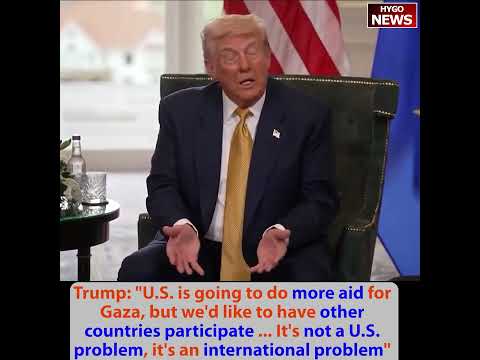
Trump: like other countries participate Gaza aid; Ursula: huge deal; Rubio Stops Short 2028
Trump said the U.S. will do more aid for Gaza but explicitly asked other nations to participate: “It’s not a U.S. problem. It’s an international problem.” He added a pointed operational detail: “A lot of that food is getting stolen by Hamas. You know, they’re stealing the food. They’re stealing a lot of things. You ship it in and they steal it. Then they sell it.” European Commission President Ursula von der Leyen called the agreement “a trade deal between the two largest economies in the world … it’s a big deal. It’s a huge deal” — with “15 percent tariffs across the board, all inclusive” and the European market (450 million consumers) now open. Secretary of State Marco Rubio, asked by Lara Trump about 2028, praised VP JD Vance as “a great nominee” and declined to rule out his own future run: “You never rule things out.” Senator Elissa Slotkin attempted a Detroit Lions football analogy — to the administration’s amusement.
”The U.S. Is Going to Do More Aid”
Trump’s commitment on continued Gaza aid. “Will I do more aid? Yeah, the U.S. The U.S. is going to do more aid for Gaza, but we’d like to have other countries participate.”
“More aid” is the commitment. “Like to have other countries participate” is the ask. The U.S. is not abandoning Gaza humanitarian efforts. But Trump is making clear that American aid should not bear the full burden.
“We’re going to mention that to the European Union today. You know, it’s that’s an international problem. It’s not a U.S. problem. It’s an international problem.”
Mentioning it to the EU during the same Scotland visit that produced the trade deal is the diplomatic pressure point. The EU — the collective representation of major European economies with substantial humanitarian-aid budgets — is being asked to match or exceed the American contribution.
“And we’re giving a lot of money and a lot of food and a lot of everything. If we weren’t there, I think people would have starved, frankly. They would have starved. And it’s not like they’re eating well.”
That is the factual frame. U.S. humanitarian contributions have been the critical margin for Gaza’s food-security situation. Absent American aid, conditions would have deteriorated to actual starvation. Even with American aid, the population is not eating well — but the intervention has prevented the worst outcomes.
”Hamas Is Stealing the Food”
“But a lot of that food is getting stolen by Hamas. You know, they’re stealing the food. They’re stealing a lot of things. You ship it in and they steal it. Then they sell it.”
That is the operational reality humanitarian agencies have documented. Hamas, as the governing authority in Gaza, has systematically diverted humanitarian aid. Food, medicine, fuel, and building materials intended for civilian populations have been intercepted and either used by Hamas fighters or resold on black markets.
“Ship it in and they steal it. Then they sell it.” That is the mechanism. Hamas does not merely hoard aid. It monetizes aid by reselling to the population that was supposed to receive it for free. The financial flow then funds Hamas operations.
That reality complicates any humanitarian response. Agencies that want to help Gaza civilians have to navigate the Hamas diversion problem. Some organizations have pulled out of Gaza operations specifically because they cannot ensure their aid reaches intended recipients. Others continue operating with reduced effectiveness.
The administration’s framing acknowledges the problem publicly while continuing the aid. The alternative — cutting aid entirely — would harm civilians more than it would harm Hamas. The current posture is second-best, but it is the available option.
Von der Leyen on “The Biggest Trading Partnership”
Ursula von der Leyen’s framing of the EU deal. “We have a deal. We have a trade deal between the two largest economies in the world. And it’s a big deal. It’s a huge deal. It will bring stability. It will bring predictability. That’s very important for our businesses on both sides of the Atlantic.”
“Stability … predictability” is the economic argument. Businesses — European exporters, American importers, European investors in the U.S., American businesses operating in Europe — need to know the trade terms. Uncertainty about tariffs, quotas, regulations produces hesitation that slows investment and commerce.
The new deal, whatever one thinks of the specific terms, provides that predictability. 15% tariff rate is known. Zero-tariff access for U.S. exports is known. The investment commitments are known. Whatever else changes, the framework is set.
“It’s 15 percent tariffs across the board, all inclusive.”
Confirmation of the 15% rate from von der Leyen. “All inclusive” means no categorical exceptions — automobiles, chemicals, machinery, wine, pharmaceuticals, anything European entering the U.S. pays 15%.
“450 Million People”
“The investments Mr. President just described that going to go to the United States and the purchases over there. Indeed, basically the European market is open. It’s 450 million people.”
450 million consumers. That is the EU’s consumer market. Combined with the U.S.’s approximately 340 million, the transatlantic market of roughly 800 million represents the wealthiest consumer bloc on Earth.
For U.S. exporters, access to 450 million European consumers at zero tariff is a transformative opportunity. European consumers have high purchasing power, established consumption patterns, and diverse preferences. U.S. products — especially agricultural, technological, and branded consumer products — can capture significant share of that market under the new terms.
“So it’s a good deal. It’s a huge deal. It was tough negotiations. I knew it at the beginning and it was indeed very tough. But we came to a good conclusion from both sides.”
“Tough negotiations” — von der Leyen acknowledging what the process actually was. The Trump administration’s negotiating posture pressed hard for specific terms. Von der Leyen and her team pressed back on others. The final agreement represents genuine compromise, not a European surrender.
“So again, congratulations and many things. Thank you very much.”
Rubio on 2028
Lara Trump, interviewing Secretary of State Marco Rubio for Fox News’ “My View,” asked about 2028. “You are talked about quite frequently as a possible contender in 2028. Do you have your sights set outside of the State Department?”
Rubio’s answer. “Well, I think J.D. Vance would be a great nominee. If he decides he wants to do that. I think he’s doing a great job as Vice President. He’s a close friend. I hope he intends to do it.”
“Great nominee … doing a great job as Vice President … close friend … I hope he intends to do it.” That is Rubio endorsing Vance for 2028 without qualification. The specific constraint Rubio adds — “I hope he intends to do it” — reflects that Vance has not yet formally committed to running.
”Rules Against Me Being Involved in Domestic Politics”
“I know it’s kind of early. But being in the role that I’m in here at the Secretary of State, I really don’t play in politics. There’s actually rules against me being involved in domestic politics.”
The legal framework. The Hatch Act and related federal-employee regulations restrict certain political activities by executive-branch officials. The Secretary of State, in particular, is expected to operate above domestic partisan politics given the role’s representation of the United States to foreign governments.
Rubio is framing his own political restraint as legal compliance rather than substantive preference. If he were permitted to engage, he might. The restrictions keep him neutral.
“And I want to do this job as long as the President allows me to do it and stay in that job, which would keep me here all the way through January of 2028.”
“Through January of 2028” is specific. That is the end of Trump’s second term. Rubio is positioning his ambition as continuing to serve as Secretary of State through the full term.
”You Never Know”
“I feel, honestly, you never know what the future holds. You never rule things out or anything. You just don’t know things change very quickly.”
That is the hedge. Rubio is not ruling out a 2028 run. He is deferring the decision.
“But that said, I believe that if I am able to be here through the duration of this presidency and we get things done at the pace that we’ve been doing the last six months, I’ll be able to look back at my time in public service and say, I made a difference. I had an impact and I served my country in a very positive way. And I would be satisfied with that as the apex of my career.”
“Apex of my career” — Rubio is framing Secretary of State as potentially the high point of his career. Not necessarily a stepping stone to the presidency. Possibly the terminal high point of his service.
That is unusual positioning for a senior political figure discussing 2028. Most politicians at Rubio’s level frame their current roles as preparation for higher office. Rubio is explicitly framing State as potentially the culmination.
”Special Things That Will Bear Fruit for a Generation”
“So that’s what I’m focused on right now because we’re doing some special things that I think are going to bear dividend and fruit for a generation.”
“Fruit for a generation” is Rubio’s framing of the administration’s foreign policy posture. The current term’s diplomatic work — trade deals, peace agreements, intelligence-community reforms, alliance restructuring — is, in Rubio’s view, producing results that will continue benefiting the U.S. for 20-30 years.
That is the long-game framing. Not quarterly results. Not even election-cycle results. Generational impact.
Slotkin’s Detroit Lions Analogy
The segment closed with Senator Elissa Slotkin’s attempted football analogy. “Inging that it’s all bad, but by charting a strategy from beginning to end on how we get through this moment. And we will. For God’s sakes, people, the Detroit Lions are going to win the national championship and the Super Bowl, and they were in the toilet for years. So.”
“The Detroit Lions are going to win the national championship and the Super Bowl.” That is Slotkin attempting to use the Detroit Lions — a Michigan NFL team that has historically been a struggling franchise — as an analogy for Democratic political recovery.
The problem with the analogy — flagged in the administration’s framing — is that the Detroit Lions have not actually won a Super Bowl. The team has not even won a national championship in the modern NFL era. Slotkin is predicting a Lions Super Bowl win, but the prediction is not yet validated.
The looser comparison — that the Lions went from “in the toilet for years” to competitive — is accurate. The Lions’ recent improvement has been notable. But the prediction of championship victory as a parallel for Democratic recovery is optimistic.
For a Michigan senator, invoking the Lions is the right emotional register. For a political analogy, it depends on prediction rather than demonstrated comeback.
Key Takeaways
- Trump committed to continued Gaza aid but asked other nations to share the burden: “It’s not a U.S. problem. It’s an international problem” — with the EU specifically asked during the Scotland visit.
- Trump acknowledged “a lot of that food is getting stolen by Hamas. You know, they’re stealing the food … You ship it in and they steal it. Then they sell it.”
- Von der Leyen: EU trade deal is “a trade deal between the two largest economies in the world … stability … predictability … 450 million people” market now open to U.S. exports.
- Secretary of State Rubio on 2028: praised VP Vance as “a great nominee” but declined to rule out his own future run — “You never know what the future holds. You never rule things out.”
- Rubio characterized Secretary of State potentially as “the apex of my career” — doing “special things that I think are going to bear dividend and fruit for a generation.”