 HYGO News
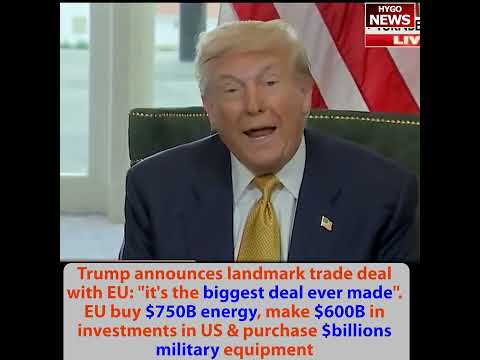
 Trump landmark EU trade deal: biggest deal ever, EU buy $750B energy, $600B invest & purchase
Trump landmark EU trade deal: biggest deal ever, EU buy $750B energy, $600B invest & purchase
President Trump announced from Scotland what he called “the biggest deal ever made” — a landmark trade agreement with the European Union, negotiated with European Commission President Ursula von der Leyen. The terms: the EU buys $750 billion of U.S. energy, makes an additional $600 billion in U.S. investment, opens European countries at zero tariff to U.S. goods, and commits to purchase “hundreds of billions of dollars worth of military equipment” from U.S. defense firms. In exchange, U.S. tariffs on EU goods are set at a flat 15% — across automobiles and everything else. “I think it’s the biggest deal ever made.” Trump also confirmed the NATO 5% defense-spending target holds. The EU deal caps an extraordinary week: Japan, Indonesia, Philippines, and now the EU, with the broader Pacific and transatlantic trade architectures being reshaped within a single week.
”$750 Billion Worth of Energy”
Trump’s first specific. “European Union is going to agree to purchase from the United States $750 billion worth of energy, $750 billion worth of energy.”
The repetition of “$750 billion worth of energy” is Trump’s rhetorical insistence on the number. That is a massive energy-purchase commitment. For context: Europe’s total annual energy imports are approximately $400-500 billion across all sources. A $750 billion EU commitment to U.S. energy represents essentially the EU shifting a majority share of its energy imports from Russian, Middle Eastern, and African sources to American LNG and crude oil.
That shift is strategic beyond the commercial terms. For decades, European energy security has been compromised by dependence on Russian gas and oil. The 2022 invasion of Ukraine exposed that dependence as a critical vulnerability. Europe has been trying to diversify its sources. The new deal with the U.S. consolidates that diversification around American supply.
”$600 Billion More”
“They are going to agree to invest into the United States $600 billion more than they’re investing already. So they’re investing a large amount of money, you know what that amount of money is. It’s very substantial, but they’re going to invest an additional $600 billion.”
$600 billion in additional EU investment into the U.S. That is on top of existing EU-U.S. investment flows, which are already large ($2-3 trillion in cumulative European-owned U.S. assets across direct investment, portfolio investment, and real estate).
The additional $600 billion could take many forms. European auto manufacturers expanding U.S. production (BMW, Mercedes, VW already have U.S. facilities). European pharmaceutical companies building U.S. manufacturing. European industrial firms relocating production. European financial institutions expanding U.S. operations. European private equity and sovereign funds purchasing U.S. assets.
Each of those categories generates American jobs, tax revenue, and technology transfer. At $600 billion scale, the cumulative economic impact over the coming years is substantial.
”Zero Tariff” for U.S. Goods
“They’re agreeing to open up their countries to trade at zero tariff. So that’s a very big factor. Opening up their countries, all of the countries will be opened up to trade with the United States at zero tariff.”
Zero tariff on U.S. goods entering EU countries. That is the specific market-access provision. For U.S. exporters, this removes the tariff barrier that has been a long-standing complaint.
For specific industries this matters enormously:
- Agriculture: U.S. beef, pork, dairy, grain, and GMO crops have faced both tariff and non-tariff barriers in Europe. Zero-tariff access is the first step toward market penetration.
- Industrial goods: U.S. machinery, construction equipment, chemicals, and manufactured products face EU tariffs that have limited competitiveness. Zero-tariff access restores competitive pricing.
- Technology products: U.S. AI systems, software, semiconductors, and related tech products can enter European markets without tariff friction.
Whether the “all countries … at zero tariff” framing holds operationally is the implementation question. The EU negotiates as a bloc on most trade matters. Individual member states may seek carve-outs. The specific implementation mechanism across the 27 member states will define how quickly American exporters can realize the zero-tariff benefit.
”Vast Amount of Military Equipment”
“And they’re agreeing to purchase a vast amount of military equipment. We don’t know what that number is, but it’s the good news is we make the best military equipment in the world.”
The military-purchase commitment is unspecified but substantial — “hundreds of billions of dollars.” European defense budgets are expanding under the 5% of GDP NATO commitment. American defense equipment — F-35s, Patriots, HIMARS, naval vessels, drones, electronic warfare systems — is the likely beneficiary of the expanded European defense spending.
“So sort of you have to do that, I mean, until somebody tops us, which is not going to happen. We’re way ahead of every other country in terms of the quality of the military equipment.”
American defense product quality as the competitive advantage. European militaries that want the best equipment have to buy American. The European defense industrial base — Airbus, BAE Systems, Rheinmetall, Leonardo — produces competitive products in specific categories, but American defense firms dominate frontier capabilities.
“You saw that recently in Iran and you see that. Unfortunately, you see that often for all the wrong reasons, right?”
The Iran strike reference. American precision munitions, delivery systems, and targeting demonstrated capabilities that no European equivalent could match. The “all the wrong reasons” framing acknowledges that demonstrating military capability typically happens in conflict — not in peacetime demonstrations.
The 15% Tariff
“We are agreeing that the tariff straight across for automobiles and everything else will be a straight across tariff of 15%. So we have a tariff of 15%.”
15% U.S. tariff on EU goods. “Straight across” — no categorical exceptions. Automobiles, chemicals, machinery, wine, pharmaceuticals, anything European entering the U.S. market pays 15%.
That rate is lower than the escalation levels Trump had threatened (30%+ on specific categories) but higher than the near-zero rates that had applied to most EU goods pre-tariff. For European exporters, the 15% is a meaningful cost, but manageable — the market-access value of the U.S. market exceeds the 15% friction.
”Essentially Closed … Now It’s Open”
“We have the opening up of all of the European countries, which I think I could say were essentially closed. I mean, you weren’t exactly taking our orders. You weren’t exactly taking our agriculture. And then you would have smaller things. But for the most part, it was closed. And now it’s open.”
“Essentially closed” is Trump’s characterization of the pre-deal European market. The characterization is substantively accurate for agriculture. EU agricultural protectionism — via tariffs, non-tariff barriers, regulatory requirements, and GMO restrictions — has effectively kept most U.S. agricultural products out of European consumer markets for decades.
“Now it’s open” is the reversal. The agricultural market-access provisions in the deal represent the biggest single shift for U.S. farmers in a generation.
“It’s open for our companies to go in and do a good job with. And I think you’ll like them. I think you’ll like it.”
The Military Number Forward
“We will very importantly, they’ll be investing a lot of money, but the military is a big number. But that’s one number we’re not determining. It’s going to be whatever it is, but they’re going to be purchasing hundreds of billions of dollars worth of military equipment.”
“Hundreds of billions” of defense purchases. The specific allocation — which systems, which timelines, which countries within the EU prioritizing which procurements — is still to be determined. But the floor is set at “hundreds of billions.”
The European defense build-up serves multiple administration objectives: it shifts defense burden to Europe, provides revenue to American defense manufacturers, and strengthens the transatlantic deterrent posture against Russia and China.
”The Biggest Deal Ever Made”
“They’re very important. They’re going to purchase $750 billion worth of energy. So that’s going to be great. And $600 billion worth of investments into the United States over and above what they have. So and I think that basically concludes the deal. I mean, those are the main factors.”
$750 billion energy + $600 billion investment + hundreds of billions in defense + zero-tariff market access. The aggregate is in the $1.5-2 trillion range of commercial terms, across multiple years.
“I don’t think there are too many other factors other than we’re going to get along great.”
Trump’s personal assessment: the deal cements the U.S.-EU relationship on favorable terms for the U.S. The combination of commercial wins, strategic alignment, and personal chemistry with von der Leyen produces a strong forward posture.
NATO 5%
“Do we have a great relationship now with NATO, which is largely the same? I mean, not exactly, but pretty, pretty close, right? Largely. NATO, as you know, they’re going up to 5% from 3 from 2%. And the relationship is very strong with NATO.”
The NATO 5% defense spending target stands. The relationship is “very strong.” The EU trade deal is in addition to — not a substitute for — the NATO commitments.
“So I just want to congratulate you. I think it’s I think it’s great that we made a deal today instead of playing games and maybe not making a deal at all.”
The closing line carries a specific warning within it. “Instead of playing games and maybe not making a deal at all.” The alternative to the signed deal was escalation — tariff escalation, trade war, transatlantic commercial damage. Both sides pulled back from that. The deal prevents the alternative.
“I think it’s I’m going to let you say, but I think it’s the biggest deal ever made. Thank you very much.”
The Week’s Trade Achievement
The EU deal caps a week of trade agreements. Japan, Indonesia, Philippines, now the EU. Four major bilateral or regional agreements in a single week. The scale is unprecedented in modern American trade diplomacy.
Taken together, these deals represent a systematic reshaping of American trade architecture. Asia-Pacific agreements (Japan, Indonesia, Philippines) open the major growth markets of the Indo-Pacific to American exports. The EU deal opens the largest single developed-economy market. The cumulative access is extraordinary.
Whether the deals hold and produce the promised economic lifts is the implementation question. Deals signed in a single week will take months to translate into actual capital flows, commodity shipments, and investment projects. But the framework is set. The trajectory is clear.
Key Takeaways
- Trump announced EU trade deal from Scotland with Ursula von der Leyen: “I think it’s the biggest deal ever made.”
- Terms: EU buys $750 billion in U.S. energy, $600 billion in additional U.S. investment, “hundreds of billions” in military equipment, zero tariffs on U.S. exports to Europe.
- U.S. tariff on EU goods set at flat 15% “straight across” — including automobiles and all other categories.
- Trump: European markets “were essentially closed” — now “open for our companies to go in and do a good job with.”
- NATO 5% defense spending target confirmed: “Going up to 5% from 3 from 2% … the relationship is very strong with NATO.”