 HYGO News
 Trump: Jerome Powell's been very bad interest rate, $2.5B Fed building; disappointed with Putin
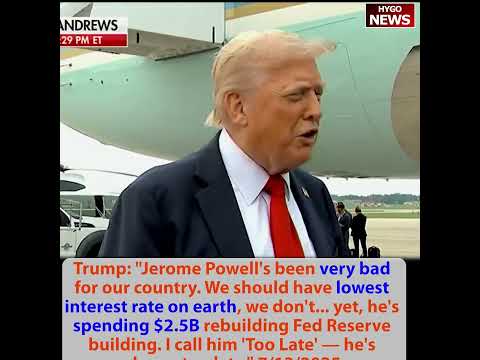
Trump: Jerome Powell’s been very bad interest rate, $2.5B Fed building; disappointed with Putin
President Trump delivered a compressed, unusually quantified case against Federal Reserve Chair Jerome Powell — “I think if Jerome Powell stepped down it would be a great thing … I call him ‘Too Late’ — he’s always too late” — while pressing on the $2.5 billion Federal Reserve building renovation and accusing Powell of costing the country “approximately a trillion dollars” through holdout interest-rate policy. On Russia, he voiced direct disappointment with Vladimir Putin: “he’ll talk so beautifully and then he’ll bomb people at night. We don’t like that.” On the Bongino situation: “I spoke to him today. Dan Bongino is a very good guy … He sounded terrific, actually.” And on Ukraine, he restated the new financing arrangement in plain language: “We basically are going to send them various pieces of very sophisticated military. And they’re going to pay us 100% for them … The European Union is paying for it. We’re not paying anything for it.” In one interview, the president revised the economic, diplomatic, and personnel news of the moment.
”Jerome Powell’s Been Very Bad for Our Country”
Trump’s critique of the Fed chair opened with the hope, stated directly. “I think if Jerome Powell stepped down it would be a great thing. I don’t know that he’s going to but he should. Jerome Powell’s been very bad for our country.”
The presidency and the Fed are, institutionally, meant to operate at arm’s length. Presidents are not supposed to call publicly for the Fed chair to resign. Trump has shredded that norm. He has done it before, he is doing it now, and he has made clear he intends to keep doing it.
“We should have the lowest interest rate on earth and we don’t.” That is the economic claim: that an economy with the underlying strength Trump is projecting ought to be able to sustain rates at or near zero, and that the Fed’s decision to hold rates higher has no economic justification. “He just refuses to do it.”
The $2.5 Billion Fed Building
The president then pivoted to the Fed’s headquarters renovation — the same $2.5 billion project OMB Director Russ Vought has been hammering from a different angle. “And yet he’s spending two and a half billion dollars rebuilding the Fed, the Federal Reserve Building. And I don’t know what he knows about building. You talk about cost overrun.”
The combination — Powell won’t cut rates, but Powell is spending $2.5 billion on a new building — is the rhetorical pincer. Whatever Powell’s technical monetary-policy argument, the optics of a central bank in the middle of a $2.5 billion construction project are difficult to defend in a populist frame.
“So he got this approved and he started the work during the Biden administration. And he doesn’t look like the kind of a guy, frankly, that wants to spend two and a half billion dollars. It’s very interesting.”
That line is intentionally ambiguous. “Doesn’t look like the kind of a guy” is either a compliment (Powell presents as frugal) or an insinuation (the frugal appearance masks the $2.5 billion spend). Trump leaves the reader to resolve the ambiguity.
”Out of 71 Economists, One Person, Me”
Trump then delivered his favorite economic brag in a new form. “Out of 71 economists, one person, me, and then one other person, I think from Wharton, got it right. And the others were all wrong in terms of the success of our country this quickly. We have no inflation. We have cash pouring in.”
“It was me and somebody else then.” The reference is to some published economic forecast exercise — likely a consensus-of-economists survey — in which Trump and one economist (the “other person from Wharton” may be Wharton’s Jeremy Siegel or another Wharton-affiliated economist) were the positive outliers on growth while the consensus predicted slower recovery, persistent inflation, or recession.
“I can tell you, I don’t need 5,000 people working for me behind the scenes like Jerome Powell to tell him what he should say once a month. Because they got it wrong. The Fed got it wrong.”
The Fed employs a large staff of economists, analysts, and researchers — the “5,000 people” figure is Trump’s rounding. His argument is that institutional size has not translated into forecasting accuracy, and that his own judgment, unaided by such a staff, has outperformed the institutional consensus.
”Every Point Costs Us $360 Billion”
Then the quantified case for rate cuts. “I call him too late. He’s always too late. Every point costs us $360 billion. Think of that. And we should be three points. That’s almost a trillion dollars. Approximately a trillion dollars less. We should be just with the signing of a piece of paper.”
The arithmetic: one percentage point of federal borrowing cost, applied against the stock of federal debt, produces approximately $360 billion in annual interest expense at current debt levels. Three points — roughly the distance from current Fed policy rates down to what Trump considers appropriate — would save approximately a trillion dollars in annual federal interest costs.
The “trillion dollars less” framing is powerful because it ties monetary policy directly to the federal budget deficit. Every point Powell refuses to cut is, in Trump’s framing, a hundreds-of-billions-of-dollars-per-year transfer from taxpayers to bondholders. That framing will land with voters who do not follow Fed policy but understand that the government owes an enormous amount of money and pays interest on all of it.
”Too Late”
Trump’s nickname for Powell — “Too Late” — has been his running label for multiple cycles of Fed decisions. “I call him too late. He’s always too late.” The argument is that Powell waits too long to make the right call, and that by the time the Fed acts, the economic moment for acting has already passed.
“So we’ll see what happens. I mean, you’re telling me he’s going to quit. I hope he quits. I don’t know that he’s going to quit. But he should quit because he’s been very bad for the country.”
“I hope he quits” is a statement from a president about a sitting Fed chair. It is extraordinary, and the administration’s critics have repeatedly warned that it undermines the Fed’s independence. Whether the critique is justified on norms grounds, the political effect is that Powell is operating under unprecedented sustained presidential pressure.
Russia: “I Am Very Disappointed With President Putin”
Asked about potential sanctions on Russia, Trump hedged on timing but elaborated on his personal assessment of the Russian president. “Are you going to be announcing sanctions on Russia tomorrow?” the reporter asked.
“We’re going to see what we will see tomorrow, okay? We have the secretary-general, as you know, Europe is, announced sanctions. But I am very disappointed with President Putin.”
Then the line that conveyed something real about where the Trump-Putin dynamic sits. “I thought he was somebody that meant what he said. And he’ll talk so beautifully and then he’ll bomb people at night. We don’t like that.”
“Talks beautifully and bombs at night” is a vivid, specific complaint. Trump has historically been more cautious in direct personal criticism of Putin. The willingness to voice disappointment publicly — at the presidential level, on camera — is a marker that the American posture toward Russia under Trump’s second term is hardening.
The Bongino Check-In
Trump also addressed the personnel question around FBI Deputy Director Dan Bongino, who has been the subject of speculation about friction inside the FBI’s senior leadership. “You’re going to have to be at the ice rink, honey,” Trump said in what appears to be a private aside to Melania. “Oh, I think so. I did. I spoke to him today.”
“Dan Bongino is a very good guy. I’ve done him a long time. I’ve done his show many, many times. And he sounded terrific, actually. No, I think he’s in good shape.”
The “in good shape” framing is the administration pushing back against reports that Bongino’s position was uncertain. Trump is publicly vouching for a senior appointee in a way that, inside the Beltway, tends to stabilize a shaky tenure — or at least delay its destabilization.
The Ukraine Financing Arrangement
Trump then restated the new NATO-Ukraine arrangement in the most direct language he has used. “I’m going to have a meeting with the secretary-general that’s coming in tomorrow. But we basically are going to send them various pieces of very sophisticated military. And they’re going to pay us 100% for them. And that’s the way we want it.”
“100% for them” is the key phrase. The U.S. ships the equipment. NATO — which, for practical purposes, means the European Union members and the UK — pays the full cost. American defense manufacturers deliver to a buyer that is not the American taxpayer.
“And we’ve been trying to get that again. I don’t think Biden ever asked what. We’re in for about 350 billion. Europe is in for 100 billion. That’s a lot of money, 100. But they should be in actually for more than us.”
“$350 billion” is the cumulative U.S. commitment to Ukraine since 2022, encompassing weapons, humanitarian aid, and economic support. “$100 billion” is the combined European commitment — still substantial, but less than one-third of the U.S. outlay. Trump’s argument: given that the war is on Europe’s doorstep, European contributions should exceed, not lag, American ones.
“So as we send equipment, they’re going to reimburse us for that equipment. Doesn’t that sound good? That’s the way it should have been a long time ago.”
The Patriot Question
Ukraine has been asking for more Patriot batteries. Trump confirmed they are coming — on the new terms. “I haven’t agreed on the number yet, but they’re going to have some because they do need protection. But the European Union is paying for it. We’re not paying anything for it. But we will send it. It’ll be business for us.”
“It’ll be business for us” is the framing. Weapons shipments become a commercial transaction rather than foreign aid. The American defense industrial base gets paid by the European Union for equipment that reaches Ukraine. American taxpayers are not the source of the money. American workers at Raytheon, Lockheed, and their suppliers are the direct economic beneficiaries.
“We will send them patriots, which they desperately need.” The desperately-need framing acknowledges that Ukraine’s air defense is under active strain — missile strikes on Kyiv and other cities have become more frequent — and that Patriot batteries are the most capable interceptor in the available inventory.
Putin: “Surprised a Lot of People”
Trump closed the Russia portion with a repeated note of disappointment. “Because Putin really surprised a lot of people. He talks nice and then he bombs everybody in the evening. But there’s a little bit of a problem there. I don’t like it.”
“Surprised a lot of people” is diplomat-speak for “I misjudged him.” Trump’s willingness to publicly name that misjudgment — even in an oblique, third-person phrasing — is a marker. Earlier in the term, the administration’s posture toward Russia was softer, with expectations that Trump’s personal rapport with Putin could produce diplomatic results. The current posture is harder. Europe is issuing sanctions. The U.S. is signaling sanctions may follow. Patriots are being shipped. Trump is calling the Russian president disappointing on camera.
A Day of Three Pressure Points
The interview hit three distinct pressure points simultaneously. Powell: institutional pressure on the Fed via rhetoric, the Versailles framing from OMB, and the trillion-dollar interest-cost argument. Putin: diplomatic pressure via presidential disappointment, European sanctions, and Patriot shipments. Ukraine financing: structural pressure on Europe to pay the full cost of U.S.-made weapons.
Each pressure point has its own logic. Each is calibrated to a specific audience. Taken together, they represent the administration’s theory of how to operate simultaneously on domestic monetary policy, transatlantic defense financing, and Russia policy — with the president personally serving as the voice applying the pressure.
Key Takeaways
- Trump called Powell’s tenure “very bad for our country,” said “I hope he quits,” and argued every percentage point of interest-rate policy costs the country $360 billion — meaning the Fed’s current stance is “approximately a trillion dollars” in excess interest expense.
- Trump linked the Fed’s rate posture to its $2.5 billion headquarters renovation, noting Powell “got this approved and started the work during the Biden administration” despite being someone who “doesn’t look like the kind of a guy … that wants to spend two and a half billion dollars.”
- On Putin: “I am very disappointed … he’ll talk so beautifully and then he’ll bomb people at night. We don’t like that” — and European sanctions have been announced with potential U.S. action signaled.
- Trump personally vouched for Dan Bongino: “I spoke to him today. Dan Bongino is a very good guy … he sounded terrific, actually. No, I think he’s in good shape.”
- On Ukraine weapons: “The European Union is paying for it. We’re not paying anything for it … it’ll be business for us” — with Patriots going because Ukraine “desperately” needs air defense.