 HYGO News
 Trump: issue dividend $2K & lower our debt; BBB: No Tax on Tips/Overtime tremendous goodies; Dem
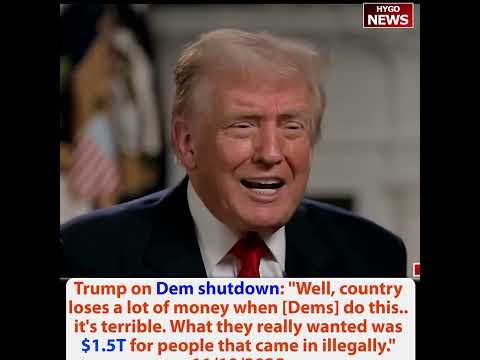
Trump: issue dividend $2K & lower our debt; BBB: No Tax on Tips/Overtime tremendous goodies; Dem
President Trump announced a significant new economic policy: issuing a $2,000 dividend directly to middle-income and lower-income Americans from tariff revenue, with the remainder going to lower the national debt. Trump emphasized the Supreme Court’s pending IEEPA tariff case — if reversed, it would be a “national security problem” given trillions in investment and revenue flowing from tariffs. Trump detailed additional Big Beautiful Bill benefits: no tax on tips, no tax on Social Security, no tax on overtime, and car loan interest deductions for the first time — a benefit traditionally only available to wealthy taxpayers. On the shutdown, Trump reiterated Democrats had wanted “$1.5 trillion for people that came in illegally” including healthcare for 11,888 murderers (many who killed multiple people) — which Republicans refused. Trump confirmed the deal approaching resolution: “We have support from enough Democrats, and we’re going to be opening up our country.” Trump: “We’re going to issue a dividend to our middle income people and lower income people of about $2,000. And we’re going to use the remaining tariffs to lower our debt.” On SCOTUS: “If that were ever reversed, it would be a disaster. Frankly, it would be a national security problem for our country. And nobody thinks it’s going to be reversed.” On shutdown demand: “They wanted one and a half trillion for health care from people that were in some cases 11,888 exactly murderers, many of whom murdered more than one person.”
$2,000 Dividend
Trump opened with a major economic announcement. “We’re going to issue a dividend to our middle income people and lower income people of about $2,000.”
This is a significant new policy. Tariff revenue, originally framed as deficit reduction, now has an additional distributive purpose: direct cash transfers to middle- and lower-income Americans.
The framework is distributionally progressive:
- High-income Americans excluded (or reduced benefit)
- Middle-income Americans included
- Lower-income Americans included
- $2,000 per person or family (details not specified)
Scale estimation:
- If per household, ~100 million households receive payment
- Total outlay: ~$200 billion
- Tariff revenue: ~$300-400 billion annually
- Remaining tariff revenue: ~$100-200 billion for debt reduction
”Lower Our Debt”
“And we’re going to use the remaining tariffs to lower our debt. We’re going to be lowering our debt, which is a national security thing.”
Trump’s framework: debt reduction is national security. High debt weakens U.S. strategic position — Chinese and other creditors gain leverage, higher interest costs reduce military and programmatic resources, currency stability threatened, credit rating risk.
The combination of direct payments + debt reduction represents using tariff revenue to simultaneously:
- Reduce distributional inequality (direct payments)
- Strengthen national fiscal position (debt reduction)
- Build political support (cash in hand for voters)
SCOTUS Stakes
“The numbers were reported so incorrectly. The real numbers are trillions of dollars have been taken in or gotten in terms of investment from the tariffs.”
Trump’s framework: media has underreported tariff success. Real numbers are trillions, not the lower figures reported.
“And so if that were ever reversed, it would be a disaster. Frankly, it would be a national security problem for our country. And nobody thinks it’s going to be reversed.”
The stakes of the Supreme Court case are enormous:
- Trillions in tariff revenue
- Trillions in investment commitments (driven by tariff-induced reshoring)
- National security implications of supply chain resilience
- Political credibility of Trump’s core policy
“I think we had a very good court case. As you know, it’s before the Supreme Court right now. But if that were ever reversed, you know, people saying, oh, it’s a billion dollars.”
Trump noted media downplaying the stakes. Some characterize the SCOTUS case as $1 billion matter. Trump’s framework: it’s trillions, not billions.
“Some people said, oh, it’s too big. Well, that obviously we can handle very easily.”
Administration had contingency planning. Even if SCOTUS ruled against IEEPA specifically, alternative authorities (Section 232, 301, 122) would provide alternative tariff frameworks.
BBB Goodies
“Don’t forget when we passed the great big beautiful bill, which gives you tremendous middle income tax benefits and tremendous.”
Trump pivoted to the One Big Beautiful Bill (OBBB) Act signed July 4, 2025.
“It gives so much to everybody. Think of it. No tax on tips, no tax on social security, and no tax very importantly on overtime. If you work overtime, you don’t have to pay tax. So many other things.”
The OBBB tax cut framework:
- No tax on tips (service industry workers, ~4 million people)
- No tax on Social Security (retirees, ~70 million)
- No tax on overtime (hourly workers, ~80 million)
- Additional provisions
Car Loan Interest
“It gives you deduction if you buy a car, you borrow money, you put a loan on a car, you’re allowed to deduct the interest. That’s never happened in our country before.”
Car loan interest deduction is a genuine novelty. Historically:
- Home mortgage interest: deductible (for wealthy with itemized returns)
- Student loan interest: limited deduction
- Credit card interest: not deductible
- Auto loan interest: not deductible
“You know, that’s always been for the richer people. They’re allowed to take deductions. Now you can deduct interest on a car.”
Trump’s populist framework: wealthy had deductions (home mortgages, investment interest). Working and middle-class Americans didn’t benefit. Adding auto loan interest deduction extends the benefit to everyone who buys a car with a loan.
“So we have tremendous goodies in there. You know, they like to try and disparage it. Oh, it’s the greatest bill ever passed in the history of a country. That’s why we did it all in one."
"Four Years of Goodies”
“It’s four years worth of goodies, and it’s largely for jobs and for the middle class and for security.”
Trump’s framework: OBBB condenses four years of Republican priorities into one major legislation. Not piecemeal reform — comprehensive policy package.
“Largely for jobs and for the middle class and for security.”
The three pillars:
- Jobs (tax cuts supporting business investment and wages)
- Middle class (direct tax relief for working Americans)
- Security (border provisions, defense, energy)
Shutdown Cost
“Well, the country loses a lot of money when they do this and they’re not getting much, but nobody gets a lot. But it’s terrible.”
Trump acknowledged shutdown damage to Americans. Both sides in shutdown lose — nobody gains substantially.
”$1.5 Trillion for Illegals”
“What they really wanted was one and a half trillion dollars for people that came in illegally, people that came in through and out of prisons. You know, we had like Venezuela, they empty, they dumped their prisons into a…”
The Democratic demand reframed: $1.5 trillion in healthcare for illegal immigrants (over budget window), specifically including those released from foreign prisons.
“But so that was all exaggerated, right? Oh, yeah, I know it’s exaggerated.”
Whisper rendered confusingly. Trump likely said the claim wasn’t exaggerated — the $1.5 trillion figure accurately represents the Democratic demand over budget window.
11,888 Murderers
“They wanted one and a half trillion for health care from people that were in some cases 11,888 exactly murderers, many of whom murdered more than one person.”
The 11,888 figure: identified murderers among illegal immigrants in the U.S. Tom Homan’s ICE had been tracking these cases.
“Many of whom murdered more than one person” = repeat murderers, multi-victim killers. Serial offenders, gang members, cartel operators.
“So they came in to a country, they poured into a country, and they want to take care of it.”
Democrats’ position: provide healthcare to these populations.
“We’re trying to get them out because we don’t want 11,000 murderers in our country. You don’t want it. Nobody wants it.”
Trump’s framework: anyone reasonable agrees 11,000+ murderers shouldn’t remain in the country. Deport them. The dispute isn’t whether they should be removed — it’s whether they should receive healthcare before removal.
Drug Dealers Too
“And we have drug dealers and we have everything else that they want to make sure they get good health care. That’s not what our country is about. And it would have hurt other people’s health care.”
Trump’s framework: providing healthcare to illegal criminal populations:
- Rewards illegal behavior
- Consumes finite healthcare resources
- Reduces healthcare availability for citizens
- Isn’t what America is “about”
Deal Announcement
“You mentioned to senators that are here, Mr. President, do you personally approve of the deal that’s happening right now, Capitol Little and the other?”
Reporter asked about the pending Capitol Hill deal.
“Well, it depends what deal we’re talking about. But if it’s a deal I heard about, that’s certainly, you know, they want to change the deal a little bit. But I would say so.”
Trump’s cautious endorsement: assuming the deal he knows about, he supports it. There had been late modifications.
“I think based on everything I’m hearing, they haven’t changed anything. And we have support from enough Democrats. And we’re going to be opening up our country. It’s too bad it was closed, but we’ll be opening up our country very quickly.”
The confirmation:
- Democrats haven’t changed the deal substantially
- Enough Democratic votes to pass
- Government reopening soon
Significance
The day’s announcements represented a policy vision shift:
-
$2,000 dividend: Tariff revenue redistribution directly to Americans. Political master stroke — voters receive cash directly traceable to Trump’s tariff policy. Makes tariff reversal (if SCOTUS rules against) immediately visible as money removed from Americans’ pockets.
-
OBBB recap: Continued emphasis on working-class tax benefits. Tips, overtime, Social Security, car loan interest — all directly beneficial to typical Americans.
-
Shutdown resolution: Democratic demands for $1.5 trillion in illegal alien healthcare clearly articulated and rejected. The 11,888 murderer figure is politically devastating.
-
Deal imminent: Trump confirming sufficient Democratic support. Shutdown ending within days.
The framework repositions Trump’s governance. Not just tariffs as tools for trade deals — tariffs as revenue source for direct wealth transfer to citizens and debt reduction. Not just tax cuts — working-class specific benefits inaccessible to previous generations of workers. Not just border security — but explicit rejection of funding healthcare for illegal alien murderers.
Each policy lever targets Trump’s coalition: working class, middle class, older Americans, legal immigrants. Against: upper-income Americans, illegal immigrants, insurance companies profiting from subsidies.
Key Takeaways
- Trump on $2,000 dividend: “We’re going to issue a dividend to our middle income people and lower income people of about $2,000. And we’re going to use the remaining tariffs to lower our debt.”
- Trump on SCOTUS stakes: “If that were ever reversed, it would be a disaster. Frankly, it would be a national security problem for our country. And nobody thinks it’s going to be reversed … This is trillions of dollars we’re talking about in terms of the tariff income and all the investment income.”
- Trump on OBBB: “No tax on tips, no tax on social security, and no tax very importantly on overtime … Now you can deduct interest on a car. So we have tremendous goodies in there.”
- Trump on shutdown demand: “They wanted one and a half trillion for health care from people that were in some cases 11,888 exactly murderers, many of whom murdered more than one person … We’re trying to get them out because we don’t want 11,000 murderers in our country.”
- Trump on deal: “Well, it depends what deal we’re talking about … But I would say so … We have support from enough Democrats. And we’re going to be opening up our country. It’s too bad it was closed, but we’ll be opening up our country very quickly.”