 HYGO News
 Trump: Iran is not winning war; trade talks with Canada, Trump welcomed by PM Carney to G7 Summit
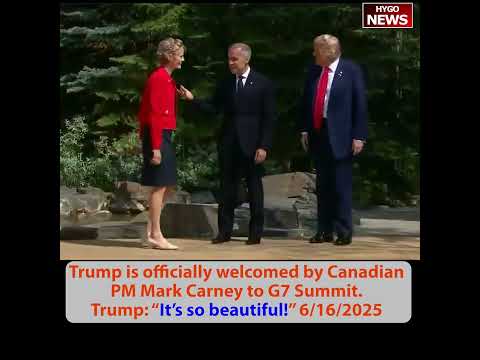
Trump: Iran is not winning war; trade talks with Canada, Trump welcomed by PM Carney to G7 Summit
President Trump arrived at the G7 Summit in Kananaskis, Alberta, and used his first session with reporters to make two significant statements: that Iran is “not winning this war” and should come to the table immediately, and that his negotiations with Canadian Prime Minister Mark Carney over trade are within reach of a deal. The Iran statement is the more consequential in strategic terms, signaling that the administration views the Israel-Iran escalation as one in which American diplomatic pressure is aimed at producing Iranian concession. The Canada statement reveals the particular compact Trump intends to build with Carney — one in which Trump’s preferred tariff instrument will be reconciled with Carney’s more complex framework. The G7 backdrop, with its own tensions over trade, climate, and Russia, gives the summit additional weight. This article works through the transcript and situates both statements in their broader contexts.
”Iran Is Not Winning This War”
The question to Trump was direct. “Have you heard any signals or seen any messages from intermediaries that Iran wishes to de-escalate the conflict?”
His answer was direct. “Yeah.”
“What have you heard from the Iranians?”
“They’d like to talk, but they should have done that before. I had 60 days and they had 60 days and on the 61st day I said, we don’t have a deal. They have to make a deal. It’s painful for both parties, but I’d say Iran is not winning this war. They should talk and they should talk immediately before it’s too late.”
The 60-Day Window
The reference to a “60-day” window is significant. Trump is describing a specific diplomatic process that unfolded over those 60 days — presumably a negotiation period with terms and conditions that, from the administration’s perspective, were communicated to Tehran. The expiration of that window without a deal is the point at which, Trump says, he concluded negotiation had failed and a different posture was required.
The framing — “they had 60 days” — places agency on Iran. Tehran was given the opportunity. Tehran did not take it. The subsequent escalation, in Trump’s telling, is the consequence of Iranian refusal to engage when the engagement was available.
”Painful For Both Parties”
Trump’s characterization of the current situation — “painful for both parties” — is a rare acknowledgment of cost. Usually, leaders of engaged states either assert their side is winning or insist on the justice of their cause. Trump is conceding, publicly, that the conflict is painful for Americans as well as for Iranians.
The concession is not weakness. It is the setup for the demand that follows. If the conflict is painful for both sides, and if Iran is not winning, then Iran’s rational course is to come to the table. Trump is constructing a logic in which Iranian leadership, evaluating the situation coldly, should conclude that continued resistance produces worse outcomes than negotiation.
”Before It’s Too Late”
“They should talk and they should talk immediately before it’s too late.” The phrase “before it’s too late” is Trump’s way of signaling that the window for negotiation is not indefinite. There are actions — the specifics of which are likely Israel-driven — that could make subsequent negotiation either irrelevant or impossible.
The warning is consistent with the administration’s earlier statement that Iran “can’t have a nuclear weapon. We’re not going to allow that.” The combination of the two statements — that Iran cannot have a nuclear weapon, and that it should negotiate before it’s too late — implies that there are concrete actions in preparation if negotiation does not produce results.
The Broader Strategic Context
The Israel-Iran escalation that forms the backdrop to these statements has been the defining international story of the summer. Israel has conducted a series of targeted strikes on Iranian nuclear infrastructure. Iran has retaliated with missile and drone barrages. The exchange has tested every regional actor’s willingness to absorb costs and has pulled the United States into an active adjudicating role.
Trump’s posture — public support for Israel’s right to defend itself, public demand that Iran negotiate, public warning that time is running out — is designed to produce the Iranian concession that sustained military operations so far have not. If it works, the administration will have brokered a de-escalation. If it does not, the alternative paths all involve expanded conflict.
The Canada Trade Talks
The second substantive topic at the press stakeout was the state of trade negotiations with Canada. The reporter: “What is holding up a deal with Canada from your perspective?”
Trump’s response was measured and, for Trump, unusually respectful of the counterparty. “It’s not so much holding up. I think we have different concepts. I have a tariff concept. Mark has a different concept, which is something that some people like, but we’re going to see if we can get to the bottom of it today."
"I’m A Tariff Person”
Trump then offered a reveal about his own negotiating temperament. “I’m a tariff person. I’ve always been a tariff. It’s simple, it’s easy, it’s precise. This goes very quickly.”
The preference for tariffs as the instrument of trade policy is Trump’s signature. Tariffs are, by design, simple: a specified percentage applied to a specified category of imports. They take effect quickly. Their impact is measurable in customs receipts. And they can be adjusted or removed unilaterally, without requiring multilateral institutional processes.
The implicit critique in Trump’s framing is of more complex trade arrangements — free trade agreements, regulatory harmonization frameworks, dispute resolution mechanisms — that, in his view, take years to negotiate, produce opaque results, and reward lawyers and lobbyists more than workers.
Carney’s “More Complex Idea”
Trump’s characterization of Carney’s position was polite but candid. “I think Mark has a more complex idea, but also very good.”
“More complex” is the diagnosis. Carney, a former central banker with a background in institutional economics, is likely offering a framework that incorporates exchange rate considerations, tax policy harmonization, regulatory cooperation, or other elements that would produce a more sophisticated deal structure than a flat tariff.
The concession — “but also very good” — is Trump’s acknowledgment that intellectual sophistication is not an obstacle to a deal. The question is whether the sophistication can be reconciled with the simplicity Trump prefers. “So we’re going to look at both and we’re going to see what we’re going to come out with something."
"Achievable Within Days, Within Weeks”
A reporter pressed on the timeline. “Mr. President, I think the deal is achievable within days, within weeks. Is there that kind of runway?”
Trump: “Yeah, it’s achievable. Both parties have to agree.”
The timeline is significant. “Within days, within weeks” is a compressed negotiation schedule by historical standards. Comprehensive U.S.-Canada trade adjustments have, in past decades, taken months or years. Trump is indicating that the current round could wrap in the shortest timeframes the two countries have managed.
The Carney Relationship
The political relationship between Trump and Carney is worth pause. Carney, elected Prime Minister earlier in the year, arrived in office after an economic crisis and a controversy-filled Liberal Party leadership campaign. He is not a politician from the Trudeau mold. He is a technocrat with a career at the Bank of Canada and the Bank of England, and his approach to international economic relationships is grounded in institutional familiarity.
The meeting at Kananaskis marks one of their first sustained in-person negotiations. Carney’s challenge is to represent Canadian interests credibly while not allowing the relationship to devolve into the kind of public posturing that made the first-term Trump-Trudeau interactions difficult. Trump’s public framing — “Mark has a different concept” — respects Carney enough to name him by first name and to acknowledge the intellectual substance of his position.
”It’s So Beautiful!”
Trump’s reaction to the Kananaskis setting produced the evening’s softest moment. “It’s so beautiful!” the president said, taking in the views of the Canadian Rockies.
Kananaskis is one of the most spectacular natural settings in North America. The choice of Kananaskis as the G7 venue was Carney’s — a deliberate decision to showcase Canadian landscapes in a way that might shape the mood of negotiations. Trump’s response, expressed as aesthetic appreciation, suggests the tactic worked.
The Carney Welcome
The video also captures the formal welcome. Carney, standing on Canadian soil, received Trump with protocol appropriate to a G7 host. The formal welcome is a political moment regardless of underlying substance. Canada is Trump’s northern neighbor, his second-largest trading partner, and a NATO ally. The public welcome — a handshake, an escort, a walk between the two leaders — is a ceremonial gesture that the diplomatic establishment values even when the underlying disputes remain.
Kananaskis As A Substantive Setting
G7 summits have, over decades, become major venues for the informal diplomacy that drives international relations. The formal communique, typically negotiated by senior diplomatic staff in advance, is less important than the bilateral meetings that happen at the margins. Trump’s G7 at Kananaskis is likely to feature meetings with the leaders of the U.K., France, Germany, Italy, Japan, and Canada — each a separate negotiating track that could produce its own deliverables.
The administration’s priority going in, based on public statements, is likely to be trade: Canada, U.K., E.U. members. Iran and the Middle East will be discussed but will not be settled at the summit. Russia and Ukraine will feature. China will loom. The dense agenda means that even a G7 with limited formal outcomes could produce meaningful bilateral progress.
The Departure From Washington
The video also captures Trump’s departure from Washington for the summit. The ceremony — Marine One lifting off the South Lawn, the president boarding Air Force One for the international flight — is the kind of ritual that has been conducted for every American president’s international travel for decades. The normalcy of the ritual is part of its value. The country’s continuity of international engagement is expressed through the repetition of these small ceremonial acts.
The G7’s Strategic Importance
The G7 itself has, over the past several years, been the subject of ongoing debate about its relevance. Some commentators have argued that the G7 is outdated — that a forum of the world’s seven largest advanced economies fails to include the emerging economies that increasingly drive global outcomes. Others have argued that the G7 remains valuable precisely because it convenes the democratic advanced economies, and that its coherence as a group matters more than its comprehensiveness.
Trump’s administration has generally been skeptical of multilateral forums that dilute American leverage. The G7, by that metric, is more acceptable than larger groupings because the United States remains the dominant economic and security power within it. The president’s presence at Kananaskis is therefore both a gesture of continued engagement and an implicit vote of confidence in the G7 as a forum.
Key Takeaways
- Trump on Iran: “They’d like to talk, but they should have done that before…I’d say Iran is not winning this war. They should talk and they should talk immediately before it’s too late.”
- Trump’s 60-day window: “I had 60 days and they had 60 days and on the 61st day I said, we don’t have a deal. They have to make a deal.”
- Trump on Canada trade: “I have a tariff concept. Mark has a different concept, which is something that some people like…I’m a tariff person. I’ve always been a tariff. It’s simple, it’s easy, it’s precise.”
- Trump on Carney: “I think Mark has a more complex idea, but also very good. So we’re going to look at both.”
- The deal timeline: “Mr. President, I think the deal is achievable within days, within weeks. Is there that kind of runway?” Trump: “Yeah, it’s achievable. Both parties have to agree.”