 HYGO News
 Trump invoking DC Home Rule Act federal control & National Guard, removing homeless public spaces
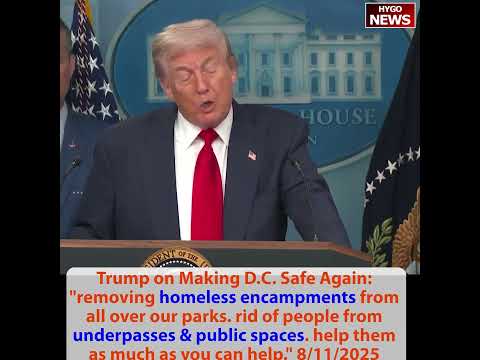
Trump invoking DC Home Rule Act federal control & National Guard, removing homeless public spaces
Trump framed the DC action in historic terms. “I’m announcing a historic action to rescue our nation’s capital from crime, bloodshed, bedlam, and squalor, and worse. This is Liberation Day in DC, and we’re going to take our capital back.” The specific legal mechanism: Section 740 of the DC Home Rule Act, placing MPD under federal control, plus National Guard deployment. Homeless encampments being removed from parks, underpasses, and public spaces. 500 federal agents surged into the District from FBI, ATF, DEA, Park Police, U.S. Marshals Service, Secret Service, and DHS. “They made dozens of arrests.” Contrast with Omar Fateh, Democratic Socialist candidate for Minneapolis mayor, whose stated top priority would be protecting “undocumented residents” from a “hostile federal government."
"Liberation Day in DC”
Trump’s opening framing. “I’m announcing a historic action to rescue our nation’s capital from crime, bloodshed, bedlam, and squalor, and worse.”
“Crime, bloodshed, bedlam, and squalor, and worse.” That list captures what Trump is characterizing as DC’s current condition. Crime (broad criminal activity). Bloodshed (violent crime including murders). Bedlam (disorder generally). Squalor (physical deterioration, garbage, homelessness). “And worse” is the gesture toward elements too grim to enumerate.
Whether that framing accurately characterizes all of DC is debatable. Some DC neighborhoods are upscale and safe. Others have significant crime problems. The aggregate picture the administration is painting is of a capital that has deteriorated to conditions unacceptable for America’s flagship city.
“This is Liberation Day in DC, and we’re going to take our capital back.”
“Liberation Day” is specific framing. The language draws from military-liberation imagery. DC is currently, per Trump’s framing, occupied by forces (crime, squalor, ineffective governance). Federal action is liberating DC from those forces. The national capital is being reclaimed.
“Take our capital back.” Whose capital? “Our” capital — America’s. The capital belongs to the nation, not merely to the Democratic-aligned DC city government that has failed to maintain it.
Section 740
“We’re taking it back under the authorities vested in me as the President of the United States. I’m officially invoking Section 740 of the District of Columbia Home Rule Act.”
Section 740 is the specific legal authority. The Home Rule Act of 1973 delegated local self-governance to DC but preserved specific presidential powers for emergencies. Section 740 allows the President to federalize the MPD for up to 30 days during a “public safety emergency.”
“And placing the DC metropolitan and police department under direct federal control, and you’ll be meeting the people that will be directly involved with that. Very good people, but they’re tough, and they know what’s happening, and they’ve done it before.”
The people: AG Pam Bondi, DEA Administrator Terry Cole (as Interim Federal Commissioner), U.S. Marshal Gati Serrata, Deputy AG Todd Blanche, FBI Director Kash Patel, U.S. Attorney Jeanine Pirro, and others. All experienced federal law-enforcement figures.
“They’ve done it before.” Each of the named figures has specific prior experience with the law-enforcement problems DC faces. Pirro as prosecutor and judge. Patel in earlier FBI roles. Cole with DEA operations. The team is not experimenting with unfamiliar problems.
National Guard Deployment
“In addition, I’m deploying the National Guard to help reestablish law order and public safety in Washington, DC, and they’re going to be allowed to do their job properly.”
That is the second specific action. National Guard deployment. In DC, the President has direct command authority over the DC National Guard (unlike state National Guards, which operate under gubernatorial command unless federalized).
“They’re going to be allowed to do their job properly.” That framing implies previous constraints on National Guard operations. Whether those constraints came from political considerations, legal limits, or administrative restrictions is not specified. But the new framework allows the Guard to operate “properly” — presumably including presence patrols, checkpoints, specific coordination with MPD.
The Guard’s visible presence on DC streets would be substantial. Uniformed military personnel on patrol. Checkpoints at strategic locations. Security at federal buildings, Metro stations, high-crime intersections. The force-multiplier effect is significant — Guard presence allows MPD officers to concentrate on specific investigative and enforcement work while Guard handles area denial and crowd management.
Homeless Encampment Removal
“We’re going to be removing homeless encampments from all over our parks, our beautiful, beautiful parks, which now a lot of people can’t walk on. They’re very dirty, very, a lot of problems, but we’ve already started that.”
Parks being reclaimed. DC has extensive park spaces — National Mall, Rock Creek Park, neighborhood parks, and dozens of smaller green spaces. Homeless encampments have accumulated in many of these spaces over recent years.
“Now a lot of people can’t walk on.” That is the operational reality. Families avoid parks with encampments. Tourists skip neighborhoods they perceive as dangerous. Locals reroute around encampment-affected areas. Public space becomes effectively private space controlled by the encampment residents.
“We’ve already started that.” Removal operations have begun. Presumably federal park-service personnel, U.S. Park Police, and other federal authorities are clearing specific encampments.
”Some Are From Different Countries”
“We’re moving the encampments away, trying to take care of people, some of those people. We don’t know how they even got there. Some of those people are from different countries, different parts of the world. Nobody knows who they are. They have no idea, but they’re there.”
That is a specific observation. Some encampment residents are not American citizens. They are immigrants or possibly foreign nationals. Their specific identities and histories are unknown.
That reality has legal and administrative consequences. Homeless Americans might receive different treatment than homeless foreign nationals. Foreign nationals without legal presence could be processed through immigration channels. Foreign nationals with legal presence could be referred to their consulates. American citizens would be referred to social services.
“Getting rid of the people from underpasses and public spaces from all over the city. There are many places that they can go, and we’re going to help them as much as you can help, but they’ll not be allowed to turn our capital into a wasteland for the world to see.”
“Places they can go.” That is the alternative framework. The federal action is not merely dispersing encampment residents. It is redirecting them to specific facilities — shelters, transitional housing, addiction treatment, mental health services. DC has capacity in these systems; the encampment population has been outside those systems for various reasons.
“They’ll not be allowed to turn our capital into a wasteland for the world to see.” That is the broader justification. DC is the world’s window into America. Tourists, diplomats, and international observers see DC. If DC is “a wasteland,” the image damages American standing globally.
500 Federal Agents
“This week, my administration surge 500 federal agents into the district, including from the FBI, ATF, DEA, Park Police, the U.S. Marshall Service, the Secret Service, and the Department of Homeland Security.”
500 agents. Seven federal agencies. That is extraordinary force deployment for domestic law enforcement. Each agency brings specific capabilities:
- FBI: major crime investigation, organized crime, gun violence, federal prosecution
- ATF: firearms trafficking, gun crimes, explosives
- DEA: drug trafficking, narcotics enforcement
- Park Police: federal parks and monuments security
- U.S. Marshals: fugitive apprehension, prisoner transport, federal court security
- Secret Service: protective details, financial crimes (secondary), counterfeiting
- DHS: immigration enforcement, border-related operations, customs
The combination addresses DC’s specific problem mix. Drugs (DEA). Guns (ATF). Violent offenders (FBI, Marshals). Fugitives (Marshals). Parks and monuments (Park Police). The coordinated deployment across all seven agencies maximizes federal law-enforcement reach.
”A Lot of Nations … Don’t Have Anything Like That”
“You know, a lot of nations, they don’t have anything like that. They got some police, and they’re rough police. They don’t have a DEA, ATF, FBI, Park Police, the U.S. Marshall Service, Secret Service, Department of Homeland Security. They got some police, but they’re rough police, and they do their job.”
Trump’s observation about federal law-enforcement capacity globally. Most countries have national police forces but fewer specialized federal agencies. American federal law enforcement, across its multiple agencies, represents a specific capacity other countries lack.
“They don’t have crime.” That is Trump’s claim about countries with “rough police.” Whether accurate or hyperbolic, the framing argues that effective law enforcement (rough or otherwise) produces low crime rates. DC’s high crime rate reflects insufficient law-enforcement effectiveness, not inadequate resources.
“We’re not going to have crime either.”
The commitment. Federal resources will be deployed at scale. Effective law enforcement will be restored. Crime will decline.
“They made dozens of arrests, and that’s what starts to happen. Again, cashless bail.”
Dozens of arrests already from the initial deployment. “Cashless bail” returns to the structural critique — the arrests will matter only if the suspects are actually detained pending prosecution rather than immediately released under DC’s no-cash-bail framework.
Omar Fateh’s Contrast
The segment closed with a striking contrast. Omar Fateh, the Democratic Socialist Minneapolis mayoral candidate, was asked about his top priorities.
“Day one, if you were elected, what would be some of your top two, three priorities for the city?”
Fateh’s answer. “So that’s a very good question. So the first, I would say, would be the hostile federal government with not only Donald Trump in office, but he has essentially a trifecta, both chambers of Congress and the Supreme Court. And a lot of our neighbors, especially our undocumented residents, are very concerned.”
That is the specific priority. Not crime reduction. Not housing affordability. Not education. Not infrastructure. Day-one priority: protecting undocumented residents from the “hostile federal government.”
That framing is revealing. Fateh’s conception of the mayoral role is oriented first toward immigrant protection from federal immigration enforcement. American citizen residents’ concerns — crime, jobs, schools, cost of living — are apparently secondary to his framework.
For Minneapolis voters, that priority-ordering is the political question. Do Minneapolis residents want a mayor whose first priority is protecting unauthorized immigrants from ICE? Or do they want a mayor whose first priority is the concerns of legal residents (who, not coincidentally, actually vote)?
The Contrast Reveals
Trump’s DC action represents one vision of municipal leadership. Federal resources deployed to protect law-abiding residents. Homeless encampments removed from parks. Violent criminals pursued by federal agents. The national capital restored to functionality.
Fateh’s framework represents the opposite vision. Municipal leadership focused on protecting unauthorized immigrants from federal enforcement. Resources deployed toward creating sanctuary from federal law. Relationships with federal authorities adversarial.
The 2026 and 2028 electoral cycles will test which vision voters prefer. For DC specifically — where federal control is now active — the immediate test is whether crime declines, whether residents feel safer, whether tourists return, whether the visible deterioration reverses. For Minneapolis and similar cities — where Fateh-style candidates are running — the test is whether voters accept “protect undocumented residents” as appropriate primary mayoral priority.
Key Takeaways
- Trump: “I’m announcing a historic action to rescue our nation’s capital from crime, bloodshed, bedlam, and squalor, and worse. This is Liberation Day in DC, and we’re going to take our capital back.”
- Legal framework: “I’m officially invoking Section 740 of the District of Columbia Home Rule Act … placing the DC metropolitan and police department under direct federal control.”
- National Guard: “I’m deploying the National Guard to help reestablish law order and public safety in Washington, DC, and they’re going to be allowed to do their job properly.”
- Homeless encampment removal underway — some encampment residents “are from different countries, different parts of the world. Nobody knows who they are.”
- 500 federal agents surged into DC from FBI, ATF, DEA, Park Police, U.S. Marshals, Secret Service, and DHS — dozens of arrests already made.
- Minneapolis DSA candidate Omar Fateh’s stated day-one priority: protecting “undocumented residents” from a “hostile federal government.”