 HYGO News
 Trump: 'Interest Rates Down -- The Beauty Is Refinancing Debt'; 'Only Chance to Reset the Table on Trade'
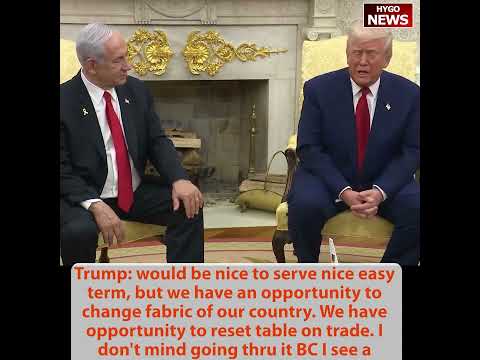
Trump: “Interest Rates Down — The Beauty Is Refinancing Debt”; “Only Chance to Reset the Table on Trade”
President Trump delivered reflective remarks in April 2025 connecting falling interest rates to federal debt management, explaining: “The beauty there is when we refinance debt — our budget’s going to look a lot better because interest costs are way down.” He acknowledged the difficulty of his approach — “It would be nice to serve a nice, easy term” — but said the tariff upheaval was “the only chance our country will have to reset the table” on trade. Trump cited nearly $2 trillion in annual trade losses, warned that China was spending its surplus “on their military,” and noted that countries “that really took advantage of us are now saying, ‘Please negotiate.’”
Prices Falling, Interest Rates Down
Trump opened with the consumer price trajectory.
“We’re cutting prices because prices got so high, people couldn’t live,” he said. “The prices for groceries, the prices for standard groceries, standard things were going through the roof. They couldn’t live. And now those prices are coming down.”
He cataloged the declines: “So call them groceries, but that’s down. Energy’s down. And interest rates are down. Everything’s down.”
Then the fiscal insight that elevated the conversation from consumer prices to government finance: “And the interest rates — the beauty there is when we refinance debt. You know, debt’s become such a big factor in this country.”
He outlined the strategy: “We’re going to start paying debt off with tariffs and other things. But it’s such a big factor because the interest rates were so high. Well, now that’s coming way down, so our budget’s going to look a lot better because interest costs are way down.”
The debt refinancing argument was one of the most sophisticated fiscal observations Trump had made. The federal government carried approximately $36.5 trillion in debt, much of it financed at the higher interest rates that had prevailed during the Federal Reserve’s inflation-fighting tightening cycle. As rates declined, the government could refinance maturing debt at lower rates, reducing annual interest payments by hundreds of billions of dollars. The savings from lower interest costs would improve the fiscal picture more dramatically than most spending cuts could.
Combined with tariff revenue — which the administration projected would bring in hundreds of billions annually — and reduced spending through DOGE, the fiscal trajectory was shifting from chronic deficit to potential improvement.
”It Would Be Nice to Serve an Easy Term”
Trump offered his most candid reflection on the personal cost of his approach.
“It would be nice to serve a nice, easy term,” he said. “But we have an opportunity to change the fabric of our country. We have an opportunity to reset the table on trade.”
He quantified the problem: “We lose close to $2 trillion a year on trade. We lose $1 trillion a year to China. A trillion. We lose hundreds of billions of dollars a year on trade to China. We lose hundreds of billions of dollars overall, probably close to $2 trillion.”
He posed the fundamental question: “Why would we do that? Number one, why would we do that? And then you have to say, is it sustainable?”
The “nice, easy term” admission humanized the tariff strategy. Trump was acknowledging that he had chosen the difficult path — market turbulence, political criticism, diplomatic confrontation — when he could have chosen the comfortable path of maintaining the status quo and presiding over a bull market. The choice was deliberate: the opportunity to restructure global trade came once in a generation, and Trump believed he was the only president willing to seize it.
China’s Military Surplus
Trump connected the trade deficit to national security in the most direct terms.
“Then you hear about all of the people that say, ‘Well, deficits.’ We have a deficit with the country. The country has a big surplus with us, like China has a massive surplus that they take and they spend on their military,” he said.
He stated the concern: “Well, we don’t want that. I don’t want them to take $500, $600 billion a year and spend it on their military. I don’t want them spending money on their military. And I shouldn’t have to spend money. We shouldn’t have to spend it either.”
Trump revealed a conversation with Xi Jinping: “I said this to President Xi — hopefully it’s money that we’re never going to use. In other words, because we’re not going to use those incredible weapons that we have and that they have. We don’t want that.”
The argument was that the American trade deficit was directly funding the Chinese military buildup. Every dollar of surplus that China accumulated from its trade with the United States was a dollar available for military spending — including the development of weapons systems designed to counter American power. The United States was, in effect, subsidizing the military of its most significant strategic competitor through its own consumption.
”The Only Chance”
Trump argued that the current moment was uniquely important.
“It’s the only chance our country will have to reset the table,” he said. “Because no other president would be willing to do what I’m doing or to even go through it.”
He expressed his personal perspective: “Now, I don’t mind going through it because I see a beautiful picture at the end.”
He described the results already materializing: “We are making tremendous progress with a lot of countries. And the countries that really took advantage of us are now saying, ‘Please negotiate.’ You know why? Because they’re getting beaten badly because of what’s happening. They’re getting beaten badly. They’re being devalued as countries.”
Trump reiterated the unique nature of the opportunity: “But it’s the only chance we’re going to have to reset the table on trade. And when we do, we’re going to come out unbelievably well.”
He described the vision: “We’re going to have a strong country economically again. We’re going to have those factories that are empty all over the United States.”
Then the number that anchored every trade argument: “We’ve lost 90,000 plants and factories. Think of this. 90,000 — you wouldn’t think it’s possible. 90,000 plants and factories since NAFTA, which was, by the way, the worst trade deal ever developed, ever had by any country, anywhere. NAFTA.”
The “only chance” framing was both honest and strategic. Honest because the political will to endure the short-term costs of trade restructuring was rare — most presidents avoided confrontation in favor of managing decline. Strategic because it created urgency: if this opportunity was missed, it might not come again for decades. The 90,000 plants lost since NAFTA were not coming back through incremental policy adjustments. Only a fundamental restructuring of trade relationships could reverse the trajectory.
Key Takeaways
- Trump connected falling interest rates to federal finances: “When we refinance debt, our budget’s going to look a lot better — interest costs are way down.”
- He acknowledged the difficulty: “It would be nice to serve an easy term, but we have an opportunity to change the fabric of our country.”
- Trade losses cited: “Close to $2 trillion a year overall, $1 trillion to China alone” — with China spending its surplus “on their military.”
- Countries “that really took advantage of us are now saying, ‘Please negotiate.’ They’re getting beaten badly.”
- Trump called this “the only chance our country will have to reset the table on trade. No other president would be willing to do this.”