 HYGO News
 Trump to Modi: India Is 'Highest Tariffed Nation in the World' -- 'Whatever India Charges, We Charge Them'
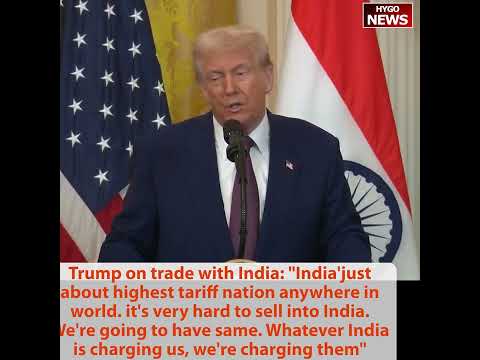
Trump to Modi: India Is “Highest Tariffed Nation in the World” — “Whatever India Charges, We Charge Them”
During a February 2025 joint appearance with Indian Prime Minister Narendra Modi in Washington, President Trump was asked directly what kind of reciprocal tariffs India could expect. His answer was blunt: “India has been to us just about the highest tariffed nation anywhere in the world.” Trump said he did not blame India for pursuing its own interests but declared that the United States was now a “reciprocal nation” where “whatever India charges, we’re charging them.” He revealed that he had attempted to negotiate tariff concessions with India during his first term and “was unable to get a concession,” leading to the simpler approach: match whatever the other country charges, dollar for dollar.
”The Highest Tariffed Nation Anywhere in the World”
A reporter asked Trump to elaborate on his repeated description of India as a major trade abuser. “Mr. President, you’ve repeatedly called India a big abuser of trade and said it is really difficult to do business in India because of tariffs,” the reporter said. “You announced reciprocal tariffs today. I am hoping you can speak about what kind of reciprocal tariffs India can expect. Are you willing to make any concessions, and how can India head off these tariffs?”
Trump’s response acknowledged India’s approach without personal animosity. “India has been to us just about the highest tariffed nation anywhere in the world,” he said. “They have been very strong on tariffs. I don’t blame them necessarily, but it’s a different way of doing business.”
The distinction between blaming India and describing its behavior was deliberate. Trump was standing next to Modi, a leader he had cultivated a personal relationship with across both terms. The “I don’t blame them” framing allowed Trump to make a devastating factual critique while preserving the diplomatic relationship. India’s tariffs were not presented as hostile acts but as rational self-interest that the United States had simply failed to reciprocate.
Trump then described the practical impact of India’s trade barriers. “It’s very hard to sell into India because they have trade barriers, very strong tariffs,” he said. India’s average applied tariff rate was among the highest of any major economy, with tariffs on some American products — including motorcycles, whiskey, and agricultural goods — reaching 100 percent or more. Beyond formal tariffs, India maintained an extensive system of non-tariff barriers, testing requirements, and regulatory hurdles that further restricted market access for American companies.
”We Are Now a Reciprocal Nation”
Trump declared that the United States had fundamentally changed its approach to trade. “We are right now a reciprocal nation,” he said. “If it’s India or if it’s somebody else with low tariffs, we’re going to have the same. Whatever India charges, we’re charging them. Whatever another country charges, we’re charging them.”
He named the policy explicitly: “So it’s called reciprocal, which I think is a very fair way.”
The simplicity of the formula was its greatest strength. Rather than negotiating complex trade agreements with dozens of countries simultaneously — a process that could take years and often produced compromises that satisfied no one — reciprocal tariffs reduced the entire system to a single rule: match whatever the other country charges. Countries that wanted lower tariffs from the United States simply needed to lower their own tariffs first.
Trump also addressed India specifically on how to avoid the tariffs. “So frankly, it no longer matters to us that much what they charge, because whatever they charge,” he said. The implication was clear: India could set its tariffs at whatever level it chose, and the United States would simply mirror that level. The ball was in India’s court.
Why It Did Not Happen in the First Term
Trump provided an unusually candid explanation of why he had not implemented reciprocal tariffs during his first term, citing both the pandemic and a deliberate humanitarian choice.
“I was going to do that in my other term, and we had the greatest economy ever in the world,” Trump said. “There’s never been an economy like we had, and then we got hit with COVID. We had a focus on that.”
He described a conscious decision to hold off on tariff reciprocity during the pandemic. “I wasn’t really in the mood to be putting it on Italy and Spain and France and India, frankly, and a lot of other countries because the world was very troubled until we got rid of that nightmare,” Trump said.
The reasoning was notable because Trump framed the delay as an act of compassion rather than weakness. “I decided, I think on a human basis, on a humane basis, not to do them because of the fact that there was such suffering all over the world,” he said. “The last thing we needed to talk about is trade problems.”
The admission that COVID had prevented the implementation of reciprocal tariffs in the first term also served as a promise that the second term would see them through. “But now we do,” Trump said. “We see a tremendous future for our country, but we felt that now it’s finally time after 45 or 50 years of abuse.”
The Failed First-Term Negotiation with India
Trump revealed that he had attempted the diplomatic route with India before resorting to reciprocal tariffs. “I had discussions with India in the first term about the fact that their tariffs were very high, and I was unable to get a concession,” he said.
The admission was significant because it established that the reciprocal tariff approach was not a first resort but a last resort. Trump had tried negotiation, been rebuffed, and concluded that the only effective strategy was automatic reciprocity.
“So we’re just going to do it the easy way,” Trump said. “And we’re just going to say, whatever you charge, we charge. And I think that’s fair for the people of the United States. And I think it’s actually fair for India.”
The claim that reciprocal tariffs were “actually fair for India” was an interesting diplomatic argument. If India believed its tariff rates were reasonable, then it should have no objection to the United States charging the same rates. If it believed the equivalent American rates would be harmful, then by implication it was acknowledging that its own rates were harmful to American exporters — in which case the solution was to lower them.
The Broader Context: EU, China, and Global Trade
Trump made clear that the reciprocal tariff policy was not directed solely at India but at the entire global trading system.
“This isn’t India. This is among a lot of nations,” Trump said. “The European Union is very difficult for us, very, very difficult. They tax our companies at levels that nobody’s ever seen before. They take advantage of a lot of things. So we’re not happy about that.”
He also cited China as a persistent problem. “China, of course, is terrible,” Trump said. “And we’ve never taken in 10 cents until I was president. We’ve taken in hundreds of billions of dollars from China since I’ve been president in the first term and now.”
By naming India, the EU, and China as the three primary targets, Trump was signaling that reciprocal tariffs would apply across the entire spectrum of American trading relationships — from close democratic allies like EU nations to strategic partners like India to adversarial competitors like China. No country would be exempt from the fundamental principle: whatever you charge us, we charge you.
The Modi Dynamic
The exchange took place with Modi sitting next to Trump, creating a diplomatic dynamic that required careful handling. Trump’s approach was to criticize India’s trade practices candidly while maintaining personal warmth toward Modi. The “I don’t blame them” and “I think it’s actually fair for India” formulations allowed both leaders to leave the meeting with their relationship intact while the substance of Trump’s trade policy remained unchanged.
Modi’s government would face immediate pressure to lower tariffs on American goods or accept that American exports to India would face even higher barriers while Indian exports to the United States would face equivalent penalties. The diplomatic calculation for India was whether the cost of losing preferential access to the American market exceeded the domestic political cost of lowering tariffs on foreign goods.
Key Takeaways
- Trump called India “just about the highest tariffed nation anywhere in the world” during a joint appearance with PM Modi, while adding “I don’t blame them necessarily” to maintain the diplomatic relationship.
- He declared the U.S. was now “a reciprocal nation” where “whatever India charges, we’re charging them,” eliminating the need for bilateral trade negotiations.
- Trump revealed he had tried to negotiate tariff concessions with India during his first term and “was unable to get a concession,” leading to the automatic reciprocity approach.
- He explained that COVID prevented him from implementing reciprocal tariffs in his first term, saying he decided “on a humane basis” not to impose them during a global pandemic.
- Trump named India, the EU, and China as the three primary targets of the reciprocal tariff policy, calling the EU “very difficult” and China “of course terrible.”