 HYGO News
 Trump Departs Abu Dhabi: 'My Daughter Had a Baby -- Going Home to See That Little Baby'; UAE Aluminum Company $4B Plant in Oklahoma -- 40% of Market
Trump Departs Abu Dhabi: “My Daughter Had a Baby — Going Home to See That Little Baby”; UAE Aluminum Company $4B Plant in Oklahoma — 40% of Market
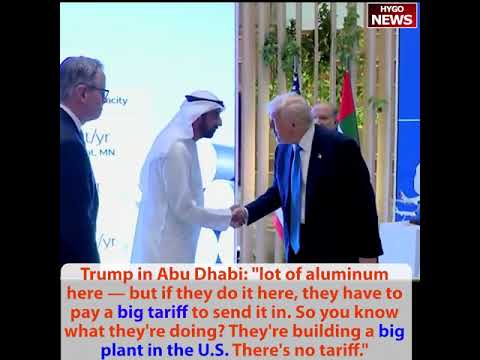
President Trump wrapped up his historic Middle East trip in Abu Dhabi in May 2025 with a mix of personal news, investment announcements, and global policy updates. “It’s been a tremendous time and now it’s time to go back home. My daughter had a baby — I’m going to go back home and see that little baby,” Trump said. On Ukraine: “5,000 young people a week on average being killed in a war that is going nowhere.” On Iran: “It’ll be taken care of 100%. It’ll be done nicely or not nicely. And then not nicely is not a good thing for them.” He announced UAE aluminum giant EGA’s $4 billion investment in Oklahoma: “If they do it here, they have to pay a big tariff. So they’re building a big plant in the U.S. There’s no tariff."
"Going Home to See That Little Baby”
Trump opened with personal family news.
“It’s been a tremendous time and now it’s time to go back home,” Trump said. “My daughter had a baby. I’m going to go back home and see that little baby.”
He set the work agenda: “And then we get back to a lot of work.”
The “daughter had a baby” referred to Tiffany Trump’s child — Trump’s newest grandchild. Throughout his demanding schedule, Trump consistently emphasized family milestones. The personal note grounded what had been a geopolitically transformative trip in the human reality that the president was also a grandfather eager to see his newest grandchild.
The juxtaposition was characteristic. Trump had just conducted one of the most consequential diplomatic trips in American history — $10 trillion in investment commitments, historic trade deals, sanctions relief for Syria, progress on Iran negotiations. But his first substantive comment upon departing was about his grandchild. The human dimension humanized the policy achievements.
”5,000 Young People a Week”
Trump provided an assessment of the Ukraine war.
“We’ll see what happens with Russia and Ukraine,” Trump said. “I think it’s something that’s just going to stop the killing.”
He cited the human cost: “5,000 people a week. 5,000 young people a week on average being killed in a war that is going nowhere.”
He made the moral argument: “It’s a shame. It should have never happened.”
The 5,000 per week casualty rate represented approximately 260,000 deaths per year across both sides. This was comparable to or exceeding the death tolls of the deadliest conflicts of the 21st century — Syria, Yemen, and others. Yet the war received a fraction of the attention and outrage that those other conflicts had generated.
Trump’s consistent emphasis on the human cost — rather than the geopolitical dimensions — reflected his pragmatic approach to the conflict. The policy debate about Ukraine focused on grand strategic questions: NATO expansion, territorial integrity, rules-based international order. Trump’s argument was simpler: young people were dying in enormous numbers every week, and any agreement that stopped the killing was worth pursuing.
The “war that is going nowhere” assessment was strategically accurate. Neither side could achieve decisive military victory. Russia could not conquer all of Ukraine; Ukraine could not expel Russian forces from occupied territory. The conflict was a grinding attrition war that would continue indefinitely without external pressure to produce a settlement.
Iran: “Nicely or Not Nicely”
Trump delivered his most direct threat on Iran.
“Plus we have an Iran situation which we’re going to take care of,” Trump said. “One way the other will take care of. It’ll be taken care of 100%.”
He stated the options: “It’ll be done nicely or not nicely. And then not nicely is not a good thing for them.”
He described the current state: “And I think we’re talking to them in there. I think they’ve come a long way.”
The “nicely or not nicely” framing was consistent with Trump’s repeated message. Iran had a choice: negotiate a deal that eliminated its nuclear weapons program and return to the international community, or face military action that would destroy its nuclear infrastructure by force.
The emphasis on “not a good thing for them” was notable. Trump was explicit that military action would be devastating for Iran. This was true in multiple dimensions:
- Direct destruction of nuclear facilities
- Likely destruction of air defenses, command and control, leadership facilities
- Economic devastation as oil infrastructure became targets
- Internal instability if the regime lost military capability
- Regional consequences as Iranian proxies were affected
The “they’ve come a long way” observation suggested genuine progress in negotiations. Trump had been signaling for weeks that Iran was moving toward accepting American terms. The Middle East trip — particularly the meeting with Iranian officials and messages conveyed through Saudi and Qatari leaders — had apparently produced substantive movement.
UAE Aluminum: $4 Billion Oklahoma Plant
Trump welcomed an EGA representative to discuss a major investment.
“How are you?” Trump asked.
“I’m from EGA. I’m from global aluminum.”
Trump responded: “You’re doing a good job with the aluminum.”
The representative described the investment: “This is a very special project. It’s a big, very special project. This is UAE technology. It’s been developed over 35 years. We were exporting it to the world in the first big project in our group. It’s the U.S. state of Oklahoma. We’re going to invest $4 billion.”
Trump emphasized: “Investing $4 billion in Oklahoma, Doug.”
The representative provided the production details: “Today the U.S. produced about 700,000 pounds. We’re almost doubling that capacity.”
He expanded: “Today we’re imposing 4.2 million pounds. This is going to be about 40% now for that capacity to spin.”
He described the recycling component: “And what we’re doing, Mr. President, is we’re actually moving also 150,000 by the end of this year into recycled aluminum. So we’re not just waiting for the snows that we’re building. 2030, we’re actually building capacity.”
He described the expansion plans: “It’s going to be about another $200 billion because this is recycled. It’s a company in Minnesota we bought last year, Mr. President.”
Trump explained the broader dynamic: “See, they’re doing all of this work in the U.S. with the aluminum. They do a lot of aluminum here, but if they do it here, they have to pay a big tariff to send it in.”
He identified the cause-effect: “So you know what they’re doing? They’re building a big plant in the U.S. There’s no tariff.”
He celebrated the outcome: “We’re exporting 700,000 pounds. Now we’re going to make it in the U.S. So it’s amazing. It’s the great thing.”
The EGA investment was a textbook example of the tariff strategy working as intended.
Emirates Global Aluminum (EGA) was one of the world’s largest aluminum producers. The company had been exporting aluminum to the United States through international trade channels, including the 25% tariff on aluminum imports that Trump had imposed.
Faced with paying 25% tariffs on every ton of aluminum shipped to the American market, EGA had made the rational economic decision: build production capacity inside the United States. The $4 billion Oklahoma investment would produce aluminum for the American market without tariff costs, creating thousands of American jobs in the process.
Multiple benefits flowed from this single decision:
For American workers: Thousands of high-paying manufacturing jobs in Oklahoma, with secondary supplier jobs throughout the supply chain.
For American aluminum capacity: Capacity nearly doubled, with the new EGA plant producing approximately 40% of projected national output.
For American security: Reduced dependence on foreign aluminum for critical industries including defense, aerospace, and infrastructure.
For American taxpayers: No direct cost. The tariffs had done the work without requiring any subsidies or tax breaks to attract the investment.
For EGA: Continued access to the world’s largest consumer market without punitive tariff costs.
The “first big project in our group” comment suggested EGA was considering additional American investments. The Minnesota company acquisition mentioned — presumably a recycled aluminum operation — represented additional American manufacturing capacity that EGA was developing.
The Abrahamic Family House
Before departing, Trump toured the Moses Ben Maimon Synagogue at the Abrahamic Family House in Abu Dhabi.
Trump’s reaction: “Amazing.”
The Abrahamic Family House was a remarkable complex in Abu Dhabi housing a synagogue, mosque, and church — all three Abrahamic faiths represented in separate but architecturally unified buildings. It was a symbol of the UAE’s vision of religious coexistence and tolerance.
The Moses Ben Maimon Synagogue was named after the medieval Jewish philosopher also known as Maimonides. Its existence in the UAE — an Arab Muslim country — represented the transformation the Abraham Accords had enabled. Before the Accords, open Jewish worship in a UAE synagogue would have been unthinkable. After the Accords, it was a tourist attraction.
Trump’s visit to the synagogue — a Christian American president visiting a Jewish worship space in a Muslim country — embodied the vision the Abraham Accords had made possible: Muslims, Christians, and Jews gathering together in religious tolerance rather than conflict. The “amazing” reaction was both genuine aesthetic appreciation and implicit validation of the diplomatic achievement that had made such a moment possible.
Key Takeaways
- Trump: “My daughter had a baby — I’m going to go back home and see that little baby. Tremendous time in the Middle East.”
- Ukraine: “5,000 young people a week on average being killed in a war going nowhere. It should have never happened.”
- Iran: “Taken care of 100%. Nicely or not nicely. Not nicely is not a good thing for them.”
- EGA $4 billion Oklahoma aluminum plant: nearly doubles U.S. capacity to 40% of market. “They’d pay big tariff — so they’re building here. No tariff.”
- Trump toured the Moses Ben Maimon Synagogue at Abrahamic Family House: “Amazing” — embodiment of Abraham Accords vision.