 HYGO News
 Trump Surveys White House Lawn for 100-Foot Flagpoles -- 'Paid for by Trump'; Says Tariffs Will 'Substantially Lower Taxes'
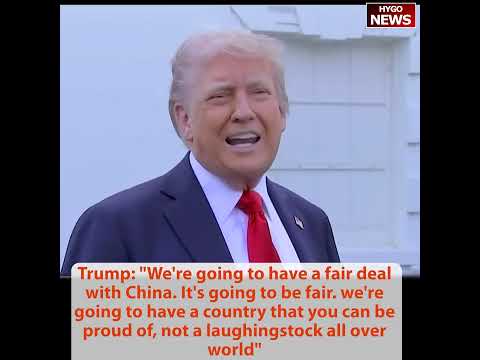
Trump Surveys White House Lawn for 100-Foot Flagpoles — “Paid for by Trump”; Says Tariffs Will “Substantially Lower Taxes”
President Trump conducted an impromptu press gaggle on the White House North Lawn in April 2025 after personally surveying locations for two new flagpoles. “We’re putting up a beautiful, almost 100-foot-tall American flag on this side and another one on the other side — top of the line,” Trump said, adding they were “paid for by Trump.” He pivoted to trade policy, invoking history: “In 1913, they traded to the income tax system. We used to be all tariff with no income tax. From about 1870 to 1913, we had the wealthiest country proportionately. They had so much money they didn’t know how to spend it.” He predicted tariff revenue would allow the government to “substantially lower taxes” and declared: “We were losing $2 trillion a year on trade. Now we’re going to be making money.”
The 100-Foot Flagpoles
Trump was spotted on the North Lawn personally choosing locations for two massive American flag installations.
“We’re putting up a beautiful, almost 100-foot-tall American flag on this side and another one on the other side,” Trump said. “Two flags, top of the line.”
He noted a historical gap: “They needed flagpoles for 200 years. It was something I’ve often said — they don’t have a flagpole, per se.”
He described the placements: “So we’re putting one right where you saw us, and we’re putting another one on the other side on top of the mounds.”
He concluded: “It’s going to be two beautiful flags.”
The detail that the flagpoles were personally funded by Trump — “paid for by Trump” — was characteristic of a president who frequently used his own money for projects he considered important. The White House, the most recognizable symbol of American democracy, would feature two nearly 100-foot American flags visible from across the National Mall. The installation was both practical and symbolic — a president who had campaigned on national pride ensuring that the nation’s flag flew prominently over the nation’s house.
The observation that the White House had lacked proper flagpoles for 200 years was vintage Trump — the real estate developer’s eye identifying a deficiency that everyone else had accepted. The White House had flags, of course, but Trump’s vision was for something monumental — flagpoles that made a statement visible from a distance, not just ceremonial standards.
”From 1870 to 1913”
Trump delivered an impromptu history lesson that connected his tariff policy to America’s most prosperous era.
“In 1913, they traded to the income tax system,” Trump said. “We used to be all tariff, and we had no income tax.”
He described the result: “So we had the wealthiest country we had proportionately from about 1870 to 1913.”
He explained the abundance: “It was all tariffs, and we did. We had more money than anybody. They had committees, how to spend the money. They had so much money they didn’t know how to spend it.”
He described the transition: “Then some brilliant person said, let’s go income tax, let’s let the people pay.”
He stated the vision: “We’re going to be able to substantially lower taxes when this is finished.”
The 1870-1913 reference was historically grounded. During that period — the Gilded Age and Progressive Era — the United States funded its federal government primarily through tariffs on imported goods. There was no income tax (the Sixteenth Amendment authorizing the federal income tax was ratified in 1913). The country industrialized rapidly, built transcontinental railroads, electrified cities, and became the world’s largest economy.
Trump’s argument was that tariffs had funded American prosperity once and could do so again. If tariff revenue replaced a significant portion of income tax revenue, the government could reduce the tax burden on American workers and businesses. The vision was not merely tariffs as trade policy but tariffs as fiscal policy — a revenue source that taxed foreign producers rather than American citizens.
The “committees to spend the money” detail was particularly effective. It suggested an era when the government’s problem was abundance rather than scarcity — when revenue exceeded spending rather than the reverse. The contrast with America’s current $36 trillion national debt could not have been sharper.
”Fair Deal with China”
Reporters pressed Trump on the China trade situation.
“Are you thinking about lowering their tariffs?” a reporter asked.
“Fair deal with China, it’s going to be fair,” Trump said.
“Are you talking to them actively now?”
“Actively, everything’s active,” Trump replied. “Everybody wants to be a part of what we’re doing.”
He assessed the dynamic: “They know that they can’t get away with it any longer, but they’re still going to do fine.”
He stated the goal: “And we’re going to have a country that you can be proud of, not a laughingstock all over the world for many years.”
The “they’re still going to do fine” addendum was important. Trump was not seeking to destroy China’s economy or punish Chinese workers. He was seeking reciprocity — equal treatment in trade. China could “do fine” under a fair trade framework; it simply couldn’t continue to exploit one-sided arrangements that enriched China at America’s expense.
The “laughingstock” characterization — that other countries had been laughing at America’s willingness to accept terrible trade deals — was a theme Trump had carried since his first presidential campaign. The argument resonated because it was true. Trade negotiators from other countries had openly acknowledged that American trade policy had been extraordinarily generous, often to the detriment of American workers.
”$2 Trillion a Year”
Trump provided the fiscal context for the trade overhaul.
“We have a lot of action going on,” he said. “We’re making a lot of money, this country. This country is not going to be losing money on trade anymore.”
He cited the deficit: “We were losing $2 trillion a year on trade. Now we’re going to be making money, a lot of money.”
He broadened the picture: “Every country wants to partake. Even countries that have ripped us off for many, many years.”
He named the offenders: “China is an example, but it’s not just China. European Union, they ripped us off for many, many years, and those days are over.”
He connected trade to the domestic agenda: “We’re going to make a lot of money for our people. We’ll be able to lower taxes substantially, and we’re going to be proud of ourselves.”
He concluded: “We’re not going to be a laughingstock that’s got taken advantage of by virtually every country in the world.”
The $2 trillion annual trade deficit figure represented the cumulative cost of decades of trade agreements that had prioritized corporate profits and consumer prices over American manufacturing and employment. Every dollar of trade deficit represented a dollar that had flowed out of the American economy and into foreign economies — purchasing foreign goods instead of supporting domestic production.
Trump’s argument was that reversing even a portion of this deficit through tariff-induced reshoring and negotiated trade agreements would generate enough revenue to fund tax cuts for American workers. The arithmetic was straightforward: if tariffs generated hundreds of billions in revenue while simultaneously reducing the trade deficit, the government could reduce income taxes without increasing the national debt.
The Most Accessible President
The impromptu nature of the press gaggle — Trump wandering the North Lawn surveying flagpole locations and stopping to take questions from reporters who happened to be present — illustrated the accessibility that defined his presidency. Previous presidents had conducted press interactions through carefully scheduled press conferences, pool sprays, and formal gaggles. Trump talked to reporters whenever he felt like it, wherever he happened to be.
The North Lawn scene was particularly evocative: the president in his suit, gesturing at locations for flagpoles, pivoting between patriotic infrastructure and geopolitical trade strategy, taking shouted questions with casual authority. It was governance conducted in real time, in public, without scripts or handlers.
Key Takeaways
- Trump personally surveyed the White House lawn for two 100-foot flagpoles — “paid for by Trump” — one on each side of the property.
- Historical argument: “From 1870 to 1913 we had all tariffs, no income tax, and the wealthiest country proportionately. They had so much money they didn’t know how to spend it.”
- On China: “Fair deal, it’s going to be fair. They know they can’t get away with it any longer, but they’re still going to do fine.”
- Trade deficit: “We were losing $2 trillion a year. Now we’re going to make money. We’ll be able to lower taxes substantially.”
- Trump declared: “We’re not going to be a laughingstock that’s gotten taken advantage of by virtually every country in the world.”