 HYGO News
 Trump: I was the hunted, now I'm the hunter; Nothing too late. only thing too late is Powell
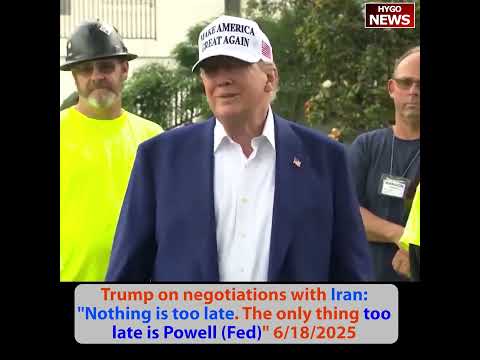
Trump: I was the hunted, now I’m the hunter; Nothing too late. only thing too late is Powell
Trump returned from the G7 to find himself in the most consequential geopolitical moment of his second term, and his press exchanges in the days that followed produced some of the sharpest rhetorical imagery of his presidency. The president characterized his shift over the past decade — from being the target of investigations and media pursuit to being the hunter pursuing Iran — in one compressed sentence: “I was the hunted. And now I’m the hunter.” He refused to confirm or deny whether the United States would strike Iranian nuclear facilities, noting that the answer is his alone and that predictability serves no strategic purpose. He dismissed Fed Chair Jerome Powell’s caution about the economic situation with the line “Powell’s too late. Too late Powell.” And he addressed the Iranian Supreme Leader directly with a single phrase: “Good luck."
"I Was The Hunted”
Trump opened the exchange with reporters by reflecting on his own trajectory. “I’ve had it for a long time. The first time I had it, you know, you guys were after me. I said I had a focus. I was the hunted. And now I’m the hunter. It’s a big difference.”
The observation traces the arc from 2017-2021, when the first Trump administration faced the Russia investigation, the impeachment proceedings, the Stormy Daniels case, and what felt to his allies like continuous pursuit by investigators, journalists, and political opponents, through the 2022-2024 period of criminal indictments and civil litigation, to the current moment in which he is in office and in control of the federal law-enforcement and national-security apparatus.
The compression of that history into “I was the hunted. And now I’m the hunter” is rhetorically efficient. The line positions the current moment as the reversal of the earlier one. Trump is, in his framing, no longer the target. He is the pursuer. The targets are those who conducted themselves as though the previous dynamic was permanent.
The Iranian Strike Question
The reporter’s question was direct. “About whether you are moving closer, or you believe the US is moving closer to striking Iranian nuclear facilities, where’s your mindset on that?”
Trump’s answer was a refusal to answer. “I can’t say that, right? You don’t seriously think I’m going to answer that question.”
Follow-up questions pressed: “Will you strike the Iranian nuclear component? And what time exactly, sir? Sir, would you strike it? Would you please inform us so we can be there and watch?”
Trump’s response was both humorous and serious. “I mean, you don’t know that I’m going to even do it. You don’t know. I may do it. I may not do it. I mean, nobody knows what I’m going to do.”
Why Ambiguity Is The Policy
Strategic ambiguity about military action is a long-standing doctrine in American foreign policy. A president who announces in advance that a strike will occur removes the element of surprise that gives the strike its military value. A president who announces in advance that a strike will not occur removes the deterrent effect that signals the possibility of action.
Trump’s deployment of ambiguity — “I may do it. I may not do it” — maintains the option in both directions. Iran cannot plan for a specific strike because the timing is uncertain. Iran also cannot assume no strike will occur because the option remains on the table.
“Nobody knows what I’m going to do” is not a failure of presidential decision-making. It is the intentional preservation of decision latitude. Telegraphing the decision in advance would narrow that latitude.
”Iran’s Got A Lot Of Trouble”
Trump then laid out his read of the Iranian position. “I can tell you this, that Iran’s got a lot of trouble. And they want to negotiate. And I said, why didn’t you negotiate with me before? All this death and destruction. Why didn’t you negotiate?”
The observation that Iran “wants to negotiate” now, after the 60-day window has closed and after Israeli strikes have degraded Iranian capabilities, is consistent with the behavior of states under duress. Iran’s theocratic leadership, facing escalating military pressure and the possibility of further American involvement, is presumably reassessing its strategic calculus.
Trump’s rhetorical question — “Why didn’t you negotiate with me before?” — is the question that defines the Iranian error, in his framing. Negotiation was available. It was rejected. The subsequent costs — “all this death and destruction” — are, in this telling, the consequence of that rejection.
”Why Didn’t You Negotiate With Me Two Weeks Ago?”
The framing continued. “I said to the people, why didn’t you negotiate with me two weeks ago? You could have done fine. You would have had a country. It’s very sad to watch. I’ve never said anything like it.”
“You would have had a country” is the ominous framing. Trump is suggesting that Iran’s ability to continue as a functional state is now in question — that the path from the current situation to a sustained Iranian national existence requires corrective action that Iran is only now contemplating.
Whether Iran’s existence as a country is genuinely at risk is a question that depends on many factors beyond American decisions. But Trump’s framing — “you would have had a country” — signals that he views the stakes in those terms.
”60 Days, And Then Came The 60… 61”
Trump returned to the timeline. “And at the end, the last minute they said, no, we’re not going to do that. And they got hit. Remember, 60 days, and then came the 60… 61 is going to become a very famous number.”
“61 is going to become a very famous number” is Trump characterizing the date on which diplomatic negotiation was replaced by military action as the pivotal moment. The reporter’s framing — “the 61st day” — was what Trump had referenced earlier. The suggestion that the number will “become very famous” implies that subsequent historical accounts will focus on that day as the hinge on which the broader conflict turned.
”One Hell Of A Hit”
Trump’s assessment of the Israeli strikes was direct. “That was one hell of a hit, that first hit. That was one hell of a hit. Not sustainable, to be honest. That’s where it ended on the first night. It ended too late though.”
The characterization — “one hell of a hit” and “not sustainable” — is a soldier’s assessment delivered by a civilian commander-in-chief. The Israeli strikes, in Trump’s reading, did enough damage that Iran’s ability to respond effectively was compromised from the opening minute of the exchange.
“It ended too late though” is the implicit critique that the American response window closed without the full deal Trump had wanted. Even though the Israeli strikes were successful, the diplomatic window for a pre-strike negotiated settlement had been lost.
”The Only Thing Too Late Is Powell”
Trump then pivoted to a topic he has returned to repeatedly — Federal Reserve Chair Jerome Powell. “Do you think it’s too late to now? Nothing’s too late. The only thing too late is Powell. Powell’s too late. Too late Powell.”
The “Too late Powell” framing is Trump’s shorthand for his view that the Fed has been consistently behind the economic curve. Powell, in Trump’s view, should have been cutting rates faster as inflation moderated. The Fed’s caution is, to Trump, evidence of poor judgment and, by implication, the need for different leadership.
The nickname “Too Late Powell” is the kind of branding that Trump has used throughout his political career to make a point stick. “Little Marco.” “Low Energy Jeb.” “Sleepy Joe.” “Too Late Powell” fits the pattern. Whether Powell’s actual decisions support the label is a separate question, but the label itself will travel.
”40 Years Of Death To America”
Trump provided the historical framing for his Iran posture. “They had bad intentions. For 40 years they’ve been saying death to America, death to Israel, death to anybody else that they didn’t like. They were bullies. They were schoolyard bullies.”
The “40 years” reference places Iranian hostility in the context of the 1979 Iranian Revolution and the subsequent four-decade-plus period of Iranian regime rhetoric and action against the United States, Israel, and Western interests. The rhetoric has been consistent. The actions — the hostage crisis, the proxy wars, the terrorist funding, the nuclear program — have produced the current situation.
Trump’s characterization — “schoolyard bullies” — is an informal framing that captures the intuition of ordinary Americans watching decades of Iranian belligerence. Schoolyard bullies persist as long as they do not encounter consequences. The implication: Iran has been bullying because the consequences have been insufficient.
”And Now They’re Not Bullies Anymore”
The present-tense contrast is sharp. “And now they’re not bullies anymore, but we’ll see what happens. Nothing’s finished until it’s finished. You know, war is very complex. A lot of bad things can happen. A lot of turns are made. I wouldn’t say that we won anything yet. I would say that we sure as hell made a lot of progress. And we’ll see.”
The observation that Iran is not bullying anymore captures the moment in which the target has been put on the defensive. The caveat — “nothing’s finished until it’s finished” — acknowledges the realist’s understanding that war does not stop simply because one side is winning.
“I wouldn’t say that we won anything yet. I would say that we sure as hell made a lot of progress” is a carefully calibrated statement. Trump is not claiming victory. He is claiming progress. That distinction matters because claiming victory too early creates hostages to fortune if the situation deteriorates.
”Maybe Less Than A Week”
Trump offered a specific timeline. “The next week is going to be very big, maybe less than a week. Maybe less.”
The timeline is meaningful. Trump is telling reporters — and, through them, Tehran — that significant developments are expected within a compressed window. Whether those developments will be diplomatic (a deal signed), military (a strike executed), or political (Iranian regime changes) is not specified. But the timeline is being compressed from open-ended to “maybe less than a week.”
The Nuclear Weapon Stakes
Trump restated the stakes in stark terms. “Is there anybody here that said it would be okay to have a hostile, very, you know, zealots really, but to have a hostile country, have a nuclear weapon that could destroy 25 miles, but much more than that, could destroy other nations just by the breeze blowing the dust.”
The concern Trump is articulating is not just the direct destruction a nuclear weapon would cause. It is the downstream effects — radioactive fallout that spreads with prevailing winds and affects populations far from the initial strike. The invocation of the dust-spreading image is a reminder that nuclear weapons have effects that extend beyond their strike radius.
”If You Go Back 15 Years”
Trump closed by invoking his own consistent position on the Iran nuclear question. “If you go back and look at my history, if you go back 15 years, I was saying, we cannot let Iran get a nuclear weapon. I’ve been saying it for a long time. I mean it more now than I ever meant.”
The consistency claim is supported by the record. Trump’s public statements over the past 15 years have included repeated warnings about Iranian nuclear weapons. The statement “I mean it more now than I ever meant” signals that the intensity of his commitment has increased as the situation has developed.
”Good Luck” To The Supreme Leader
The reporter asked about Ayatollah Khamenei’s statement that Iran would not surrender. “What do you say to the supreme leader of Iran? He said, yeah, they will not kill him. Say good luck.”
The two-word response — “Good luck” — is a dismissal so dry it reads as polite. It also signals that the administration’s posture is not one of seeking direct dialogue with the Supreme Leader. Trump is, in effect, telling Khamenei that his position of defiance is unlikely to serve him well, and that the attempt to wait out the American pressure is a losing strategy.
Key Takeaways
- Trump’s signature arc line: “I was the hunted. And now I’m the hunter. It’s a big difference.”
- On Iranian strikes: “I may do it. I may not do it. I mean, nobody knows what I’m going to do” — strategic ambiguity preserved as policy.
- On Iran negotiating now: “Why didn’t you negotiate with me two weeks ago? You could have done fine. You would have had a country.”
- “Too Late Powell” coined: “Nothing’s too late. The only thing too late is Powell. Powell’s too late. Too late Powell.”
- Two-word message to the Supreme Leader: “Good luck.”