 HYGO News
 Trump in Abu Dhabi: 'Shook More Hands Than Any Human Being -- They Were Starving for Love'; Slams Biden's Saudi Fist Bump
Trump in Abu Dhabi: “Shook More Hands Than Any Human Being — They Were Starving for Love”; Slams Biden’s Saudi Fist Bump
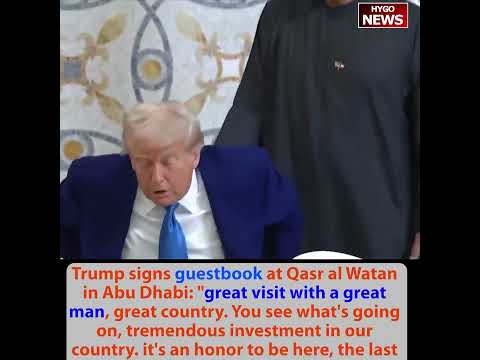
President Trump concluded his historic Middle East trip in Abu Dhabi in May 2025 with characteristic commentary on diplomatic relationships. “I shook more hands than any human being is capable of doing. They were starving for love because our country didn’t give them love,” Trump said, referencing the Gulf leaders’ warm reception. “They gave them a fist bump. Remember the fist pump in Saudi Arabia?” — a reference to Biden’s infamous greeting of MBS that had been widely criticized. Trump signed the guest book at Qasr al Watan: “A great visit with a great man, a great country. The last four days have been really amazing. It shows you where our country can go.” He confirmed AI purchases would flow largely through American companies with Jensen Huang present throughout.
”Starving for Love”
Trump assessed the Gulf leaders’ warm reception.
“Jennifer, I’m sure that you saw that last night,” Trump said. “I shook more hands than any human being is capable of doing. That was a long deal, and they were big people.”
He explained the emotional dimension: “But they were starving for love, because our country didn’t give them love.”
He delivered the comparison: “They gave them a fist bump. Remember the fist bump in Saudi Arabia? He travels all the way to Saudi Arabia in that case, and he gives them a fist bump.”
He stated what they actually wanted: “That’s not what they want. They don’t want a fist bump. They want to shake his hand.”
The “fist pump” reference was to July 2022, when Biden had visited Saudi Arabia and greeted Crown Prince Mohammed bin Salman with a fist bump rather than a handshake. The gesture had been widely mocked at the time. Biden had spent months attacking Saudi Arabia during his 2020 campaign, calling the kingdom a “pariah state” over the Khashoggi killing. He then needed Saudi cooperation to address rising oil prices and had traveled to Riyadh seeking help — but refused to shake MBS’s hand out of human rights concerns.
The fist bump had satisfied nobody. Human rights advocates criticized Biden for any physical contact with MBS. Saudi leaders were insulted by the symbolic rejection. The Saudis didn’t increase oil production despite Biden’s visit, deepening American-Saudi tensions that persisted throughout Biden’s term.
Trump’s approach was the opposite. He embraced Gulf leaders as partners. He shook their hands enthusiastically. He described their countries in superlative terms. The response was visible in the $142 billion Saudi military deal, the 160-aircraft Qatar Boeing order, and the massive UAE investment commitments. Warm diplomacy produced warm deals; cold diplomacy produced cold shoulders.
The “starving for love” characterization was both emotionally resonant and factually grounded. Gulf leaders had been treated as embarrassments by the Biden administration — allies to be managed rather than partners to be celebrated. Trump’s approach provided the dignity and respect they wanted, and the business relationships followed.
Qasr al Watan
Trump signed the guest book at the United Arab Emirates’ presidential palace.
“This has been a great visit with a great man, a great country,” Trump recorded. “You see what’s going on — tremendous investment in our country, and the development you just looked at.”
He highlighted the specific technology focus: “AI Plus is going to be purchased through mostly companies based in the United States. Jensen was here — in the whole group — and I think it’s going to be something very special.”
He described the scope: “It’s a massive project, and it’s going to be bought through the United States largely.”
He praised the host: “It’s an honor to be here. The last four days have been really amazing. I think they’ve been amazing, but it shows you where our country can go.”
Qasr al Watan — the “Palace of the Nation” — was the UAE’s presidential palace complex, a massive marble and glass architectural achievement that served both ceremonial and governmental functions. Trump signing the guest book represented formal diplomatic tradition: the signature marked his presence and became part of the palace’s historical record.
The AI reference was commercially significant. The UAE was investing tens of billions in AI infrastructure — data centers, chip acquisitions, and AI-powered applications across its economy. Jensen Huang’s presence throughout the trip signaled that NVIDIA would be a primary supplier. For American technology companies, the UAE represented one of the largest AI infrastructure markets in the world.
“AI Plus” appeared to reference an enhanced AI partnership program, potentially involving advanced chip exports that had been restricted under Biden-era policies. By allowing American AI chips to flow to UAE in exchange for UAE commitments to purchase primarily from U.S. companies, the Trump administration created a framework that benefited both economies while maintaining technological leadership.
”Media Treated Us Very Fairly”
Trump continued his unusual acknowledgment of positive media coverage.
“The media’s treated us very fairly,” Trump said. “Maybe because you’re with me, I don’t know, but they’ve treated us very fairly.”
He summarized the trip: “It’s been an amazing trip. I don’t think there’s ever been anything like it.”
The repetition of fair media treatment — a theme Trump had raised multiple times during the trip — reflected his genuine surprise at the coverage. The trip’s success had been so comprehensive that even hostile outlets couldn’t find substantial angles for negative coverage. The deals were real. The diplomacy was real. The economic impact was real.
More importantly, the trip had reframed the overall narrative about Trump’s second term. After 100 days that had been characterized by opponents as chaotic tariff escalation, the Middle East trip demonstrated strategic discipline producing concrete results. Rather than endless conflict with foreign nations, Trump was building relationships that generated trillions in investment. Rather than isolationism, he was advancing American commercial interests through aggressive engagement.
”Almost Destination Unknown”
Trump hinted at next steps with his characteristic showmanship.
“We’ll be leaving tomorrow, as you know, almost destination unknown,” Trump said. “We’re getting close. Could you be here? Could you be there? Probably going back to Washington, DC tomorrow.”
He noted the potential stop: “Some of you are going to be traveling with us.”
The “destination unknown” language suggested Trump was keeping options open for potential stops on the return journey. The possibility of a side trip to Turkey for Putin-Zelensky talks had been raised earlier; other potential stops could have included Israel, Egypt, or other regional partners who might want to meet while Trump was in the area.
Presidential travel was rarely genuinely uncertain — the complex logistics of Air Force One required advanced planning, security coordination, and diplomatic clearances. Trump’s “destination unknown” comment was more likely a rhetorical flourish suggesting flexibility than a genuine statement of undetermined itinerary. But the message served its purpose: emphasizing that Trump would seize any opportunity to advance American interests, wherever that might lead him.
The Team’s Role
Trump explicitly thanked his administration team.
“I want to thank all of my team — Howard, Scott, everybody. They’ve done an amazing job,” Trump said.
The team references were to Secretary of Commerce Howard Lutnick and Treasury Secretary Scott Bessent, who had accompanied Trump throughout the trip and played key roles in the commercial agreements. Both had worked extensively on the Middle East trip preparation, handling the negotiations that produced the specific contracts Trump announced publicly.
The acknowledgment reflected Trump’s generally consistent practice during the second term. Unlike the first term, when personnel disputes and public criticism of cabinet members had been frequent, the second term featured substantially more team cohesion. Trump publicly praised his cabinet secretaries regularly; they publicly praised him in return. The contrast with the first term’s often-dysfunctional dynamics was substantial.
Key Takeaways
- Trump: “I shook more hands than any human being is capable of doing. They were starving for love because our country didn’t give them love.”
- Biden critique: “They gave them a fist bump. Remember the fist pump in Saudi Arabia? That’s not what they want.”
- Abu Dhabi guest book: “A great visit with a great man. Tremendous investment. Last four days have been really amazing.”
- AI investment: “AI Plus is going to be purchased through mostly companies based in the United States. Jensen was here.”
- “Media’s treated us very fairly. It’s been an amazing trip. I don’t think there’s ever been anything like it.”