 HYGO News
 Trump: I love construction, WH opened 1800, Why no flagpole from grass? you're not real people
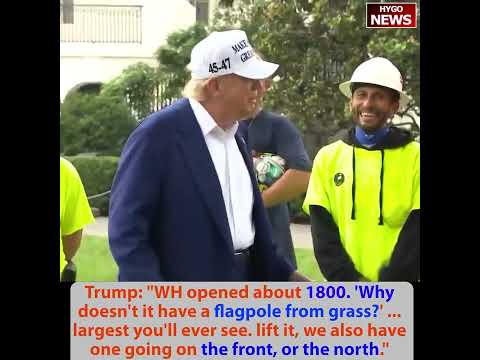
Trump: I love construction, WH opened 1800, Why no flagpole from grass? you’re not real people
A morning that was supposed to be a small ceremonial moment — the installation of new American flagpoles on the North and South Lawns of the White House — turned into a vintage Trump exchange with the press corps about construction, California’s high-speed rail project, architectural history, and who among the people gathered on the South Lawn qualified as “real people.” Trump’s delivery was part policy, part monologue, part aside to the construction crew he clearly admired. The flagpoles themselves are the kind of detail that presidents have either added to or subtracted from the White House grounds for more than two centuries, and Trump is adding. The aesthetic result — two large, tapered flagpoles flying the American Flag on each of the building’s primary lawn elevations — will be a visible and durable artifact of the current administration.
”I Love Construction”
Trump’s opening was unguarded. “I know you enjoy being present. Have you ever missed a movie? I love it in Star Shader. I love it to your heart. Well, I love it. I know it better than anybody.”
The Whisper transcription is choppy, but the substance is that Trump is expressing his affection for construction, a subject he has made central to his adult biography. His real-estate development background gives him an unusual fluency on the operational details of building projects — what materials cost, how long things take, why some projects go over budget.
“I know it better than anybody” is Trump’s signature superlative. It is the kind of claim that produces eye-rolls from critics and nods from supporters. On this particular subject — construction — the claim has more basis than on some others.
The California High-Speed Rail
The first policy content of the morning came in the form of a sharp critique of California’s high-speed rail project. “When I see a train railroad going from San Francisco to LA, I think it’s a hundred times over that. That’s incredible. One of the most incompetent things that’s an instrument. And why do they keep pointing down? I think we’re not going to like it. In fact, a little bit of a story. We’re not going to find that anywhere. It’s out of control.”
The specific numbers — “a hundred times over” the original budget — is Trump’s rhetorical compression. The actual overrun is not quite 100x, but the direction is right. The project’s initial estimates in the early 2010s came in around $33 billion. Current estimates exceed $128 billion, and the scope has been reduced relative to the original plan.
”It Doesn’t Go Where It’s Supposed To”
Trump then delivered the scope critique. “First of all, it doesn’t go where it’s supposed to. It’s supposed to go from LA to San Francisco now because they’re not having money. They’ve spent what is it? Thirty, forty times more than those that go to San Francisco. And they made it much shorter because it no longer goes into the cities. It stops miles outside of the city.”
The criticism is factually grounded. The project was originally planned to connect downtown Los Angeles to downtown San Francisco. The current buildout — known as the Central Valley segment — connects Merced to Bakersfield, neither of which is Los Angeles nor San Francisco. The extension to the anchor cities has been deferred due to cost and environmental concerns.
For a rail project, the value of the system is determined by where it goes. A high-speed rail that connects Merced to Bakersfield serves a fraction of the ridership that would have used a line between the state’s two largest metro areas. Trump’s observation — that the line no longer goes to the cities it was supposed to connect — is a substantive analytical point, not just political rhetoric.
”We’re Not Going To Fund That Anymore”
The operational consequence of Trump’s critique is federal funding policy. The federal government has provided billions in grants to the California high-speed rail project over its history. Trump’s stated position is that the federal government will not continue to fund a project he views as fundamentally mismanaged.
The policy implication is significant. California has been counting on continued federal support to complete the next phases of the project. Without federal support, the project is dependent on state sources alone, which are already strained. The result may be that the Central Valley segment becomes the only segment that ever operates — a truncated result that would disappoint almost everyone involved in the project’s original vision.
The Flagpoles
Trump then pivoted to the primary purpose of his remarks — the new flagpoles. “The White House opens about 1800. A little before that, it’s just a tad. And I’ve always said, why doesn’t it have a flagpole from the grass?”
The historical reference is accurate. The White House — or, as it was known at the time, the Executive Mansion — was first occupied by President John Adams in November 1800. President Jefferson was the first to spend a full year there. The “1800” date Trump gives is the standard anchor for the building’s occupancy.
”They Caught A Flagpole From The Grass”
Trump’s observation about the existing flag arrangement was direct. “They caught a flagpole from the grass. They have a little one on top, very little one. This is about the largest you’ll ever see.”
The existing American flag on the White House flies from the building itself — the familiar image of the flag on the roof. What Trump is adding is ground-level flagpoles on the lawns, which will produce a visibly different impression from the South Lawn and the North Lawn perspectives. The poles are, in his description, “about the largest you’ll ever see.”
The Pole Specifications
“It’s tapered. It’s an equality that you guys rarely get to even put up. They do that for a living. They’re incredible people.”
“Tapered” is a technical specification. A tapered flagpole is wider at the base than at the top. The taper produces both aesthetic benefit (the pole’s silhouette is more visually balanced) and structural benefit (the wider base handles wind loads more effectively). High-quality flagpole manufacturers offer tapered poles as premium products.
“An equality that you guys rarely get to even put up” is almost certainly “a quality that you guys rarely get to even put up” — with “you guys” referring to the construction crew on site. Trump is acknowledging that the crew is working with materials at a higher quality grade than most residential or commercial projects involve.
”They All Voted For Trump”
Trump’s aside to the press corps was characteristic. “I don’t know them, but I love them. And I would bet that they all voted for Trump. I mean, I don’t know for a fact, but I think so.”
The observation is a small political statement. Construction workers — particularly those in skilled trades like flagpole installation — shifted significantly toward Trump in 2024. The president is aware of that demographic shift and is comfortable acknowledging it publicly. The crew on the South Lawn are, he is suggesting, members of the coalition he represents.
Two Flagpoles, Two Lawns
Trump described the installation plan. “But we’re about to lift it and we also have one going on what’s called the front or the north. We have one going there identical. So we’ll have one on this side of the building. We’ll have one on that side of the building properly placed.”
The two-pole symmetry is deliberate. The White House has two public-facing elevations — the South Lawn side (toward the Mall) and the North Lawn side (toward Pennsylvania Avenue). A single flagpole on only one side would create an aesthetic imbalance. Two poles, identically specified and symmetrically placed, will produce a visual effect that reads as intentional design rather than ad hoc addition.
”I Have A Similar Pole”
Trump’s personal connection to the aesthetic was direct. “I have a similar pole. These are the best poles anywhere in the country or in the world, actually. They’re tapered. They have the nice top.”
The “similar pole” is presumably at one of Trump’s private properties — Mar-a-Lago, Trump Tower, Trump National Doral, or one of his other holdings. Trump’s own preference for tapered flagpoles with specific aesthetic features is being translated into the White House installation. The result is a White House detail that reflects the president’s personal taste rather than merely the default government-issue fare.
”You’re Not Real People”
The closing moment of the interaction produced one of the more memorable Trump asides to the press corps. “And I hope you enjoy it and let’s see how real people work. These are real people. You’re not real people. You have the stories.”
The line is delivered with characteristic Trump humor. The “you’re not real people” addressed to reporters is not literal — obviously reporters are people. The implicit contrast is between work that produces tangible products (flagpoles being installed) and work that produces stories. Trump is, in effect, paying the construction crew a compliment at the reporters’ expense.
“Your job is too easy” is the secondary line that completes the thought. Reporting on events is, in Trump’s framing, easier than building things. Whether that judgment is fair depends on one’s view of journalism, but the line is vintage Trump — punchy, aimed at a specific audience, and designed to reinforce a coalition.
”Thanks For Bringing America Back Again”
The informal exchange with the crew produced its own notable moment. “Thanks for having us. Thanks for bringing America back again.”
The crew members thanked the president for the visit and for his broader political work. That kind of informal acknowledgment between a president and working tradesmen is the sort of exchange that would not typically happen with an administration that was politically distant from the skilled trades. The interaction is one more data point in the coalition shift that defined the 2024 election.
The Two Flag Liftings At 11
Trump closed with logistics. “But we’re going to lift it and we also have one going on what’s called the front or the north. We have one going there identical. So we’ll have one on this side of the building. We’ll have one on that side of the building properly placed…And then we’re going to do, I think, two flag liftings. We’ll be putting it up at 11 on here and a couple of minutes later on the other side. We’ll start here at 11. So that’ll be very nice, very patriotic. We’re doing well and as a country.”
The 11 AM lifting ceremonies were the flag raising events. Two elevations of the same flag, minutes apart, at symmetric positions on the White House grounds. The ceremonial detail is the kind of thing that presidents in more formal administrations leave to protocol officers. Trump was personally involved in the logistics, which produced the kind of unscripted reporter-Q&A that would not happen if the event were stage-managed more tightly.
The Architectural Legacy
Flagpoles on the White House grounds are a small architectural legacy, but they are legacy. They will remain after the current administration ends. Future presidents will either maintain them, relocate them, or remove them. Each choice will be a statement. Trump’s decision to install them in the first place is his statement.
The broader point — that presidents shape the physical White House in large and small ways — is one that Americans do not often stop to consider. The Jefferson-era renovations, the Teddy Roosevelt-era West Wing addition, the Truman-era reconstruction, and the Obama-era kitchen garden are all physical artifacts of particular administrations. Trump’s flagpoles will be part of that record.
Key Takeaways
- Trump on California HSR: “it’s a hundred times over budget…It doesn’t go where it’s supposed to. It’s supposed to go from LA to San Francisco…They’ve spent thirty, forty times more…We’re not going to fund that anymore, it’s out of control.”
- Trump on White House flagpoles: “The White House opens about 1800…I’ve always said, why doesn’t it have a flagpole from the grass? They have a little one on top, very little one. This is about the largest you’ll ever see.”
- Two poles on two lawns: “We have one going on what’s called the front or the north. We have one going there identical. So we’ll have one on this side of the building.”
- The “real people” line: “let’s see how real people work. These are real people. You’re not real people. You have the stories.”
- The political coalition moment: “Thanks for bringing America back again” from the crew to the president at the informal flagpole ceremony.