 HYGO News
 Trump Praises Vance's Munich Speech on Free Speech; Vance Meets Zelensky; Water Restrictions Reversed
Trump Praises Vance’s Munich Speech on Free Speech; Vance Meets Zelensky; Water Restrictions Reversed
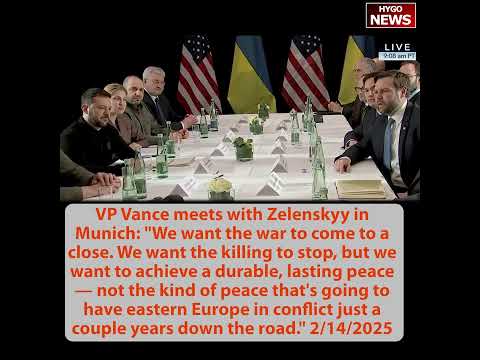
A February 2025 compilation captured three threads of the Trump administration’s agenda in a single day. President Trump praised Vice President JD Vance’s Munich Security Conference speech — which had “ruffled quite a few feathers in Europe” — as “a very brilliant speech” about the threats that eroding free speech and mass immigration posed to Europe. In Munich, Vance himself provided a readout of his meeting with Ukrainian President Zelensky, saying the goal was “a durable, lasting peace, not the kind of peace that’s going to have Eastern Europe in conflict just a couple years down the road.” And back in Washington, Trump announced the reversal of Biden-era water efficiency restrictions on dishwashers, sinks, and showers, calling them “unnecessary” and promising to make the change permanent through Congress.
Trump on Vance’s Munich Speech: “A Very Brilliant Speech”
A reporter noted that Vance’s Munich address had provoked strong reactions from European leaders and asked whether Trump believed Europeans held a fundamentally different worldview than his administration.
“I heard his speech, and he talked about freedom of speech,” Trump said. “And I think it’s true in Europe. It’s losing their wonderful right of freedom of speech. I see it.”
Trump praised the speech in unambiguous terms. “I mean, I thought he made a very good speech, actually, a very brilliant speech,” he said.
He highlighted the two themes that had drawn the most attention. “Europe has to be careful. And he talked about immigration. And Europe has a big immigration problem,” Trump said. “Just take a look at what’s happened with crime. Take a look at what’s happening in various parts of Europe.”
Trump concluded: “I thought his speech was very well received, actually. I’ve heard very good remarks.”
The assessment was significant because Vance’s Munich speech had been treated by much of the European media as a provocation. Vance had lectured European leaders about their commitment to free speech, their handling of immigration, and their failure to invest adequately in defense — all topics that touched on sensitive political debates within European countries. Trump’s enthusiastic endorsement signaled that Vance had delivered exactly the message the administration intended: a direct challenge to the European consensus on issues where the Trump White House believed Europe was failing.
Vance Meets Zelensky: “A Durable, Lasting Peace”
In Munich, Vice President Vance provided a public readout of his meeting with the Ukrainian delegation led by President Zelensky. The readout was brief but substantive, revealing the administration’s approach to the peace process.
“We’re, of course, happy to welcome the Ukrainian delegation led by President Zelensky,” Vance said. “We had a number of fruitful conversations, a number of things for us to follow up and work on.”
Vance then articulated the administration’s core objective. “Fundamentally, the goal is, as President Trump outlined it, we want the war to come to a close. We want the killing to stop,” he said. “But we want to achieve a durable, lasting peace — not the kind of peace that’s going to have Eastern Europe in conflict just a couple years down the road.”
The distinction between a quick ceasefire and “a durable, lasting peace” was important. Vance was signaling that the administration would not accept a superficial agreement that merely froze the current lines of contact, only for fighting to resume later. The peace had to address the underlying security concerns of both sides to prevent a repetition of the conflict.
“We had a number of good conversations about how we might accomplish that together,” Vance said. “And certainly, we’ll have many more in the days, weeks, and months to come."
"The Threat I Worry the Most About Is the Threat from Within”
The most provocative portion of Vance’s Munich remarks came in his assessment of Europe’s security challenges. Rather than identifying Russia, China, or terrorism as the primary threat, Vance pointed inward.
“While the Trump administration is very concerned with European security, and believes that we can come to a reasonable settlement between Russia and Ukraine, and we also believe that it’s important in the coming years for Europe to step up in a big way to provide for its own defense, the threat that I worry the most about vis-a-vis Europe is not Russia. It’s not China. It’s not any other external actor,” Vance said.
“And what I worry about is the threat from within — the retreat of Europe from some of its most fundamental values, values shared with the United States of America,” he continued.
The statement was a direct challenge to European leaders who viewed external threats as their primary security concern while downplaying internal erosion of democratic norms, particularly on free expression. Multiple European countries had enacted or expanded hate speech laws that criminalized forms of expression that would be protected under the First Amendment in the United States. Social media companies faced European regulations requiring them to remove content that was legal in America. Journalists and commentators had been prosecuted or investigated for statements that European courts deemed offensive.
Vance was telling European leaders, in their own security conference, that their approach to these issues was the biggest threat to the continent’s future.
Water Restrictions: “People Turn On the Sink and Water Barely Comes Out”
In a shift from geopolitics to domestic quality of life, Trump announced the reversal of Biden-era water efficiency standards that had regulated the flow rates of dishwashers, sinks, and showers.
“They mentioned dishwashers and sinks and showers and the whole thing. We’re going to get rid of those restrictions,” Trump said. “You have many places where they have water, they have so much water, they don’t know what to do with it. But people buy a house, they turn on the sink, and water barely comes out. They take a shower, water barely comes out, and it’s an unnecessary restriction.”
Trump had made water flow a recurring theme since his first term, when he had rolled back Obama-era efficiency standards. The Biden administration had restored and in some cases tightened those standards, which Trump was now reversing again.
He offered the practical argument that low-flow appliances were counterproductive. “And you know what they do? They press the button 10 times. They run it 10 times, so it ends up costing a lot more,” Trump said of dishwasher users who ran multiple cycles because the reduced water flow was insufficient to clean dishes in a single pass.
Trump noted that the administrative reversal would be temporary without legislative action. “We’re going back, and we’ll get it approved by Congress,” he said. “So for four years, it’s good, but we’re going to get it permanently taken care of.”
An administration official confirmed the implementation path: “We are overhauling the water sense standards that are there to update them for the American people, to bring down cost of living and combat inflation, and just pursue common sense.”
The water restriction issue, while seemingly minor compared to Ukraine peace negotiations and European security, resonated with ordinary Americans who experienced the practical inconvenience of reduced water flow daily. It was the kind of tangible quality-of-life improvement that the administration used to demonstrate its commitment to deregulation in terms every household understood.
Key Takeaways
- Trump called VP Vance’s Munich Security Conference speech “a very brilliant speech,” praising its focus on freedom of speech and immigration, and said “Europe has to be careful” about both issues.
- Vance met with Zelensky in Munich and said the goal was “a durable, lasting peace — not the kind of peace that’s going to have Eastern Europe in conflict just a couple years down the road.”
- Vance declared that the biggest threat to Europe was “the threat from within — the retreat of Europe from some of its most fundamental values, values shared with the United States.”
- Trump announced the reversal of Biden-era water efficiency restrictions on dishwashers, sinks, and showers, saying “people buy a house, they turn on the sink, and water barely comes out.”
- Trump pledged to make the water restriction reversal permanent through Congressional legislation rather than relying solely on executive action.