 HYGO News
 Trump Announces Hyundai's $5.8B Steel Plant in Louisiana: 'Tariffs Very Strongly Work'; $3-4 Trillion in Total Investment
Trump Announces Hyundai’s $5.8B Steel Plant in Louisiana: “Tariffs Very Strongly Work”; $3-4 Trillion in Total Investment
President Trump announced in March 2025 that Hyundai would build a $5.8 billion steel plant in Louisiana — the company’s first ever steel mill in the United States — producing 2.7 million metric tons of steel annually and creating more than 1,400 jobs. The steel would supply Hyundai’s auto plants in Alabama and Georgia, which would “soon produce more than 1 million American-made cars every single year.” Trump declared the investment “a clear demonstration that tariffs very strongly work” and said total corporate investment commitments had reached the “$3 trillion and $4 trillion mark, which has never happened to our country before.”
$5.8 Billion and 2.7 Million Metric Tons
Trump opened with the announcement in characteristically specific terms.
“Today, we’re delighted to report that Hyundai is announcing a major $5.8 billion investment in American manufacturing,” Trump said. “In particular, Hyundai will be building a brand new steel plant in Louisiana, which will produce more than 2.7 million metric tons of steel a year, creating more than 1,400 jobs for American steelworkers.”
He noted this was just the beginning: “And then there’ll be major expansion after that.”
Trump emphasized the historic nature of the investment: “This will be Hyundai’s first ever steel mill in the United States — one of the largest companies in the world, by the way — supplying steel for its auto parts and auto plants in Alabama and Georgia, which will soon produce more than 1 million American-made cars every single year.”
The vertical integration was the key detail. Hyundai was not merely building a steel plant; it was building the supply chain that would feed its existing American manufacturing operations. Steel produced in Louisiana would be shipped to auto plants in Alabama and Georgia, where it would be turned into parts and assembled into cars — all within the United States. The days of shipping steel from Korea or importing auto parts from overseas would be replaced by a domestic supply chain that kept every dollar of value creation within American borders.
“The cars are coming into this country at levels never seen before,” Trump added. “Get ready."
"Tariffs Very Strongly Work”
Trump drew the direct causal line between his trade policy and the investment.
“This investment is a clear demonstration that tariffs very strongly work,” he said. “And I hope other things also, but the tariffs are bringing them in at levels that have not been witnessed.”
The Hyundai announcement was the most tangible evidence yet for the tariff argument. A major foreign automaker was building a steel mill and expanding car production in the United States specifically because the economic calculus had changed. The cost of importing steel and manufactured goods into the United States now included tariffs that made domestic production comparatively attractive. Hyundai’s $5.8 billion was not charity or goodwill; it was a rational business decision made in response to a changed trade environment.
The steel plant was particularly significant because steel had been at the center of the tariff debate since Trump’s first term. The 25% tariffs on steel imports that Trump had imposed in 2018 had been criticized as protectionist and inflationary. But the Hyundai investment demonstrated the tariffs’ intended effect: rather than paying the tariff to import steel, Hyundai would produce the steel domestically, creating American jobs and tax revenue in the process.
Governor Landry: “We Were Going to Have a Great President”
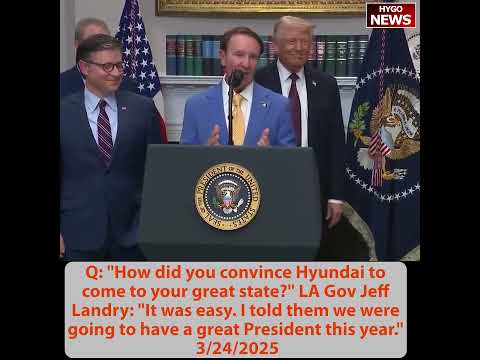
When a reporter asked Louisiana Governor Jeff Landry how he had convinced Hyundai to choose his state, Landry delivered the line of the event.
“How did you convince Hyundai to come to your great state?” the reporter asked.
“It was easy,” Landry said. “I told them we were going to have a great president this year.”
The crowd laughed, but Landry then provided the substantive answer: “I think that this is America seeing the America First policy in action. It’s not just promises. It’s about action.”
Landry described the state-level reforms that complemented the federal environment: “All last year, many of these legislators — the Speaker and the Senate President — we worked on making Louisiana as friendly for business as the President is making America. We worked on public safety. We worked on educational reform, which the President’s been working on. We worked on tax reform — historic tax reform.”
He quantified the impact: “In Louisiana right now, I believe before the summer’s over, we’ll have $50 billion worth of construction projects going on in Louisiana. That is a record, Mr. President. It has never happened under any other president, under any other administration.”
Landry credited Trump’s leadership: “I can only look at the leadership that he has brought, not only to the White House but to the world as well, and sort of have these executives come here and say, ‘Hey, we want to invest in America,’ because for decades now, what Americans have seen is jobs being offshored rather than onshored.”
The $50 billion figure for a single state was remarkable. Louisiana — a state with a GDP of approximately $270 billion — was seeing construction investment equivalent to nearly 20% of its entire economy. The combination of federal tariff policy and state-level reforms had created conditions that attracted investment at a scale that would transform the state’s economy.
The $3-4 Trillion Total
Trump placed the Hyundai announcement within the broader investment wave.
“Hyundai’s a great company,” he said. “We have other great companies coming in, and we have some that are going to be staying here and very much expanding. And we have tremendous interest in every business. I can’t just say automobiles, but automobiles is a big one.”
He contextualized the scale: “We’ve had, as you know, Apple’s announced a $500 billion investment, and other companies have announced $250 billion, $300 billion.”
Then the cumulative total: “But we’re well into the $3 trillion and $4 trillion mark, which has never happened to our country before.”
Trump defined what the number meant in human terms: “What it really means is jobs. All we care about is jobs, right? We care about quality and quality of life and safety and security, but we care about jobs. And we have a lot of people coming in.”
The $3-4 trillion figure had escalated from the $4 trillion Trump had cited at the cabinet meeting just days earlier, suggesting that new commitments were flowing in continuously. The roster of companies — Apple at $500 billion, Hyundai at $20+ billion total U.S. investment, plus hundreds of other announcements — represented the most concentrated wave of domestic industrial investment in American history.
The Onshoring vs. Offshoring Reversal
Governor Landry’s observation about the reversal from offshoring to onshoring captured the historical significance of the moment. For three decades, the dominant trend in American manufacturing had been the movement of production overseas — first to Mexico and Canada under NAFTA, then to China after its WTO accession. Communities that had been built around factories watched their economic foundations disappear as companies chased lower labor costs, weaker regulations, and proximity to growing Asian markets.
The Hyundai steel plant represented the reversal of that trend in its most concrete form. A Korean company was building a steel mill in Louisiana — not in Korea, not in Vietnam, not in Mexico, but in the American South. The steel would feed auto plants that would produce a million cars per year. The jobs would pay steelworker and autoworker wages. The tax revenue would fund Louisiana’s schools, roads, and public services.
Trump’s claim that “tariffs very strongly work” was not an abstract economic argument. It was standing next to the governor of a state that was about to host $50 billion in construction, announcing a $5.8 billion steel plant that would not have been built without the trade policy changes the administration had implemented.
Key Takeaways
- Hyundai will build its first-ever U.S. steel mill in Louisiana: $5.8 billion, 2.7 million metric tons/year, 1,400+ jobs, with “major expansion after that.”
- The steel will supply Hyundai auto plants in Alabama and Georgia, which will produce over 1 million American-made cars per year.
- Trump called it “a clear demonstration that tariffs very strongly work” and said total investment commitments had reached “$3-4 trillion, which has never happened to our country before.”
- Louisiana Governor Landry said $50 billion in construction projects were underway in his state — “a record that has never happened under any other president.”
- When asked how he convinced Hyundai to come to Louisiana: “It was easy. I told them we were going to have a great president this year.”