 HYGO News
 Trump on Harvard: 'Remedial Mathematics -- How Did These People Get In? 1,600 Board Scores Can't Get In'; Buttigieg Thinks Porn Will Win Back Young Men; OMB's Vought: First Rescissions Package Next Week -- USAID, CPB, NPR; Stephen Moore on Art of the Deal
Trump on Harvard: “Remedial Mathematics — How Did These People Get In? 1,600 Board Scores Can’t Get In”; Buttigieg Thinks Porn Will Win Back Young Men; OMB’s Vought: First Rescissions Package Next Week — USAID, CPB, NPR; Stephen Moore on Art of the Deal
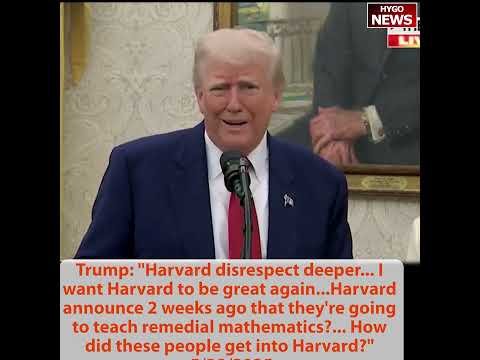
Multiple significant stories converged in late May 2025. President Trump continued his Harvard battle with a devastating observation: “How could Harvard be great when you have Harvard announce two weeks ago that they are going to teach remedial mathematics, remedial, meaning they’re going to teach low-grade mathematics, like two plus two is four. How did these people get into Harvard if they can’t do basic mathematics? People with 1,600 in their boards don’t get in. And they’re letting people in. And they’re bragging about how they’re teaching them basic mathematics. Where do these people come from?” He contrasted Harvard’s obstinance with Columbia’s cooperation: “Columbia has been very bad — very anti-Semitic and lots of other things. But they’re working with us on finding a solution. But Harvard wants to fight. They want to show how smart they are. And they’re getting their ass kicked.” Pete Buttigieg suggested gay marriage and porn defense as ways to win back young men. OMB Director Russ Vought confirmed: “First rescissions bill next week — USAID, many of the wasteful garbage funding, and Corporation for Public Broadcasting and NPR.” Stephen Moore framed Trump’s trade approach: “US is the hub of the world economy. He’s using leverage to get better deals.”
Harvard: “Remedial Mathematics”
Trump’s Harvard critique reached new specific heights.
Asked how the Harvard confrontation would end, Trump said: “I don’t know. I don’t know.”
He described the ongoing tension: “Harvard’s got to behave themselves. Harvard is treating our country with great disrespect. And all they’re doing is getting in deeper and deeper and deeper.”
He claimed positive motivation: “You know, I’m looking out for the country. And for Harvard. I want Harvard to do well. I want Harvard to be great again, probably.”
Then came the devastating specific.
”Two Plus Two Is Four”
Trump made the specific indictment.
“How could it be great when you have Harvard announced two weeks ago that they are going to teach remedial mathematics,” Trump said, “remedial, meaning they’re going to teach low grade mathematics, like two plus two is four.”
He asked the pointed question: “How did these people get into Harvard if they can’t do basic mathematics?”
He emphasized the absurdity: “I mean, people with 1,600 in their boards don’t get in.”
He described the institutional position: “And they’re letting people in. And they’re bragging about how they’re teaching them basic mathematics.”
He expressed bewilderment: “Where do these people come from?”
The Harvard remedial mathematics announcement was factually accurate. Harvard had announced in spring 2025 that it would launch a remedial mathematics course targeting incoming students who lacked basic algebra skills. This was remarkable because:
Traditional Harvard standards: Harvard had historically required strong mathematics preparation. SAT math scores for Harvard admits were typically 780-800.
Holistic admissions: Harvard’s holistic admissions approach had gradually reduced the weight placed on academic achievement relative to other factors (essays, extracurriculars, diversity, etc.).
Affirmative action effects: Even after the Supreme Court’s 2023 SFFA decision ending race-based admissions, Harvard had modified its admissions to preserve racial diversity through other mechanisms.
Standardized test role: Harvard had made standardized tests optional during COVID, which had persisted for years. Reduced reliance on standardized testing had potentially weakened academic preparation assessment.
Legacy and donor preferences: Students admitted through legacy, donor, or athletic preferences might lack the strongest academic preparation.
The combined result was that some Harvard admits lacked mathematical preparation that would have been taken for granted in previous generations. The remedial mathematics course was institutional acknowledgment that some incoming students needed fundamental skills development.
Trump’s “people with 1,600 in their boards don’t get in” referenced the SAT scoring system. A perfect SAT score of 1,600 (800 verbal + 800 math) was not sufficient for Harvard admission; students with perfect scores were routinely rejected. Yet Harvard was admitting students who needed remedial algebra.
The logical inference Trump was drawing was troubling:
- High-scoring students couldn’t get in
- Some admitted students couldn’t do basic math
- Therefore admissions was selecting for factors other than academic capability
- Those other factors (race, connections, politics, diversity) had displaced merit
- Harvard was no longer primarily an academic institution
The Columbia Comparison
Trump contrasted Harvard with Columbia University.
“Columbia has been really, and they were very, very bad what they’ve done,” Trump said. “They’re very anti-Semitic and lots of other things.”
He noted Columbia’s different approach: “But they’re working with us on finding a solution. And, you know, they’re taking off that hot seat.”
He described Harvard’s posture: “But Harvard wants to fight. They want to show how smart they are. And they’re getting their ass kicked.”
Columbia’s situation had been similar to Harvard’s:
- Extensive antisemitism after October 7, 2023
- Federal investigations and funding freezes
- Administrative controversies and leadership changes
- Pressure from alumni, donors, and government
Columbia’s response had been different from Harvard’s. Columbia had:
- Negotiated with federal authorities
- Accepted various reforms
- Made specific commitments about curriculum and faculty
- Worked with federal oversight
- Sought resolution rather than confrontation
Harvard’s response had been more combative:
- Legal challenges to federal oversight
- Public defiance of demands
- Appeals to academic freedom
- Coordination with other elite institutions
- Institutional posture of resistance
Trump’s framing was that cooperative institutions received accommodation while confrontational institutions received aggressive federal response. Columbia was “taking off the hot seat” through cooperation while Harvard was “getting their ass kicked” through defiance.
Buttigieg’s Strategy
The broadcast included footage of former Transportation Secretary Pete Buttigieg discussing Democratic strategy for young men.
The context: “Of course, we should be talking about how, yeah, if, you know, Speaker Johnson got his way, it wouldn’t be possible, not just for gay people to get married, but for straight people to get divorced, let alone like birth control or how he would want to regulate porn or whatever people, most people would have a problem with.”
Buttigieg’s argument was that Democrats could win back young male voters by:
- Defending gay marriage rights
- Opposing Republican divorce restrictions (which did not actually exist)
- Supporting birth control access
- Defending pornography against regulation
- Attacking Mike Johnson’s alleged religious views
The analysis was politically problematic for several reasons:
The strawman argument: Speaker Johnson had not advocated banning straight divorce, restricting birth control, or other extreme positions Buttigieg attributed to him. The argument was attacking positions nobody held.
The porn defense: The political calculation that Democrats should win young men by defending pornography was dubious. Young men’s political alienation from Democrats had multiple causes that pornography defense would not address.
The young male collapse: Young men had shifted toward Trump significantly in 2024. This was partly driven by:
- Cultural messaging that male traits were problematic
- Economic concerns about jobs and opportunity
- Educational systems that had pushed young men down
- Dating and relationship difficulties
- Concerns about masculinity being devalued
Defending gay marriage and pornography did not address any of these concerns. Instead, it confirmed Democratic messaging priorities that had alienated young men in the first place.
The Buttigieg framing revealed Democratic strategic confusion. Rather than addressing the substantive reasons young men had moved toward Trump, Democrats were doubling down on cultural positions that had contributed to the shift.
Vought’s Rescissions Package
OMB Director Russ Vought provided details on the first rescissions package.
Asked if a rescissions package was coming: “I can. We’ll be sending that up on Monday or Tuesday, whenever the house is back in session.”
He described the contents: “They will get our first rescissions bill. And again, this has been proposed and we’ve talked about it. We want to make sure that Congress passes its first rescissions bill, including the doge.”
He specified the targets: “And so this is the first one is foreign aid, USAID cuts, many of the waste and garbage that was funding not only wasteful but hurting our foreign policy, but also the Corporation for Public Broadcasting and NPR.”
He described the coordination: “We’ll be sending that up and we’ll be working with Congress. And we’ve had good conversations to make sure that they knew what was coming. They had some input as to changes that could be made to make it something that could pass the house.”
Understanding Rescissions
Rescissions are a specific budget mechanism:
Traditional appropriations: Congress passes laws appropriating money for specific purposes. Once appropriated, the money is generally expected to be spent as directed.
Rescission process: The president can propose to “rescind” previously appropriated funds, meaning Congress would remove the authority to spend specific money. This requires a specific procedure under the Congressional Budget and Impoundment Control Act of 1974.
Simple majority: Asked about passage requirements, Vought confirmed: “Simple majority in both the House and the Senate and the virtue of this is that it’s a process that also evades the Senate filibuster.”
The filibuster-proof aspect was crucial. Most legislation in the Senate required 60 votes due to filibuster rules. Republicans held a majority but not 60 votes. Rescissions could pass with simple majorities (51 in Senate), making them achievable despite Democratic opposition.
The Specific Targets
The three categories targeted were politically symbolic:
USAID waste: USAID had been the primary target of DOGE findings. Specific examples had included:
- Dance classes in Wuhan
- Sesame Street in Iraq
- Gender studies programs in Pakistan
- Climate programs in various countries
- Administrative overhead consuming large shares of aid budgets
Cutting USAID waste addressed real problems while being politically popular with the Trump base.
Corporation for Public Broadcasting: CPB provided federal funding for public broadcasting, including PBS and NPR affiliates. Conservative criticism had focused on:
- Left-leaning editorial content
- Subsidization of politically-biased programming
- Use of taxpayer funds for advocacy rather than news
- Failure to represent conservative perspectives
- Competition with private media
Eliminating CPB funding would require public broadcasters to rely entirely on donations and underwriting.
NPR: National Public Radio received approximately 1% of its funding from CPB directly, but its affiliates received more through various mechanisms. Eliminating NPR funding:
- Was politically popular with conservatives
- Was modest in actual dollar impact
- Had symbolic importance
- Addressed persistent conservative grievance
The three targets combined had several characteristics:
- Politically popular with Trump’s base
- Relatively modest in total dollar terms
- Symbolically important
- Achievable without filibuster
- Demonstrated administration commitment to DOGE findings
Stephen Moore on Art of the Deal
Economic commentator Stephen Moore framed Trump’s trade approach.
“The one thing I’ve really discovered just watching Trump over the last three or four months is really, he does get out of the deal,” Moore said.
He described Trump’s style: “He doesn’t show his hand. He always starts with a very strict position. And then, you know, he negotiates from there.”
He explained the strategic underpinning: “And what he is doing, just so people understand, is because the United States is the hub of the world economy, all of these other countries, Bill, have to trade with the United States. Canada has to trade with the United States. Mexico does. Britain does. The Chinese do.”
He identified the specific technique: “So he’s using that leverage. And that’s the word he uses in a book all the time, leverage to get better deals for the U.S.”
He made the prediction: “I think in the end of the day, he will prevail.”
Moore’s analysis was economically correct. The United States was indeed:
- The world’s largest consumer market
- The world’s largest economy (roughly 25% of global GDP)
- The world’s largest destination for exports
- The world’s reserve currency issuer
- The world’s largest military and security provider
These structural advantages gave the United States substantial leverage in bilateral trade negotiations. Other countries needed American market access more than America needed their market access. American absence from their export market would be devastating; their absence from American markets would be manageable.
Trump’s characteristic negotiating approach involved:
- Starting with extreme demands (100%+ tariffs)
- Creating crisis conditions that forced attention
- Offering relief in exchange for substantive concessions
- Maintaining flexibility to accept various outcomes
- Claiming victory regardless of exact outcome
This approach had worked in multiple contexts during Trump’s first term (USMCA, Phase 1 China deal, various bilateral agreements). It was being applied more aggressively in the second term with tariffs on China, EU, Canada, and others.
The Broader Trade Context
By late May 2025, Trump’s trade approach had generated multiple outcomes:
China deal: Initial tariff reductions in exchange for preliminary commitments on fentanyl, trade practices, and other concerns.
EU negotiations: Von der Leyen’s request for extension to July 9 indicated willingness to negotiate substantively.
UK deal: Comprehensive trade deal completed in March 2025 with significant British concessions.
Mexico and Canada: USMCA implementation proceeding with various enforcement actions.
Various bilateral deals: South Korea, Japan, India, Brazil, and others in various negotiation stages.
The cumulative pattern was American leverage being successfully deployed to reshape global trade relationships. Whether this would produce sustained long-term benefits was contested, but short-term success was evident.
Key Takeaways
- Trump on Harvard remedial math: “How did these people get into Harvard? People with 1,600 board scores don’t get in.”
- Columbia vs Harvard: “Columbia working with us — off the hot seat. Harvard fighting, getting their ass kicked.”
- Buttigieg’s young men strategy: Defend gay marriage and pornography — strategic confusion about why young men left Democrats.
- Vought on rescissions: “First package next week — USAID, CPB, NPR. Simple majority, no filibuster.”
- Stephen Moore on Trump’s trade: “US is hub of world economy — using leverage to get better deals. He will prevail.”