 HYGO News
 Trump: Hamas pulled out negotiating, Macron recognize Palestinian state, Powell; City-funded grocery
Trump: Hamas pulled out negotiating, Macron recognize Palestinian state, Powell; City-funded grocery
Five news items compressed into a single Trump press engagement. On Gaza: “Hamas didn’t really want to make a deal. I think they want to die … they’re going to have to fight and they’re going to have to clean it up.” On Emmanuel Macron’s announcement that France would recognize a Palestinian state: “He’s okay. He’s a team player pretty much. But here’s the good news. What he says doesn’t matter. It’s not going to change anything.” On the post-Fed-visit Powell meeting: “He said to me very strongly, the country is doing well. He said congratulations … I got that to mean that I think he’s going to start recommending lower rates.” On tariff revenues: “We have so much money coming in … we’re thinking about a little rebate. But the big thing we want to do is pay down debt.” And on Democrats: “Everything is fake with the Democrats. Take a look at what they just found about the dossier — everything is FAKE. They’re a bunch of sick people.” Plus a Kansas City city-funded grocery store in ruin as another cautionary tale about the Mamdani model.
”Hamas Didn’t Really Want to Make a Deal”
Trump’s framing of the Gaza ceasefire breakdown. “They pulled out of Gaza, they pulled out in terms of negotiating. It was too bad. Hamas didn’t really want to make a deal. I think they want to die.”
“I think they want to die” is Trump’s characterization. The negotiating posture Hamas adopted — delaying, conditioning, reneging — suggests to Trump that the organization’s leadership either is not interested in a deal or has concluded that continued fighting is preferable to any reasonable agreement.
“And it’s very, very bad. And it got to be to a point where you’re going to have to finish the job. And don’t forget, we got a lot of hostages out.”
“Finish the job” is the framing of what comes next. If Hamas is not interested in a deal, Israel (backed by the U.S.) will have to complete the military campaign. That means continued military operations, likely including operations into areas Hamas still controls, until the organization is either destroyed or so degraded it cannot resist.
“So now we’re down to the final hostages. And they know what happens after you get the final hostages.”
The “final hostages” reference is to the remaining hostages (living and deceased) that Hamas has held. The negotiating logic: hostages are Hamas’s primary bargaining chip. Once they are released, Hamas has no remaining leverage over Israel’s military posture. “They know what happens after” means Hamas leadership understands that hostage release removes the strategic constraint on Israel finishing the campaign.
”They’re Going to Have to Clean It Up”
“So they pulled out and they’re going to have to fight and they’re going to have to clean it up. You’re going to have to get rid of it.”
That is Trump’s forward posture. Fighting continues. Military operations proceed. The objective remains the destruction of Hamas as an organized military-governance force in Gaza.
The administration has supported Israel’s operational autonomy on Gaza while pushing for hostage deals where possible. The current breakdown of negotiations means the support continues through the military phase.
Macron on Palestinian Statehood
Trump addressed French President Emmanuel Macron’s announcement that France would recognize a Palestinian state. “They are productive for France to say that they would recognize the Palestinian state. Macron said that yet. Look, he’s a different kind of a guy. He’s okay. He’s a team player pretty much.”
“Different kind of a guy” is Trump’s euphemism for Macron’s approach. Macron has consistently positioned as a centrist-left European leader with stylistic differences from Trump. “He’s okay. He’s a team player pretty much” is Trump’s relatively mild assessment.
“But here’s the good news. What he says doesn’t matter. It’s not going to change anything.”
That is the dismissal. France recognizing a Palestinian state does not actually alter the operational situation. Palestinian statehood is primarily determined by:
- Whether there is coherent Palestinian governance (currently fragmented between Fatah in the West Bank and a disintegrating Hamas in Gaza)
- Whether Israel accepts such governance
- Whether the United States supports the process
French recognition, while symbolically significant, does not change any of those underlying factors. Trump is making that explicit.
“So how could he? How could he not? Well, he made a statement, friends. Macron, the statement doesn’t carry any weight. He’s a very good guy. I like him, but that statement doesn’t carry weight.”
The Rebate Teaser
Trump then introduced a notable fiscal possibility. “We’re thinking about that actually. We have so much money coming in. We’re thinking about a little rebate.”
“A little rebate” is significant. The administration has been sitting on substantial surplus tariff revenue. That revenue is not earmarked. It can be used for debt paydown, tax cuts, or direct rebates to citizens.
“But the big thing we want to do is pay down debt. But we’re thinking about a rebate. That’s a very good plan. We’re thinking about a rebate because we have so much money coming in from tariffs. Tariffs that a little rebate for people of a certain income level might be very nice.”
“A little rebate for people of a certain income level” is the specific framing. Means-tested. Targeted at middle-class and below. Not a universal transfer. That specificity matters — it excludes high earners from the rebate, preserving the rebate’s political framing as benefiting working Americans.
If the rebate materializes, it would be a concrete political touchpoint ahead of the midterms. Direct transfers to voters are among the most politically salient policies a government can implement. A tariff-funded rebate — “checks from President Trump’s tariffs” — would be the kind of tangible deliverable that resonates with voters who may not track abstract fiscal data.
”Everything Is Fake With the Democrats”
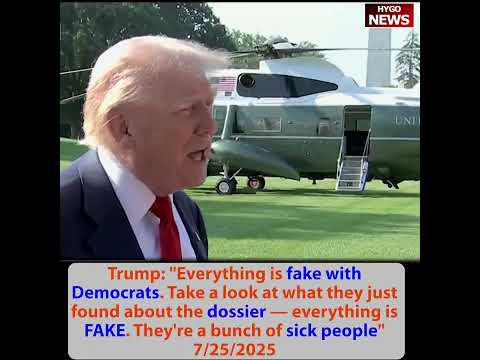
Trump pivoted to the Democratic Party’s response to the Gabbard revelations. “Everything’s fake with that administration. Everything’s fake with the Democrats. Take a look at what they just found about the dossier. Everything is fake. They’re a bunch of sick people.”
“Everything is fake” is the summary judgment. Trump is grouping the Biden administration, the Democratic Party, and the mainstream media into a single institutional complex that produces fake information. The Steele Dossier revelations are offered as the latest evidence of the pattern.
“They’re a bunch of sick people.” That is the personal characterization. Not merely wrong. Not merely mistaken. Sick. The term conveys moral condemnation beyond political disagreement.
The Powell Meeting
“I think that’s your own pal. I think we had a very good meeting. We’re getting about the building. That’s out of control. But I think we had a very good meeting on interest rates.”
“We had a very good meeting on interest rates.” That is the key phrase. The Fed site visit and adjacent meetings apparently produced a substantive discussion of monetary policy.
“And he said to me, now I don’t know if he’s going to say this on Thursday or whatever he speaks, but he said to me very strongly, the country is doing well. He said congratulations. The country is doing really well.”
Powell apparently offered congratulations. “The country is doing really well” is the kind of acknowledgment that, coming from a Fed chair to a president, validates the president’s economic positioning.
“And I got that to mean that I think he’s going to start recommending lower rates.”
Trump’s interpretation: if Powell is acknowledging the economy is doing well (low inflation, strong employment, strong growth), Powell’s public monetary policy recommendations should move toward rate cuts. Whether Powell actually makes that pivot at the next FOMC meeting is the test.
Kansas City’s Failed Grocery Store
The segment closed with an extended look at the Linwood Shopping Center grocery store in Kansas City — a city-funded grocery that is failing. “It’s clear the sun for a shed, 31st and Prospect is struggling. This is the first section people see when they come in. There’s barely any produce. A lot of the coolers and shelves around the store look the same way. Empty.”
Empty shelves at a city-funded grocery store in what has historically been a food-desert neighborhood. The city stepped in to operate the grocery when private operators could not make it work. City operation is producing the same failure.
“So shoppers have been asking us if the store isn’t closing, then where is all the food? A rotten smell comes through the door and anywhere you turn you’ll see products that need to be restocked. No hot food or deli. I watch people walk in and walk out.”
“Rotten smell … no hot food or deli … people walk in and walk out.” That is the operational reality of a grocery store that has lost the ability to serve its customers. Whether through inadequate staffing, insufficient supply chain management, theft reducing available inventory, or broader operational dysfunction, the store is failing even to meet basic grocery expectations.
“The grocery store has received financial assistance from the city, but has been unable to keep those shelves stocked in an area that in the past has often been referred to as a food desert.”
City assistance was supposed to solve the food-desert problem. It has not. The store’s inability to keep shelves stocked suggests the problem is more than a capital-access issue. Running a grocery store profitably requires operational expertise that cannot be easily manufactured through municipal subsidy.
“Around here, a good thing don’t last too long. It will impact a lot of people and a lot of families. The city owns the Lomwood shopping center. A non-profit operates the grocery store.”
Mamdani’s Warning
The Kansas City grocery store case study matters specifically because Zohran Mamdani’s NYC mayoral platform includes government-run grocery stores as the food-desert solution. Senator Elizabeth Warren endorsed the plan as “a new and fresh plan” with “real successes” in other cities.
Kansas City’s experience is not that of a real success. It is a real failure. A city with a non-profit operator, receiving financial assistance from the city, in a neighborhood that needed the service — and the store cannot keep shelves stocked.
If Kansas City’s effort, smaller and more focused than the Mamdani proposal, is failing, NYC’s larger and more ambitious version is almost certain to fail at the same operational level. The difference: NYC’s failure would affect millions of residents, cost hundreds of millions of dollars, and embarrass the Democratic coalition backing the experiment.
Five Items, One Administration Day
Gaza fighting. Macron’s Palestinian state recognition. Powell meeting. Rebate possibility. Democratic “fake” news. Plus Kansas City’s municipal grocery failure as cautionary evidence against Mamdani-style proposals.
The administration is operating on multiple fronts simultaneously. Each front produces specific data points. The cumulative message: the Trump administration is engaged, productive, and generating concrete outcomes while Democrats are producing material (Macron’s statement that “doesn’t carry weight,” Mamdani-style grocery proposals that demonstrably fail) that ranges from ineffective to counterproductive.
Key Takeaways
- Trump on Gaza: “Hamas didn’t really want to make a deal. I think they want to die … they’re going to have to fight and they’re going to have to clean it up.”
- On Macron’s Palestinian state recognition: “What he says doesn’t matter. It’s not going to change anything … that statement doesn’t carry weight.”
- Trump teased a potential tariff rebate: “We have so much money coming in, we’re thinking about a little rebate. But the big thing we want to do is pay down debt … a little rebate for people of a certain income level might be very nice.”
- On the Powell meeting: “He said to me very strongly, the country is doing well … I got that to mean that I think he’s going to start recommending lower rates.”
- Kansas City’s city-funded grocery store failing with empty shelves and a “rotten smell” — a cautionary counter-example for Mamdani’s NYC government-grocery plan that Elizabeth Warren endorsed.