 HYGO News
 Trump greets King & Queen of Netherlands; Sec Gen NATO: Let me salute Trump, NATO additional $1T
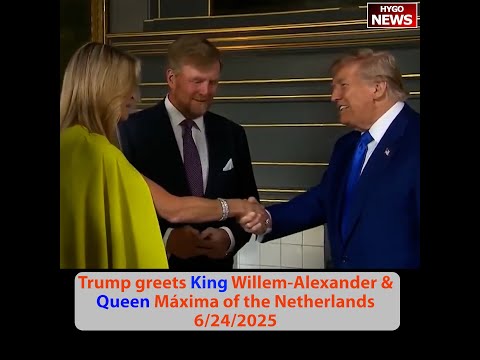
Trump greets King & Queen of Netherlands; Sec Gen NATO: Let me salute Trump, NATO additional $1T
Trump arrived in The Hague wearing his signature white “USA” cap for a NATO summit that, within hours of his arrival, produced an unusual public salute from NATO Secretary General Mark Rutte. Rutte credited Trump personally — addressing the president by his first name, “dear Donald” — for the $1 trillion additional defense spending that NATO members have committed over the past decade. The gesture is extraordinary in the context of NATO diplomacy, where secretaries general typically maintain careful distance from specific heads of state, and it captured a moment in which the administration’s long-running insistence that European allies pay more for their own defense has, at least rhetorically, been embraced by the alliance’s senior institutional voice.
Arrival At The Hague
Trump’s arrival sequence was captured across multiple video angles. The early morning departure from the United States, the overnight flight, the landing at the Dutch airport, the motorcade to the Royal Palace — each element was documented. The white “USA” cap that Trump wore throughout the travel is the kind of detail that distinguishes Trump’s public diplomacy from the more subdued visual vocabulary of conventional presidential travel.
Meeting The Royals
Trump’s arrival at the Royal Palace in The Hague included the formal greeting by King Willem-Alexander and Queen Máxima of the Netherlands. Royal greetings at major international summits are diplomatic gestures of hosting hospitality. The Netherlands, as the host country, provides the royal couple as official greeters for visiting heads of state and government.
The footage captures a standard royal-protocol encounter — handshakes, brief exchanges, photo opportunities. Trump’s conduct during these encounters has varied across the presidencies of his two terms. The current encounter appears routine — a formal exchange of courtesies without the kind of diplomatic incident that has occasionally characterized his royal meetings.
”Let Me Salute President Trump’s Longstanding Leadership”
The moment that gave the video its news value came from NATO Secretary General Mark Rutte. “For decades, the United States sought to get Europe to truly step up. Now, European allies in Canada will equalize their defence spending with the United States. So let me salute President Trump’s long-standing leadership in calling for NATO to increase defence spending.”
“Let me salute” is formal diplomatic language. Rutte is not merely acknowledging Trump’s role — he is formally saluting it. The verb choice elevates the moment beyond pleasantry into explicit endorsement.
The $1 Trillion Figure
Rutte then delivered the specific number. “Today, I am pleased to announce that NATO has already added an additional one trillion dollars in defence spending over the past decade.”
One trillion dollars in additional NATO defense spending over the past decade is a substantial figure. The context matters. In 2014, NATO members pledged at the Wales Summit to move toward spending 2% of GDP on defense. Most members fell short of that target throughout the following years. Trump, beginning in his first term and continuing into his second, made the under-spending a central grievance — threatening American commitments to the alliance unless European members increased their spending.
The $1 trillion cumulative increase is the measurable outcome of that pressure. Whether Trump deserves sole credit for the increase, or whether Russia’s 2022 invasion of Ukraine was the larger catalyst, is debatable. Rutte’s framing gives Trump substantial credit.
”Dear Donald”
The most unusual moment of Rutte’s remarks was the informal salutation. “Mr. President, dear Donald, that is thanks to you pushing us.”
“Dear Donald” is personal, not diplomatic. Secretaries general of NATO generally do not address American presidents by their first names in public speech. The deviation is deliberate. Rutte is signaling a level of personal rapport with Trump that he wants observers to understand.
Some reactions to the phrase have characterized it as obsequious — a NATO secretary general adapting personal registers to accommodate a specific president’s preferences. Other reactions have read it as diplomatically sophisticated — a secretary general using personal language to build personal rapport that will pay dividends in subsequent negotiations.
Whether the phrase serves NATO’s interests well depends on what it produces over time. If personal rapport between Rutte and Trump translates into better alliance outcomes, the phrase was a smart investment. If not, critics will return to it as an example of misjudged diplomacy.
”Add Trillions More”
Rutte closed with the forward commitment. “And tomorrow we will build on that foundation and add trillions more in defence spending, because we need to do this.”
“Trillions more” is plural. Rutte is committing to defense spending increases that, cumulatively across the alliance, will total multiple trillions of dollars. The specific mechanism is the emerging consensus that NATO members should commit to 5% of GDP on defense — well above the 2% target that has been the baseline.
The 5% Target Context
The 5% target is significant because it represents a substantial expansion of European defense budgets. Germany, France, Britain, Italy — each would need to increase their defense spending substantially to reach 5% of GDP. Smaller members would face similar challenges relative to their economies.
Whether European publics will support the increased spending is an open question. Defense spending competes with social spending in most European countries. Every euro spent on defense is a euro not spent on healthcare, education, or social services.
The political case for the increase rests on the changed security environment. Russia’s invasion of Ukraine demonstrated that major European wars are not a relic of the twentieth century. Russian aggression could extend beyond Ukraine. European forces, in a post-Ukraine environment, need to be capable of deterring such extension without relying exclusively on American backing.
Why Rutte’s Endorsement Matters
The political significance of Rutte’s endorsement extends beyond personal relationship with Trump. It signals that NATO’s institutional apparatus has accepted the Trump administration’s central critique of European under-spending and is committed to addressing it.
For decades, American presidents of both parties have complained about European defense spending. The complaint was understood, but the response was limited. Every administration worked around the complaint rather than producing sustained increases.
Rutte is signaling that the current moment is different. European members are committing to spending increases at a scale that addresses the historical critique. The NATO secretary general, standing beside the American president, is publicly crediting the president with the shift.
The Rhetorical Effect
Beyond the policy substance, Rutte’s remarks served the political function of preempting Trump’s own NATO-related grievances. If the secretary general begins the summit by saluting Trump’s leadership and crediting him with a $1 trillion increase, Trump has less reason to use his summit time to complain about European under-spending. The summit can focus on forward-looking commitments rather than retrospective grievances.
That is diplomatically clever. Rutte is allocating his limited time with Trump to maximize the productive time rather than the grievance time. Whether Trump will accept the framing and move on to forward-looking topics is a separate question. The option has been created.
The Broader Summit Context
The NATO summit at The Hague comes at a moment of substantial international activity. The Iran-Israel ceasefire is still being consolidated. The Russia-Ukraine war continues with limited movement. The administration is simultaneously pursuing trade negotiations with multiple major partners. China’s posture in the Pacific is the subject of ongoing strategic planning.
Against that background, the NATO summit is one of several diplomatic tracks. Its outcomes will be measured against what it produces for alliance cohesion, European defense capability, and American strategic positioning. Rutte’s opening remarks set up the substantive discussions that will follow.
The White USA Cap
The detail that circulated widely in the hours after Trump’s arrival was his choice of the white “USA” cap. Presidents typically travel in dark suits without specific political or thematic headwear. Trump’s cap choice was, like most Trump choices, both specific and intentional.
The cap is the kind of item Trump has worn throughout his political career. Wearing it in the Netherlands is a low-cost signal that his identity as an American leader — his “America First” posture — travels with him regardless of the diplomatic context. European leaders who meet with him see, immediately, that his brand of American leadership is distinct from the more cosmopolitan styling of his predecessors.
Whether European publics appreciate the distinction is one question. Whether American supporters see the cap and feel represented is another. The cap serves both audiences simultaneously, which is why Trump chose it.
The Protocol Calibrations
Presidential travel to foreign capitals involves thousands of small protocol decisions. The motorcade route, the specific greeters, the seating at formal functions, the scheduled bilateral meetings, the gifts exchanged — each detail is the product of careful planning and, often, considerable negotiation.
For the Netherlands portion of the summit, the decision to have the King and Queen greet Trump on arrival is itself a significant protocol choice. Royal greetings elevate the visit’s apparent stature. American presidents sometimes receive royal greetings; sometimes they receive less elevated protocol treatment. The King and Queen’s presence signals that the Dutch government considers the visit substantial.
The Opening Of The Summit
The summit’s substantive work begins after the opening ceremonial events. Defense spending commitments, Ukraine support, Russia posture, Indo-Pacific strategy — all will be addressed in sessions over the course of the summit. Whether the outcomes match the ambitious framing of Rutte’s opening remarks will depend on the specific commitments each member makes.
The test of Rutte’s framing will come in the final communique. If members agree to the 5% of GDP target, the framing is validated. If members hedge or qualify the commitment, the framing is aspirational rather than substantive. The communique will be the measurable output against which the summit will be judged.
The Political Benefit Of Being Saluted
For Trump specifically, being publicly saluted by the NATO secretary general at the summit’s opening is a political benefit. American voters who have supported Trump’s pressure on European allies see the pressure producing results. American voters who have been skeptical of the pressure see a NATO secretary general acknowledging that the pressure was justified.
The benefit is the kind of thing Trump values. Public recognition — particularly from institutional figures who have, in the past, been perceived as insufficiently appreciative — is politically valuable. Rutte has provided it.
The Stakes Of Continued Credibility
For the alliance, Rutte’s opening is a bet. If Trump continues through the summit in a cooperative posture — if he commits American forces to NATO missions, if he endorses the collective defense framework, if he refrains from public criticism of specific members — the alliance emerges stronger. If Trump uses the summit to criticize specific members or to question specific commitments, the salute will be read as having failed to achieve its purpose.
Rutte is staking institutional credibility on the bet. If it pays off, he looks like a skillful alliance manager. If it does not, he looks like he overcommitted to a specific personal relationship at the expense of institutional posture.
Key Takeaways
- Trump arrived at The Hague for the NATO summit wearing a white “USA” cap, greeted at the Royal Palace by King Willem-Alexander and Queen Máxima.
- NATO Secretary General Mark Rutte: “Let me salute President Trump’s long-standing leadership in calling for NATO to increase defence spending.”
- The $1T figure: “NATO has already added an additional one trillion dollars in defence spending over the past decade.”
- The personal register: “Mr. President, dear Donald, that is thanks to you pushing us” — unusual informal salutation from a NATO secretary general.
- Forward commitment: “Tomorrow we will build on that foundation and add trillions more in defence spending, because we need to do this.”