 HYGO News
 Trump at 2 AM on Air Force One: 'Unlike Biden, I'm Always Available'; '$2-3 Billion a Day'; Ukraine: 'Put Up or Shut Up'
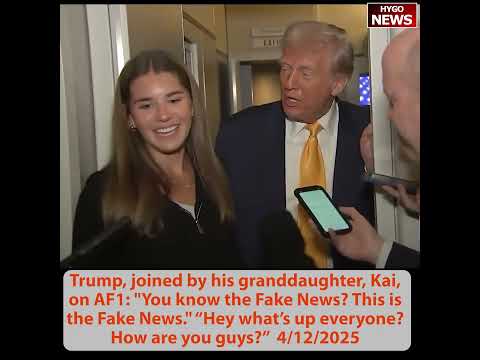
Trump at 2 AM on Air Force One: “Unlike Biden, I’m Always Available”; “$2-3 Billion a Day”; Ukraine: “Put Up or Shut Up”
President Trump gave a freewheeling Air Force One interview at 2:15 AM in April 2025 with granddaughter Kai beside him, telling reporters: “I’m always available, unlike Biden. Think Biden would do an interview at 2 in the morning? He wouldn’t do one at 9 in the morning.” He reported the country was “making $2-3 billion a day” in tariff revenue, previewed a Monday meeting with El Salvador’s president about the prison housing America’s “worst people on earth,” said he would announce semiconductor tariff details Monday, and offered his most direct assessment of Ukraine peace talks: “There’s a point at which you just have to either put up or shut up.”
2:15 AM on Air Force One
The interview’s most remarkable feature was its timestamp. Trump was fielding questions from reporters at 2:15 in the morning aboard Air Force One, with his granddaughter Kai sitting beside him.
“What about Kai? What’s she doing on the news?” a reporter asked.
Trump introduced her: “You know the fake news? This is the fake news.” He turned to Kai: “Hey, what’s up, everyone? How are you guys?”
Kai greeted the press corps: “Good morning.”
Trump added: “She’s a great athlete actually, great golfer. A great student actually.”
The 2 AM interview was itself the story. Trump used the late hour to draw the Biden contrast: “I’m always available, unlike Biden. Think Biden would do an interview at 2 in the morning? He wouldn’t do one at 9 in the morning.”
The stamina argument had been central to the 2024 campaign, and Trump continued to make it through demonstration rather than assertion. He was not claiming to be energetic; he was proving it by conducting a press availability in the middle of the night after a full day of events that had included a fight card. The fact that his granddaughter was with him — alert and greeting reporters at 2 AM — added to the image of a family that operated on a schedule that would exhaust most people half their age.
El Salvador and “The Worst People on Earth”
Trump previewed his Monday meeting with El Salvador’s president.
“On Monday, you’re having a meeting with the president of El Salvador,” a reporter noted.
“Yes,” Trump confirmed. “I think he’s doing a fantastic job. He’s taking care of a lot of problems that we have. We really wouldn’t be able to take care of it at cost standpoint.”
He described the CECOT prison that was housing deported gang members: “We have some very bad people in that prison. People that should have never been allowed into our country. People that murdered, drug dealers. Some of the worst people on earth are in that prison. And he’s able to do that.”
The El Salvador partnership had become one of the administration’s most productive bilateral relationships. President Bukele’s willingness to accept deported gang members and house them in the mega-prison known as CECOT had given the Trump administration a solution to one of the most vexing problems in immigration enforcement: what to do with violent criminals from countries that lacked the institutional capacity to incarcerate them securely.
”$2-3 Billion a Day”
Trump provided the latest tariff revenue update.
“Inflation’s dropping. Americans have more money and the country has more money,” he said. “You know, we’ve been making $2 and $3 billion dollars a day the last couple of weeks.”
He emphasized the historical reversal: “We didn’t make that ever. And we’re making a lot of money. And then to be nice, I lowered the tariffs on everybody. But we’ve been making a lot of money. And it’s always been the other way around. Other countries, in particular China, was making a lot of money.”
The $2-3 billion per day in tariff revenue — even after the 90-day pause reduced rates on most countries to 10% — represented an annualized revenue stream of $700 billion to over $1 trillion. The revenue was flowing into the U.S. Treasury rather than being spent by foreign governments on their own economic development and military buildups. The direction of the money flow had reversed.
Summer Vacations and “No Inflation”
A reporter provided personal context: “I was with the Trump campaign this time last year. And Americans were telling me they weren’t planning to take a summer vacation because of inflation and gas prices. It’s a different scenario now. What’s your message to the American family?”
Trump responded: “Well, we have no inflation. We have lots of success. We have a lot of great things in the hope column.”
He cited the border: “We have a border that’s totally sealed at a level that nobody’s seen. Even during my four years, I was very successful with it. But I think we have it even a little more closed.”
He maintained the legal immigration distinction: “We are allowing people into the country, but they have to come in legally.”
The summer vacation question captured the kitchen-table economic reality that mattered most to ordinary Americans. A year earlier, families had been canceling vacations because of inflation and gas prices. Now, with gas prices down 20%, egg prices down 50%, and the CPI showing declining consumer prices, the economic pressure had eased enough that families could plan their summers again.
Semiconductor Tariffs: “Monday”
When asked about the announced exemptions for electronics from China tariffs, Trump was precise about the timeline.
“I’ll give you that answer on Monday,” he said. “We’ll be super specific on Monday.”
The semiconductor tariff question was one of the most closely watched trade issues. The exemption of iPhones, computers, and related electronics from the China tariffs had been announced over the weekend, raising questions about whether the administration was carving out exceptions that would undermine the tariff regime. Trump’s promise of Monday specificity suggested that the electronics exemption was temporary and that a dedicated semiconductor tariff framework was coming.
Ukraine: “Put Up or Shut Up”
Trump offered his most direct public statement on Ukraine peace negotiations.
“I think Ukraine and Russia might be going okay,” he said. “And you’re going to be finding out pretty soon.”
Then the bluntest assessment he had given: “There’s a point at which you just have to either put up or shut up. And see what happens.”
He added: “But I think it’s going fine.”
The “put up or shut up” formulation suggested that the negotiations had reached a critical juncture where both sides needed to make final commitments or acknowledge that talks had failed. The phrase implied that Trump’s patience with the negotiating process was not unlimited — that he expected results, not just process.
He broadened the optimism: “We have lots of fights going around the world. And I think we have some pretty good news coming on some of the conflicts.”
Key Takeaways
- Trump conducted a press availability at 2:15 AM with granddaughter Kai: “I’m always available, unlike Biden. He wouldn’t do one at 9 in the morning.”
- Tariff revenue: “$2-3 billion a day the last couple of weeks — we didn’t make that ever.”
- El Salvador meeting Monday: Bukele “doing a fantastic job” housing “some of the worst people on earth” in CECOT prison.
- Semiconductor tariff details promised for Monday: “We’ll be super specific.”
- Ukraine: “There’s a point at which you just have to either put up or shut up. I think it’s going fine.”