 HYGO News
 Trump at Daytona 500: 'More Progress in Three Weeks Than Biden Made in Four Years'; Putin Wants to Stop Fighting
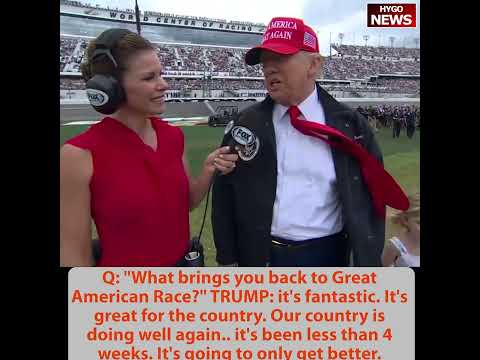
Trump at Daytona 500: “More Progress in Three Weeks Than Biden Made in Four Years”; Putin Wants to Stop Fighting
President Trump attended the 67th annual Daytona 500 on February 16, 2025, accompanied by his granddaughter, and used the high-profile sporting event to deliver a series of impromptu remarks to reporters. Trump declared that “this country has made more progress in the last three weeks than it’s made in the last four years,” blamed Biden entirely for the latest inflation numbers, explained his reciprocal tariff policy in the simplest possible terms, delivered a memorable line about Russia’s territorial history under four presidents, and offered his most confident assessment yet that Putin “wants to stop fighting” in Ukraine.
Return to the Great American Race
Trump had last attended the Daytona 500 five years earlier, during his first term. A reporter opened by noting the anniversary: “Five years ago we were standing in this very spot. What brings you back to the Great American Race?”
Trump’s answer turned the question into a statement about the state of the country. “I think it’s fantastic. It’s great for the country,” he said. “Our country is doing well again. And we have spirit all over the world. There’s spirit again. We brought it back, and it’s been less than four weeks.”
He projected optimism: “So you’ll see what we do. And in a little period of time, it’s going to only get better.”
Trump had brought his granddaughter to the event, and the reporter asked about the experience of riding around the track in the presidential limousine, known as “the Beast.” Trump quipped: “I’ll let you know in about two minutes because they’re going to be going quite quickly, I understand.”
When asked if he would get on the radio to address the drivers before the race, Trump deflected with admiration: “I say they have a lot of courage doing this. I see it, and I’ve been here, and they have a lot of guts, as they would say.”
The Daytona appearance was strategically valuable for the White House. NASCAR events draw audiences that skew heavily toward the working-class, patriotic demographics that formed the core of Trump’s political coalition. The president’s visible comfort at the event — bringing his granddaughter, joking with reporters, praising the drivers — reinforced his connection to a cultural world that felt distinctly different from the Washington political establishment.
”More Progress in Three Weeks Than in Four Years”
Away from the race festivities, Trump delivered his sharpest assessment of his first weeks in office versus the Biden presidency.
“Remember, I’ve been here for three weeks,” Trump said. “And when you saw the inflation numbers — I’ve been here for three weeks. I had nothing to do with inflation. This was caused by Biden. I had four years of virtually no inflation.”
He then delivered the headline: “But I’ll tell you what, this country has made more progress in the last three weeks than it’s made in the last four years, and we’re respected again as a country.”
The claim was sweeping but reflected the pace of executive action that had characterized the early second term. In his first three weeks, Trump had signed dozens of executive orders covering the border, energy, DOGE, tariffs, military policy, vaccine mandates, and government restructuring. The volume of activity contrasted with what Republicans had characterized as the slow, chaotic, and ineffective pace of the Biden administration.
The inflation point was politically important. January 2025 inflation data had come in higher than expected, and the White House needed to ensure the numbers were attributed to Biden rather than to the new administration. By emphasizing that he had been in office for only three weeks, Trump was drawing a clear temporal line: anything negative in the current economic data was Biden’s legacy; anything positive was Trump’s doing.
”Under Trump, They Took Nothing”
Trump then delivered one of his most memorable lines of the early second term, summarizing Russia’s territorial behavior under four consecutive presidents.
“Remember this: under Bush, they took a lot. Under Obama, they took a lot. Under Biden, they’re trying to take the whole thing. And under Trump, they took nothing,” he said.
The statement compressed two decades of Russian expansionism into a single sentence. Under George W. Bush, Russia invaded Georgia in 2008. Under Barack Obama, Russia annexed Crimea in 2014. Under Joe Biden, Russia launched its full-scale invasion of Ukraine in 2022. Under Trump’s first term, Russia did not engage in any territorial aggression.
The formulation was effective because it was factually accurate in its broad strokes and devastatingly simple in its implication: American presidential strength deterred Russian aggression, and American presidential weakness invited it. Whether or not the correlation was causal, the pattern was undeniable, and Trump’s ability to compress it into a single sentence made it one of the most repeatable arguments of his presidency.
Reciprocal Tariffs: “Very Simple”
Reporters asked Trump about his tariff policy, and he offered the most concise explanation possible.
“We’re having reciprocal tariffs. Whatever they charge, we charge. Very simple,” Trump said. “If a certain country like India, which is very high tariff, if they charge us X dollars, we charge them X dollars.”
He noted that the approach had even won praise from unlikely quarters: “Sorry, it’s a fair thing to do. Even the media said it was fair.”
The Daytona setting made the simplicity of the explanation particularly effective. The NASCAR audience — millions of working Americans who did not follow the details of trade policy — could understand “whatever they charge, we charge” in the time it took to say it. The policy was reduced to its most essential principle: fairness through reciprocity.
Trump added that the tariff policy would be “very good for the United States,” projecting the same confidence he brought to every aspect of his early second-term agenda.
Putin “Wants to Stop Fighting”
The most significant policy remarks came when reporters asked about Trump’s conversations with Russian President Vladimir Putin regarding the Ukraine war.
“I think he wants to stop fighting,” Trump said of Putin. “I see that. We spoke long and hard. Steve Witkoff was with him for a very extended period, like about three hours.”
Trump repeated his assessment with emphasis: “I think he wants to stop fighting. They have a big, powerful machine, you understand that. And they defeated Hitler, and they defeated Napoleon. You know, they’ve been fighting a long time. They’ve done it before. But I think he’d like to stop fighting.”
A reporter pressed on whether Putin was willing to hold onto current territorial gains or make concessions. Trump responded directly: “No, I think he wants to stop. That was my question to him. Because if he’s going to go on, that would have been a big problem for us. And that would, of course, be a big problem, because you just can’t let that happen.”
Trump concluded with his strongest statement about the direction of negotiations: “I think he wants to end it. And they want to end it fast. Both of them. And Zelensky wants to end it too.”
The assessment that both Putin and Zelensky wanted to end the war “fast” was the most optimistic language any American official had used about the Ukraine peace process since the full-scale invasion began in February 2022. Combined with the report that Special Envoy Witkoff had spent three hours with Putin, it suggested that substantive negotiations were underway at a level of seriousness that had not existed under the Biden administration.
The Daytona Optics
The choice to deliver these remarks at the Daytona 500 rather than in a formal White House setting was itself a communication strategy. By mixing geopolitical assessments with race-day banter, Trump projected the image of a president who was simultaneously managing global crises and living a normal life. The granddaughter, the Beast ride around the track, the praise for drivers’ “guts” — all of it framed Trump as a leader who was in command without being consumed by the job.
The contrast with Biden, who had faced persistent criticism for his limited public schedule and extended vacations, was implicit but unmistakable. Trump was at Daytona, taking questions on Russia, India, tariffs, and inflation, while also enjoying the race with his family. The message was that presidential leadership and personal life were not in tension — at least not for a president operating at Trump’s pace.
Key Takeaways
- Trump declared at the Daytona 500 that “this country has made more progress in the last three weeks than it’s made in the last four years,” blaming Biden entirely for the latest inflation numbers.
- He delivered a memorable summary of Russian aggression: “Under Bush, they took a lot. Under Obama, they took a lot. Under Biden, they’re trying to take the whole thing. And under Trump, they took nothing.”
- Trump explained reciprocal tariffs in the simplest terms: “Whatever they charge, we charge. Very simple.”
- He said Putin “wants to stop fighting” in Ukraine after Special Envoy Witkoff spent three hours with the Russian president, adding that “Zelensky wants to end it too.”
- Trump attended the 67th annual Daytona 500 with his granddaughter, marking his second presidential appearance at the Great American Race.