 HYGO News
 Trump: GENIUS Act named after me, never allow Central Bank Digital Currency, PROMISES KEPT!
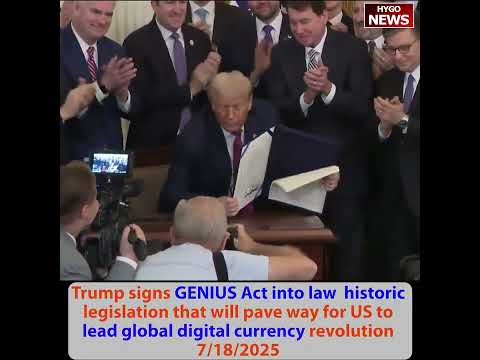
Trump: GENIUS Act named after me, never allow Central Bank Digital Currency, PROMISES KEPT!
At the GENIUS Act signing ceremony, President Trump delivered one of his most relaxed crypto-policy speeches to date — joking that the legislation was “named after me,” re-pledging categorically that the U.S. will “never allow the creation of a central bank digital currency in America,” and marking one year since he became the first presidential candidate to address the Bitcoin conference in Nashville. “The crypto builders and founders were under relentless assault by the Biden administration, which was trying to crush your industry and crush you as people and go after your families. They were a vicious group of people.” The signing moment itself carried another signal: “This is not an auto pen, by the way. Which is a big scandal.” And Chicago Mayor Brandon Johnson reiterated the sanctuary-city posture: “We will not cooperate with ICE."
"They Named It After Me”
Trump’s opening line was characteristic self-deprecating humor. “It’s a very important act. The Genius Act. They named it after me and I want to thank you. I want to thank you. This is a hell of an act.”
The GENIUS Act’s actual acronym expansion — Guiding and Establishing National Innovation for U.S. Stablecoins — is a congressional construction that happened to produce a word the president could joke about having been named for. The joke landed with the room. The underlying legislation, whatever its acronym, is the first major federal framework for stablecoin regulation.
“This is a hell of an act” — Trump’s plain-language endorsement. The bill has been industry-shaped, bipartisan-supported, and timed to anchor the administration’s broader crypto agenda. Its passage represents the crypto industry’s most significant policy win at the federal level in the sector’s history.
”Never Allow the Creation of a CBDC”
Trump then delivered the CBDC pledge with unusual formality. “I also remain fully committed to my pledge never to allow the creation of a central bank digital currency in America. It won’t happen by first.”
“It won’t happen by first” is the transcribed version of what was almost certainly “It won’t happen. Period.” or “It won’t happen. First.” The speech continued without clarification.
The CBDC pledge matters because the debate is not theoretical. The Federal Reserve has studied CBDCs extensively, other central banks (the ECB, the People’s Bank of China, the Bank of England) are in various stages of CBDC development, and CBDC proponents in U.S. financial policy circles have argued that the U.S. will fall behind if it does not develop its own digital dollar.
Trump’s position — flatly opposed, with an executive order already banning them, and with legislation being pursued to codify the ban into permanent law — is the strongest anti-CBDC posture any major government has taken. For the crypto industry, which views private, permissionless cryptocurrencies as categorically distinct from state-issued digital currencies, this is the foundational guarantee.
”Impressed That They Knew What the Hell It Was”
Trump recounted the experience of working with members of Congress on the CBDC prohibition. “And the other night, I will say with some of the congressmen and women, they wanted that so badly that was so important to them. I was impressed that they knew what the hell it was, to be honest with you.”
That is vintage Trump honesty about how Washington works. Most members of Congress — across parties — do not deeply understand cryptocurrency policy or CBDC architecture. The members who do are a small but passionate minority, concentrated in specific committees. Trump’s surprise that “they knew what the hell it was” reflects the rarity of that depth.
“Please, sir, please, the central bank digital currency, will you have to make sure, sir? And I’m saying, what do you know about that? It’s amazing the knowledge that people have gained all of a sudden.”
The “knowledge that people have gained all of a sudden” is the friendly jab. Members of Congress who had never spoken publicly about CBDCs now feel urgent about them, because the policy is being decided and they want their fingerprints on the outcome.
”We’ve Already Got It From the Fed, Right”
Trump continued with a policy detail. “We had a lot of problems with some of them. I said, we’ve already got it from the Fed, right, from commerce and from an executive order. You don’t need it a fourth time.”
The reference is to the multiple layers of CBDC prohibition already in place. The Federal Reserve, via Chairman Jay Powell’s congressional testimony, has committed not to pursue a CBDC without explicit congressional authorization. The Commerce Department has issued guidance against CBDC development. And Trump’s January executive order banned CBDC work across the executive branch.
“You don’t need it a fourth time” is Trump pushing back on members who wanted redundant legislative prohibitions. His position: the CBDC is already banned through three independent mechanisms; a fourth statutory prohibition is redundant engineering.
“Sir, we have to get it. Amazing. They knew their subject that in there and we helped them out.”
Trump’s concession to the members who pushed: “we helped them out” — meaning the legislation Trump signed or will sign does codify the CBDC prohibition into statute, redundant or not.
”My First Week in Office”
Trump laid out the CBDC timeline. “My first week in office, I signed an executive order to ban the creation of a CBDC in the United States and very soon I look forward to signing legislation that will codify and ban the make it a permanent law, put it in permanence.”
“Put it in permanence” is Trump’s phrase for the statutory codification — making the CBDC ban immune to reversal by future executive orders.
”This Is Not an Auto Pen”
Then, in the middle of the speech, Trump returned to the autopen theme. “This is not an auto pen, by the way. Which is a big scandal. If that were a Republican, it would really be a big scandal, but it is one of the great scandals of our time. Thank you very much, everybody. Thank you.”
“If that were a Republican, it would really be a big scandal” is the partisan media-double-standard argument. Trump is arguing that if a Republican president had used an autopen for major signing events, the coverage would have been relentless. That the Biden administration’s alleged autopen use has received relatively muted attention is, in Trump’s framing, evidence of partisan media protection.
“One of the great scandals of our time” repeats Trump’s consistent elevation of the autopen issue. Whether the legal and political consequences match that framing is a future question. The framing itself — that every signature of the prior administration may be vulnerable to challenge — is being established as the administration’s working premise.
Nashville, One Year Ago
Trump then pivoted to the anniversary of his Bitcoin conference address. “Exactly one year ago this month, many of you were with me in Nashville, Tennessee. Do you remember that day, right? That was a big day in Nashville, Tennessee. When we became and I became the first presidential candidate ever to address the Bitcoin conference and at this time and at that time, crypto builders and founders were under relentless assault by the Biden administration, which was trying to crush your industry and crush you as people and go after your families.”
The Nashville Bitcoin conference address in 2024 was one of the defining moments of the crypto industry’s political awakening. Trump’s appearance — the first presidential candidate to deliver a substantive crypto-policy speech at an industry event — gave crypto a political home in a way the industry had not previously had. The industry responded with significant campaign support and, post-election, with public commitments to U.S. investment.
”A Vicious Group of People”
Trump’s characterization of the Biden administration’s posture toward the crypto industry was sharp. “They were a vicious group of people. People don’t realize that they were vicious, incompetent, but vicious. Joe was an incompetent guy, but he was always known as a vicious guy.”
“Vicious, incompetent, but vicious” is a deliberate construction. Trump is distinguishing between the former president’s individual competence and his temperament — and arguing that the Biden administration’s approach to crypto was less the byproduct of incompetent policy and more the active result of a hostile posture.
”Better If They’re Incompetent”
Then Trump offered one of his sharper self-referential asides. “I guess if you’re going to be in that, you’re probably off if they’re incompetent is better, right? Because you don’t want to have a vicious guy that’s competent. If you did, I wouldn’t be standing here today.”
That is a lucid moment of political self-awareness. Trump is observing that when political adversaries combine viciousness with competence, the targets of that combination do not survive. Because the Biden-era adversaries were, in Trump’s framing, vicious but incompetent, Trump survived to return to office. A vicious-and-competent adversary would have, in his read, ended his political career during the lawfare years.
“If you did, I wouldn’t be standing here today” is rare candor about how close some of the first-term and 2021-2024 legal pressures came to achieving their apparent objective.
”Crypto Capital of the World”
Trump closed the substance. “But I pledge that we would bring back American liberty and leadership and make the United States the crypto capital of the world and that’s what we’ve done. Under the Trump administration, this is only going further. You’re going to do really well.”
“That’s what we’ve done” is Trump claiming the deliverable in the present tense, not the future. The GENIUS Act signing is the evidentiary anchor for the claim. Stablecoin regulation is now federal. CBDC is banned. The industry’s banking access is being restored. The administration is treating crypto as a growth sector, not a suspicious category.
“Under the Trump administration, this is only going further. You’re going to do really well.” That is Trump’s closing message to the industry in the room: the policy trajectory you are living inside is not done. More legislation is coming. More regulatory clarity is coming. Keep building.
Brandon Johnson: “We Will Not Cooperate With ICE”
The segment closed with a Chicago data point. Mayor Brandon Johnson, in a separate clip woven into the video, reiterated his sanctuary-city posture: “We will not cooperate with ICE.”
That line has been Johnson’s signature posture for the Chicago sanctuary debate. He has repeated versions of it across multiple public appearances. Its inclusion at the end of a crypto-signing segment is the administration’s editorial choice — contrasting the productive policy work of the day with the obstructionist posture of a Democratic mayor on federal immigration enforcement.
Two Posts in One Day
Reform and obstruction. The crypto industry moving forward under clear federal rules. The Chicago mayor standing against the federal enforcement apparatus. One day, two polar movements of government — productive in Washington, resistant in Chicago.
The administration’s framing, across every cycle this summer, is that it is the productive side of that polarity. The legislative wins, the investment commitments, the deregulatory actions, the crypto framework. The obstruction is the other side — the mayors, the AGs, the congressional Democrats digging into positions that the White House is arguing are increasingly out of step with the American voter.
Key Takeaways
- Trump joked the GENIUS Act “was named after me” at the signing ceremony — the first major federal framework for stablecoin regulation.
- On central bank digital currencies: “I also remain fully committed to my pledge never to allow the creation of a central bank digital currency in America. It won’t happen” — with legislation to “put it in permanence.”
- Trump emphasized “This is not an auto pen, by the way. Which is a big scandal” — continuing the autopen critique of the Biden administration.
- One year after becoming “the first presidential candidate ever to address the Bitcoin conference” in Nashville, Trump characterized the Biden-era crypto posture: “They were a vicious group of people … vicious, incompetent, but vicious.”
- Trump’s rare self-referential line: “I guess if you’re going to be in that, you’re probably off if they’re incompetent is better … If you did [have a vicious competent adversary], I wouldn’t be standing here today.”