 HYGO News
 Trump on Gaza: 'A Lot of People Are Starving -- We Gotta Get That Taken Care Of'; Etihad Buying ~100 Boeings with GE Engines; First Charlotte Flight
Trump on Gaza: “A Lot of People Are Starving — We Gotta Get That Taken Care Of”; Etihad Buying ~100 Boeings with GE Engines; First Charlotte Flight
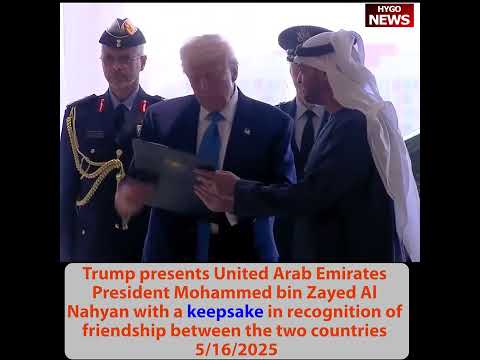
President Trump addressed the Gaza humanitarian situation before departing Abu Dhabi in May 2025: “We’re looking at Gaza and we got to get that taken care of. A lot of people are starving. There’s a lot of bad things going on.” He toured the Abrahamic Family House, praising “great unity, great faith, incredible people with a tremendous leader.” He announced that UAE’s Etihad Airways would purchase approximately 100 Boeing aircraft powered by General Electric engines: “The big body general electric engine is phenomenal. 20% less fuel. That’s a very hot engine. GE has made one of the great comebacks.” The first Etihad flight to Charlotte, North Carolina was also announced as part of the $1 trillion-plus in investment secured during the trip.
Gaza: “A Lot of People Are Starving”
Trump addressed the humanitarian crisis directly.
“We’re going to handle a couple of situations that you have here with some very serious situations,” Trump said.
He named the specific challenge: “And we’re looking at Gaza and we got to get that taken care of.”
He described the conditions: “A lot of people are starving. A lot of people are — there’s a lot of bad things going on.”
The Gaza humanitarian situation had reached critical levels. The Israel-Hamas war, triggered by the October 7, 2023 Hamas attack, had destroyed much of Gaza’s infrastructure and displaced the majority of its population. Food, medicine, and basic supplies had become increasingly scarce as the conflict dragged on.
Trump’s “we gotta get that taken care of” framing reflected his approach to Gaza since his April conversation with Netanyahu. Trump had privately and publicly pressed the Israeli government to allow expanded humanitarian aid into Gaza, distinguishing between Hamas (the enemy) and Gaza’s civilian population (people deserving humanitarian protection). The position was consistent with Trump’s broader Middle East strategy: strong support for Israeli security combined with pressure on Israeli conduct when civilian suffering became excessive.
The “bad things going on” language covered multiple dimensions of the crisis:
- Famine-level food shortages among Gaza’s 2 million civilians
- Medical supply disruptions affecting wounded and sick populations
- Continued Hamas military activity that made aid distribution difficult
- Israeli security concerns that restricted aid flows
- International media coverage that had been highly critical of Israeli conduct
Trump’s statement indicated that Gaza would be a priority following the Middle East trip. Whether this meant pressuring Israel to allow more aid, pressuring Hamas to accept a ceasefire, or engaging directly in humanitarian diplomacy remained to be seen.
The Abrahamic Family House
Trump signed the guestbook at the Abrahamic Family House with a message of unity.
“Sir, your message to people about the doctor is great,” an aide prompted.
Trump’s message: “It’s just a message of unity when you look at what we’ve just seen. It’s great unity, great faith, incredible people with a tremendous leader. Who’s a friend of mine.”
Reflecting on the day: “This was a great and just an amazing day. This was a little bit of an endurance test. He was just testing to see whether or not I had the endurance. I do very easily. We could have done it ten times over.”
He praised the venue: “But what a beautiful job. It’s made easier by the incredible work you’ve done.”
He thanked his hosts: “On behalf of a lot of these people that came with me, congratulations. Beautiful job. Nothing like it.”
The Abrahamic Family House embodied the vision of religious coexistence that the UAE had promoted. The complex housed architecturally distinct but unified buildings for the three Abrahamic faiths — Judaism, Christianity, and Islam — on a single site. This was a concrete expression of the principle underlying the Abraham Accords: that the three faiths traced their origins to the same patriarch and could therefore coexist peacefully.
Trump’s presence at the site as an American president was itself significant. An American president visiting a Jewish synagogue in a Muslim country would have been impossible a decade earlier. The Abraham Accords had made it not only possible but routine, transforming the Middle East from a place where such coexistence was unthinkable into a place where it was architecturally celebrated.
The “endurance test” comment reflected the extraordinarily packed schedule of the four-day trip. State visits of this scope typically involved dozens of meetings, ceremonial events, business announcements, and diplomatic interactions. Trump had maintained the pace while also conducting substantive negotiations on trade deals, investment commitments, and major geopolitical issues.
Etihad: 100 Boeings
The UAE Etihad Airways announcement was the capstone of the aviation deals.
A UAE aviation executive explained: “Yes, sir. And 20% less fuel, which is really, really important in terms of efficiency and emissions.”
The conversation continued about GE engine technology.
Trump asked: “How many engines will they be buying then, ultimately?”
The response: “About a hundred.”
Trump confirmed: “About a hundred.”
He asked about scale: “And are they the biggest engines at this point?”
“The 3.7X, yes. That’s the biggest one.”
“The biggest one. It’s the one we’re hearing about. And it’s an amazing point.”
The executive described the breakthrough: “They had a breakthrough — GE on engines, and the big engine is the hottest engine there is. It’s through the roof.”
Trump celebrated the company’s turnaround: “And General Electric, you talk about a comeback. General electric has made one of the great comebacks, and it’s both in healthcare and other things. But on your engine, I think that’s really maybe the greatest story of them all.”
He praised the innovation: “They came out with a way to make a better engine with 20% less fuel. That’s a tough combination. So congratulations.”
He noted a specific executive: “I was with Larry yesterday and he’s done a fantastic job.”
He praised the business model: “And great customer service. Which is very important for engines. That’s true. So it’s not only selling the engine but keeping the engines running for — extremely important.”
He closed the segment: “A tremendous investment being made in the United States by this group and this airline. They don’t need financing. That’s a nice one. A lot of them say subject to financing. They don’t say subject to financing. They have no problem.”
The ~100 engine Etihad order was substantial for both Boeing and GE. Each GE9X engine (the “3.7X” Trump referenced was apparently the GE9X, which generated 105,000 pounds of thrust) sold for approximately $40-50 million. A hundred-engine order represented roughly $4-5 billion in GE engine revenue alone, not counting the aircraft airframes that Boeing would also produce.
The broader transformation of General Electric was itself a remarkable story. GE had been one of America’s most iconic industrial companies, but had struggled in the 2010s with financial engineering missteps, leadership failures, and strategic drift. The decision to break GE into three separate companies (aerospace, healthcare, energy) had been controversial but ultimately successful — each of the split-off entities had outperformed the conglomerate’s later-stage performance.
GE Aerospace, now focused exclusively on jet engines and related products, had emerged as a leader in commercial aviation propulsion. The 20% fuel efficiency improvement Trump mentioned was a major technological achievement — reducing fuel consumption by 20% translated directly into lower airline operating costs and reduced emissions.
First Flight to Charlotte
A notable regional economic announcement concluded the segment.
“We’re also announcing today our first flight to Charlotte,” an Etihad representative said.
Trump: “Oh, North Carolina.”
“North Carolina.”
Trump: “That’s a good place.”
“Yes. It’s the first airline in the Middle East to fly to Charlotte, North Carolina.”
Trump acknowledged: “So that’s the GE championship going on there right now.”
The Charlotte announcement was a regional economic win. Charlotte — North Carolina’s largest city and a major banking center — had not previously had direct service to the Middle East. Etihad’s new route would connect Charlotte to the UAE, creating business opportunities for companies in both regions.
The “GE championship” reference pointed to the PGA Championship (or a similar major golf tournament) being held near Charlotte at the time. The Etihad decision to inaugurate Charlotte service during a major international event was strategically astute, generating maximum visibility for the new route.
The $1 Trillion in Trip Investment
The segment closed with the overall investment total.
Trump referenced: “A tremendous investment being made in the United States by this group and this airline.”
The broader context was the approximately $1 trillion in U.S. company investments secured during the four-day trip. Beyond the Saudi military deal ($142 billion), the Qatar Boeing order ($60+ billion), and the various commercial agreements, the Etihad aviation deal alone likely totaled tens of billions between aircraft, engines, and service contracts.
Cumulatively, the trip had demonstrated that aggressive American diplomacy combined with attractive domestic economic conditions could generate investment flows at scales previously considered impossible. The $10 trillion total that Trump had claimed earlier — including potential investments over time — was ambitious but not implausible given the scale of specific deals announced.
Key Takeaways
- Trump on Gaza: “We gotta get that taken care of. A lot of people are starving. There’s a lot of bad things going on.”
- Abrahamic Family House tour: “A message of unity — great unity, great faith, incredible people with a tremendous leader.”
- Etihad buying ~100 Boeings with GE9X engines: “20% less fuel. The hottest engine there is. GE made one of the great comebacks.”
- First Middle East airline flight to Charlotte, NC announced as part of trade expansion.
- “They don’t need financing. A lot of them say subject to financing. They don’t. They have no problem.”