 HYGO News
 Trump: fulfilled so many of our promises; NPR/PBS Took 19 Hours to Post Anything; Dem on Deporting
Trump: fulfilled so many of our promises; NPR/PBS Took 19 Hours to Post Anything; Dem on Deporting
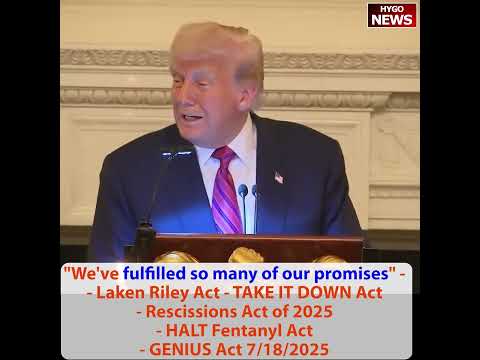
At a White House dinner with senators, President Trump walked through a stretch of legislative wins from the second term’s opening months: the One Big Beautiful Bill, the Laken Riley Act, the Take It Down Act (passed with Melania Trump’s championing), the Rescissions Act of 2025, the HALT Fentanyl Act, and the GENIUS Act. His characteristic boast, with an outside source: “somebody said today, a person that’s not particularly good for us said that we actually fulfilled more promises than we promised.” Rep. Chip Roy then buried NPR’s federal-funding defense with a Texas-flood data point: “when the floods were hitting the people that I represent, it took NPR through Texas Public Radio 19 hours to post anything about the flooding on its social media” — while private stations were posting alerts starting at 7:24 AM. Senator Alex Padilla argued deporting illegal immigrants isn’t in American security or economic interests — listing the farm workers, cooks, car wash employees, and restaurant employees as the “main target” of “increasingly cruel raids."
"We’ve Fulfilled So Many of Our Promises”
Trump opened at the dinner with a sweeping claim. “The one big beautiful builder live it on that mandate and we’ve fulfilled so many of our promises. In fact, somebody said today, a person that’s not particularly good for us said that we actually fulfilled more promises than we promised, which is pretty nice statement. You don’t hear that very often, but it’s true, by a lot actually.”
“Fulfilled more promises than we promised” is the double-count framing — not just checking the campaign-promise boxes, but exceeding them with additional accomplishments not originally committed. That the source was “not particularly good for us” is Trump’s way of signaling the assessment is not a partisan pat on the back; a hostile or neutral observer is conceding the point.
The specific campaign-promise accounting is contested. Promise-tracking websites and fact-checkers have reached varying conclusions about what percentage of Trump’s 2024 promises have been fulfilled. Whether he has “fulfilled more promises than he promised” is a claim closer to rhetoric than to audit. But the underlying reality — a dense, early legislative calendar packed with significant enactments — is documented.
The Legislative Catalog
Trump walked through the bills by name. “That’s just the beginning in January we passed Senator Katie Brits, Lakin Riley Act.”
The Laken Riley Act — named for the 22-year-old Georgia nursing student murdered by an unauthorized immigrant — requires federal detention of unauthorized immigrants who commit theft-related offenses, among other provisions. It passed with bipartisan support in January, the first major immigration-enforcement legislation of the second term.
“And a few months ago we passed Senator Ted Cruz’s and this was done with a very fantastic woman named Melania, right? You worked together. First lady, you passed the Take It Down Act, something that was very important that actually had very good bipartisan support, almost unanimous support.”
The Take It Down Act criminalizes the non-consensual distribution of intimate images, including AI-generated deepfakes, and requires platforms to remove them within 48 hours of victim notice. Melania Trump’s championing of the legislation — described as “a very fantastic woman … you worked together” — gave it bipartisan momentum that translated into overwhelming passage.
“A couple of people, I won’t tell you their names, but a couple of people.” That is Trump’s shorthand for the handful of holdouts in an otherwise unanimous vote — usually members whose unique concerns about the legislation’s specific mechanism or scope prevented agreement.
The Rescissions Act
“And just this week we passed the Recisions Act of 2025 slashing nearly $10 billion of waste. I guess I could say some fraud and some abuse, but at least we can say waste, almost $10 billion.”
“Waste, fraud, and abuse” is the classic triad for defensible spending cuts. Trump’s concession — “at least we can say waste” — is calibrated to avoid overclaiming without proof. The $10 billion rescission targets public broadcasting funding and certain foreign aid categories.
“And we have numerous other recisions coming up, many more $10 billion to it. So we’re saving a lot of money.”
“Many more $10 billion to it” — Trump is signaling that the $9-10 billion figure is the opening installment, not the final total. The rescissions mechanism, which requires congressional approval for cancellation of previously appropriated spending, can be used sequentially across the fiscal year.
HALT Fentanyl and GENIUS
“On Wednesday I signed the Halt Fentanyl Act and earlier today I signed Senator Bill Haggarty’s Genius Act and he named it after me. And I was really happy. Thank you very much.”
Trump’s tone when mentioning Haggerty’s GENIUS Act reveals the crypto-legislation enthusiasm that defined his signing ceremony earlier in the day. “I pushed very hard because of that. To make America the crypto capital of the world and that’s what it’s become.”
“To make America the crypto capital of the world” is Trump’s consistent crypto slogan. The GENIUS Act signing is the evidentiary point for the claim that the outcome — not merely the aspiration — has been achieved.
Padilla: “Farm Workers, Cooks, Car Wash Employees”
The segment then pivoted to Senator Alex Padilla’s argument against ICE enforcement. “The people that are being caught up in these increasingly cruel raids are farm workers, cooks, car wash employees, restaurant employees. They were deemed essential to our economy at the tail end of the first Trump administration at the beginning of the COVID-19 pandemic. And now they’re the main target of these cruel ICE raids.”
Padilla’s categorical list — farm workers, cooks, car wash employees, restaurant employees — is selected for sympathy. Each category describes work that is economically essential, often physically demanding, and typically low-wage. Padilla’s argument is that the raids are not targeting the dangerous criminal aliens the administration claims to target but rather the working-poor populations who keep basic economic functions running.
“Deemed essential to our economy at the tail end of the first Trump administration at the beginning of the COVID-19 pandemic” is the specific historical hook. During the 2020 pandemic, agricultural workers, food service workers, and other categories of low-wage labor were formally designated as essential to maintain food supply and economic function. Padilla is arguing that a population designated essential by one administration is now being targeted by a later administration.
”There’s Got to Be a Better Way”
“Based on these artificial quotas that are being set, there’s got to be a better way. This is not in our security interest. It’s not in our economic interest.”
“Artificial quotas” references the reports that ICE has been working to specific numerical targets for apprehensions and removals. The administration has denied that specific quota instructions are driving enforcement, but the operational pattern — predictable daily numbers, press-reportable milestones — suggests the quota framing is, if not explicit, at least implicit.
“Not in our security interest. It’s not in our economic interest.” Padilla is arguing the raids are counterproductive: they do not advance public safety (because most targets are not dangerous), and they do not advance economic interests (because they remove workers who fill essential roles in labor markets that cannot easily be replaced).
The administration’s counter-argument is that the raids target a mix of populations, including individuals with criminal records, prior removal orders, and other enforcement priorities — not only the sympathetic categories Padilla’s framing emphasizes. The full data on enforcement profiles is mixed, and both framings have factual bases.
Chip Roy and the 19-Hour NPR Delay
Rep. Chip Roy’s critique of NPR used a specific, damaging data point from the Texas flooding response. “NPR, PBS, public broadcasting and so forth talked about how they’re cutting their funding and somehow going to endanger communities and rural communities.”
“Well, when the floods were hitting the people that I represent, it took NPR through Texas Public Radio 19 hours to post anything about the flooding on its social media. What was NPR and TPR doing in the interim?”
Nineteen hours from flood onset to first NPR social-media acknowledgment is the specific failure Roy is pointing to. The NPR/PBS argument for federal funding relies substantially on public broadcasting’s emergency-information role in rural communities. If the actual response to a rural emergency — Kerr County flooding, more than 135 dead — was 19 hours of silence on social media while other channels were urgently posting alerts, the public-broadcasting emergency-information claim is undermined by its own operational record.
”Lobbying Congress for Billions of Dollars”
“What were they doing in the morning at 4, 5, 6, 7 in the morning when private radio stations that I listened to and that I talked to were breaking in and presenting the information of the news, they were playing a program, a DC-based program, lobbying Congress for billions of dollars to continue their funding.”
That is the kill shot. Roy is arguing that in the critical early-morning hours of a deadly flood, NPR Texas affiliates were airing pre-produced Washington-based content that was, in effect, lobbying Congress for NPR’s federal funding — while the flood killed people within their coverage area.
“When the flood hit at 4 in the morning instead of providing local news, they were airing the morning edition of the Washington, D.C. Well, that’s fine. They already had it pre-taped. I get that. But they didn’t break in like the local stations did and so forth.”
“They didn’t break in” is the professional charge. In an emergency, broadcasting protocols call for interrupting pre-recorded content with live local updates. Private stations did. NPR-affiliated Texas stations, per Roy’s account, did not.
The 70 Alerts Contrast
“The seven private stations posted over 70 alerts on their social pages throughout the day, starting at 7.24 in the morning. My point being, private stations in the communities in which I live were there for the people of Texas. They were there presenting the information necessary and the public stations were completely MIA.”
Seven private stations. Seventy alerts. Starting at 7:24 AM. That is the counter-evidence. The emergency-broadcasting role that NPR invokes as justification for federal funding was, in this specific case, performed by private stations that receive no federal subsidy — while the subsidized NPR affiliates were silent for 19 hours.
“Completely MIA” is Roy’s verdict. For a member of Congress representing the affected district, that framing carries both operational credibility (he was living through the event in real time) and political weight (his constituents experienced the asymmetry directly).
Three Threads, One Argument
Trump’s legislative catalog, Padilla’s humanitarian framing of ICE enforcement, and Roy’s emergency-broadcasting indictment of NPR. Three distinct items, one common thread: the administration and its congressional allies are pressing on every available front, using specific factual data (legislative enactments, enforcement profiles, emergency-response timelines) to build cumulative pressure.
Padilla’s argument for sympathy toward enforcement targets runs against Trump’s legislative delivery on the enforcement mandate. Roy’s argument against NPR funding runs against the standard Democratic defense of public broadcasting. Each exchange narrows the political space the opposition has to stand on.
Key Takeaways
- Trump catalogued the second-term legislative wins at a White House senator dinner: Laken Riley Act, Take It Down Act (with Melania Trump), Rescissions Act (“nearly $10 billion of waste”), HALT Fentanyl Act, GENIUS Act — citing a hostile source saying the administration “fulfilled more promises than we promised.”
- Sen. Alex Padilla argued against ICE enforcement: “The people that are being caught up in these increasingly cruel raids are farm workers, cooks, car wash employees, restaurant employees … deemed essential to our economy at the tail end of the first Trump administration at the beginning of the COVID-19 pandemic.”
- Padilla: enforcement based on “artificial quotas” is “not in our security interest. It’s not in our economic interest.”
- Rep. Chip Roy used the Texas flood response to indict NPR: “It took NPR through Texas Public Radio 19 hours to post anything about the flooding on its social media” — while NPR aired “a DC-based program, lobbying Congress for billions of dollars to continue their funding.”
- Contrast: “seven private stations posted over 70 alerts on their social pages throughout the day, starting at 7.24 in the morning” — while “the public stations were completely MIA.”