 HYGO News
 Trump focus on blue cities Dem-run cities CA Dems bill to ban masks for law officers; resist Trump
Trump focus on blue cities Dem-run cities CA Dems bill to ban masks for law officers; resist Trump
Trump’s immigration enforcement strategy was articulated with unusual directness across a 24-hour news cycle that produced a cluster of revealing political moments. The president named the specific jurisdictions that will be the focus of the deportation operation — blue cities, Democrat-run cities, the sanctuary jurisdictions where, in his telling, 21 million Biden-era arrivals are concentrated. House Democrat Yvette Clarke called Trump’s enforcement “definitely” impeachable. California Democrats unveiled legislation that would ban federal law enforcement officers from wearing masks while conducting operations in California. The Chicago Mayor pledged to continue “resisting” the administration by “taking to the streets” and maintaining sanctuary policies. And the LA Mayor insisted, despite abundant footage to the contrary, that the city’s recent protests had been “overwhelmingly peaceful.” The pattern is a Democratic resistance that has moved from rhetorical opposition to active legislative and operational interference.
”I Want Them To Focus On The Cities”
Trump’s description of the enforcement strategy was direct. “I want them to focus on the cities because the cities are where you really have what’s called sanctuary cities and that’s where the people are. I look at New York, I look at Chicago. I mean you got a really bad governor in Chicago and a bad mayor but the governor’s probably the worst in the country, Pritzker.”
The logic is straightforward. Sanctuary jurisdictions, by their own policy frameworks, have chosen not to cooperate with federal immigration enforcement. That non-cooperation has, over years, created concentrations of undocumented populations within the sanctuary jurisdictions. The administration’s enforcement priorities therefore naturally focus on those jurisdictions — not because of political animus but because that is where the enforcement population is located.
”Pritzker Is Probably The Worst”
Trump’s specific attack on Illinois Governor JB Pritzker is one of his sharpest personal criticisms of a Democratic governor. “I look at how that city has been overrun by criminals.”
The Chicago situation — elevated crime in specific neighborhoods, consistent sanctuary policy from the state and city governments, visible tensions between federal agents and local officials — has made Illinois a political priority for the administration. Pritzker’s own political ambitions, often mentioned as a potential 2028 Democratic candidate, have made the criticism of his governance more politically salient than it might otherwise be.
”Those People Weren’t From LA”
Trump then made an observation about the Los Angeles protests that had attracted federal attention. “You know New York and LA, look at LA. LA, those people weren’t from LA, they weren’t from California, most of those people, many of those people and yeah that’s a focus.”
The framing is that the individuals being detained in Los Angeles operations are not local residents in the conventional sense. They are people who arrived during the Biden-era border surge and migrated to sanctuary jurisdictions because those jurisdictions offered reduced cooperation with federal enforcement. That analysis shapes the administration’s operational posture: enforcement in Los Angeles is enforcement of federal law against individuals who are in Los Angeles specifically because of Los Angeles’s sanctuary status.
”Biden Allowed 21 Million People”
Trump’s aggregate figure was the one the administration has been building toward. “Biden allowed 21 million people to come into our country. Most of those people are in the cities, all blue cities, all Democrat run cities and they think they’re going to use them to vote. It’s not going to happen.”
The 21 million figure is contestable but is the administration’s preferred aggregate — encompassing not only documented border crossings during the Biden years but also estimated “gotaways” who evaded apprehension and visa overstays. Critics argue the number is inflated. Administration supporters argue the number is, if anything, conservative given the poor reporting from that period.
”They Think They’re Going To Use Them To Vote”
The political charge Trump levels is that the current undocumented population was, in his framing, imported with electoral purpose. “They think they’re going to use them to vote. It’s not going to happen.”
This is a charge Democrats vigorously dispute. The legal framework does not permit noncitizens to vote in federal elections. State-level experiments with noncitizen voting in local elections have been narrow in scope. The charge that undocumented arrivals would materially affect federal elections through voter fraud is, in the formal sense, unsupported by the available evidence.
The political charge, however, is not primarily about literal voter fraud. It is about demographic composition. A state’s political complexion shifts with its population. Large undocumented populations translate, over time, into shifts in congressional apportionment (since apportionment counts total residents) and into naturalization pipelines. Trump’s “use them to vote” framing is a compressed version of the demographic argument.
Rep. Clarke: “Definitely” Impeachable
The interview with Representative Yvette Clarke captured a different Democratic response. “You’ve described what Trump is doing in Los Angeles as lawlessness and unconstitutional and a violation of human rights. Do these things rise to the level of impeachment? Are these impeachable?”
Clarke: “Well you know I do, I believe it is. I definitely believe it is.”
“Definitely” impeachable is the Democratic position articulated in its most direct form. The theory: federal immigration enforcement in sanctuary jurisdictions constitutes a constitutional violation, and the constitutional violation rises to a high crime and misdemeanor that would justify impeachment proceedings.
Whether the House Democratic caucus would actually pursue impeachment proceedings on these grounds is a separate question. The procedural reality is that impeachment requires a majority of the House. Democrats do not currently hold that majority. The rhetorical invocation of impeachment is therefore primarily a political signal rather than a procedural plan.
Chicago Mayor: “Resist”
The Chicago Mayor’s response was operationally precise. “We’re going to continue to resist and we’re going to do it in many different ways whether it’s taken to the streets or to the courts or policy. One of the things that I am very proud of is that we are a welcoming city which means our local law enforcement do not dub or behave as federal ICE agents and so our local law enforcement as we continue to rebuild and expand trust amongst all of our residents it’s important that we hold that line.”
The word “resist” is the one that defines the political moment. The mayor is not describing cooperation with federal authorities. He is describing resistance. The vehicles of resistance are multiple — streets, courts, policy — but the purpose is to prevent or impede federal enforcement in Chicago.
”Hold That Line”
The phrase “it’s important that we hold that line” is particularly revealing. The line being held is the line between local and federal law enforcement authority. The mayor is insisting that Chicago police will not assist federal immigration operations. The legal status of that refusal is complicated — courts have generally held that federal authorities cannot compel local cooperation, but federal agents can still operate within sanctuary jurisdictions without local assistance.
The practical effect of “holding the line” is that federal operations in Chicago become more difficult. Agents have to import backup from out of state. They cannot rely on local intelligence. They face higher operational friction. That higher friction is, from the mayor’s perspective, the point. The sanctuary policy exists to make federal enforcement harder, not to eliminate it entirely.
LA Mayor: “Overwhelmingly Peaceful”
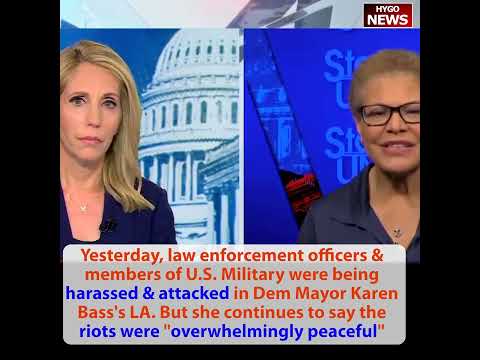
The LA Mayor’s framing of the recent protests was the most contested assertion of the video. “The 30,000 people were downtown LA. There were protests in 15 different locations in our city. I flew over each one of them and they were overwhelmingly peaceful. It’s not shocking that at the end of a protest that you’re going to have some confrontation. Of course I wish there was none at all but I don’t think that characterized the day at all.”
The administration’s response is that the footage from the protests — including cars set on fire, federal agents attacked, businesses vandalized — speaks for itself. Characterizing the protests as “overwhelmingly peaceful” requires a definition of peaceful that excludes the kind of property destruction and personal violence that clearly occurred.
The “Overwhelmingly Peaceful” Echo
The phrasing echoes the 2020 summer protest characterizations that were widely criticized at the time. The “mostly peaceful” framing became a cultural touchstone for many Americans who felt media and political characterizations of events did not match what they were seeing in footage. The LA Mayor’s “overwhelmingly peaceful” appears designed to position her protests within that same framing, with the predictable political consequences.
”If The Raids Hadn’t Happened”
The LA Mayor offered a counterfactual that defines the Democratic framing of causation. “If the raids hadn’t happened then that protest would have been a no-kings protest. We know that that was planned months in advance but the disruption and the fear that has been caused by the raids has really had a devastating effect and has been a body blow to our economy.”
The framing is that the raids caused the protests. Without the raids, the protests would have been peaceful political demonstrations. The raids are, in the mayor’s telling, the proximate and avoidable cause of the violence that followed.
The administration’s counter-framing is that federal agents conducting lawful enforcement of federal law cannot be blamed for the response of protesters who choose violence. The responsibility for violent response lies with the people who chose to respond violently, not with the agents enforcing the law that existed before they arrived.
”Entire Sectors Of Our Economy”
The mayor’s closing economic argument was: “I don’t think the president understands that we have entire sectors of our economy that cannot function without immigrant labor.”
The argument is worth acknowledging. Agriculture, construction, hospitality, and food service in California rely heavily on immigrant labor — both documented and undocumented. Policies that disrupt the supply of that labor create real operational costs for California businesses.
The administration’s response is that the correct path forward is to regularize the labor market through legal channels — expanded guest worker programs, streamlined visa processes for the industries that need workers — rather than through continued tolerance of undocumented labor. Whether that regularization is politically achievable is a separate question.
The California Mask Ban Bill
California Democrats unveiled legislation that would ban federal law enforcement officers from wearing masks while conducting operations in California. The argument, as captured in the video: “People covering their faces and impersonating police officers. It erodes trust in law enforcement and undermines community safety. That’s really what this bill is about.”
The bill’s framing conflates two separate issues. Impersonation by non-officers in masks and tactical gear is one concern. Federal officers who wear masks for their own safety during operations in hostile environments is a different concern.
”Require People Not To Wear Masks”
The specific language of the California bill would “require that people not have to wear masks except for some very limited exceptions and that there be identifying information.”
The administration’s concern is that federal agents conducting enforcement operations in a state where Democratic officials have compared them to the Gestapo and called their work “terrorism” have legitimate personal safety concerns. Masks — plus protective equipment — are part of the operational security posture. A state law that prohibits federal officers from wearing masks while conducting their duties would, in the administration’s view, put those officers at elevated physical risk.
Preemption And The Legal Challenge
The legal question is whether California can impose such a requirement on federal officers. Federal law generally preempts state law when the state law interferes with federal operations. A California statute that banned masks for federal agents would face immediate federal court challenge on preemption grounds. Whether it would survive that challenge is uncertain, but the political aim of the legislation is, at least in part, to provoke the legal confrontation.
”SB 54” — The Existing Sanctuary Law
The video also references “our sanctuary law SB 54 which says that local law enforcement are not going to be involved in immigration enforcement.” SB 54, enacted in 2017, is California’s core sanctuary statute. It prohibits state and local law enforcement from cooperating with federal immigration enforcement in most cases.
The statute has been tested in court repeatedly. Federal challenges to similar statutes have produced mixed results. California has been particularly assertive in defending its sanctuary framework, and the mask ban legislation is the latest extension of that posture.
Key Takeaways
- Trump’s enforcement focus: “I want them to focus on the cities…Biden allowed 21 million people to come into our country. Most of those people are in the cities, all blue cities, all Democrat run cities.”
- Rep. Yvette Clarke on Trump’s LA posture: “Do these things rise to the level of impeachment? Are these impeachable? Well you know I do, I believe it is. I definitely believe it is.”
- Chicago Mayor on Trump: “We’re going to continue to resist…whether it’s taken to the streets or to the courts or policy…it’s important that we hold that line.”
- LA Mayor on the LA riots: “I flew over each one of them and they were overwhelmingly peaceful…If the raids hadn’t happened then that protest would have been a no-kings protest.”
- California Democrats’ mask ban bill: “people not have to wear masks except for some very limited exceptions and that there be identifying information” — a direct challenge to federal agent operational security.