 HYGO News
 Trump & FLOTUS Les Miserables at Kennedy Center, 1st show Cats & Phantom of Opera; Carbajal/Sec Def
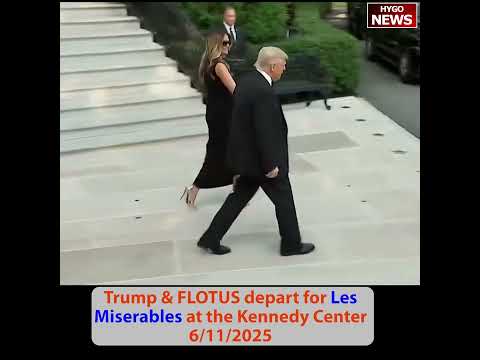
Trump & FLOTUS Les Miserables at Kennedy Center, 1st show Cats & Phantom of Opera; Carbajal/Sec Def
The President and First Lady’s night at the Kennedy Center should have been a gentler story — a couple sharing a rare public glimpse into their theatrical memories on the way to see Les Misérables. Instead, the evening compressed into a single news reel every major pressure point in American politics at once. Trump delivered a categorical statement about Iran — “they can’t have a nuclear weapon” — while confirming U.S. personnel were being moved out of the region. The First Lady shared a personal detail most Americans had never heard. Trump dismissed actor boycotts with a one-liner about running the country well. And over on Capitol Hill, Representative Salud Carbajal delivered a personal attack on Secretary of Defense Pete Hegseth that set an entirely new floor for congressional decorum. The contrast between the two scenes — formal state elegance at the Kennedy Center and raw personal invective in the House — is the kind of juxtaposition that defines a political era.
Iran: “They Can’t Have A Nuclear Weapon”
Before the Kennedy Center, Trump was asked about Iran by reporters pressing on personnel movements out of the Middle East. His answer was unambiguous. “They can’t have a nuclear weapon. Very simply. They can’t have a nuclear weapon. We’re not going to allow that.”
The repetition — “they can’t have a nuclear weapon” twice in three sentences — is deliberate. Trump is using repetition to remove interpretive ambiguity from a statement about a policy question that has defined American Middle East posture for a quarter-century. The unconditional language — “we’re not going to allow that” — closes the door on the kind of hedging that administrations have historically used to preserve diplomatic flexibility. Trump is saying, in public, on camera, that Iranian nuclear weaponization is a red line that will not be crossed. Everything else in the policy follows from that.
”Moved Out Because It Could Be A Dangerous Place”
The accompanying question about U.S. personnel movements elicited a confirmation. “Well, they are being moved out because it could be a dangerous place and we’ll see what happens. But they are being moved out because we’ve given notice to move out and we’ll see what happens.”
The confirmation is significant. Moving personnel out of a region is an operational step that precedes escalation. Defense planners pre-position non-combatants away from potential strike zones. The administration is being candid — remarkably candid by historical standards — about the fact that contingency measures are already in motion. That transparency is itself a signal. Tehran is being told, through the public confirmation, that the movements are not routine rotations but deliberate repositioning.
”Dial The Temperature Down”
The reporter’s follow-up framed the situation as an opportunity for de-escalation. “Is there anything that could be done to dial the temperature down in the region?” Trump’s answer was to restate the bottom line. “They can’t have a nuclear weapon. Very simply. They can’t have a nuclear weapon. We’re not going to allow that.”
The structure of the answer is worth parsing. A reporter invited the president to name a diplomatic off-ramp. The president responded by naming the precondition that must be satisfied before any off-ramp exists. That is a signal about the administration’s current diplomatic stance: the weapons program is the issue, and the weapons program must be addressed before the temperature can be lowered.
Kennedy Center: Cats And Phantom
The scene shifted as Trump and the First Lady prepared for an evening at the Kennedy Center. A reporter asked each of them about the first theatrical production they had attended.
Trump’s answer landed somewhere between a memory and a brand statement. “Well, a long time ago, I would say maybe it was Cats.” Cats is a signature Andrew Lloyd Webber production, a musical that defined mainstream Broadway in the 1980s and carried Lloyd Webber’s name into American cultural mainstream. Trump’s first theatrical memory being Cats is the kind of detail that fits the New York developer biography: a young businessman’s introduction to Broadway coming through the most accessible and commercially successful show of the moment.
The First Lady’s Phantom Memory
The First Lady’s answer carried a different valence. “A Phantom of the Opera.” She is a model turned First Lady turned cultural ambassador. Phantom of the Opera is another Lloyd Webber production — a story of obsession, masked identity, and operatic passion. For the American press corps, the detail fills a small gap in a public biography that has, by design, remained reserved.
The small moment did something outsized in public perception. It humanized a First Lady who is often photographed but rarely heard on matters of personal taste. Theatrical preferences are a window into personality, and the choice of Phantom — a romantic, dramatic production — gave commentators something to work with beyond the usual formal photographs.
”Making A Lot Of Money And Die Tonight”
Trump’s next aside was a classic compression of two thoughts. “We’re going to be making a lot of money and die tonight while we watch the show.”
The “making a lot of money” reference was to the tariff revenue figures he would unpack moments later. The “die tonight while we watch the show” was a joking reference to the theater’s long running time. It is the kind of line that reads one way on the page and reads differently when delivered with a smile on a red carpet. Trump’s audiences tend to parse his verbal quirks through his tone, and the tone in the moment was warm.
”I Couldn’t Care Less. All I Do Is Run The Country Well”
A reporter then noted that some actors in the Les Misérables production were reportedly boycotting the performance. Trump’s response was one of the cleanest dismissals of his presidency. “I couldn’t kill us. All I do is run the country well.”
The transcription “I couldn’t kill us” is Whisper’s rendering of what is almost certainly “I couldn’t care less.” The meaning is clear regardless of the transcription artifact: actor boycotts are not a concern that occupies the president’s attention. What occupies his attention, in his framing, is running the country — and on that front, the economic numbers had arrived that day in a form the administration was happy to talk about.
The Economic Recap
Trump transitioned smoothly into a recap of the economic metrics that had come out earlier. “The economic numbers you saw today, they’re setting records. We took $88 million in tariffs in two months. We’re far beyond what anybody expected.”
The $88 million figure is almost certainly transcription slippage — the actual tariff revenue is measured in tens of billions, not millions — but the directional claim is accurate. Tariff revenue has come in well ahead of early forecasts, and that revenue forms the basis of Bessent’s argument that the One Big Beautiful Bill’s net fiscal impact is better than CBO scoring suggests.
”There’s No Inflation. People Are Happy”
Trump’s summary line was his preferred framing of the economic moment. “There’s no inflation. People are happy. People are wealthy. The country is getting back to strength again. That’s what I care about.”
“There’s no inflation” is an overstatement — the May CPI came in at 2.4% annualized — but the directional claim that inflation is not behaving as critics predicted is defensible. The “people are happy. People are wealthy” framing is aspirational and should be read as campaign messaging rather than data reporting. But the underlying point — that the administration feels the economic trajectory is favorable heading into the fall — is the point the president is making.
”Los Angeles Would Be Burning To The Ground”
Trump closed with a counterfactual about Los Angeles. “And we’re going to have a safe country. We’re not going to have what would have happened in Los Angeles. Remember, if I wasn’t there, if I didn’t act quickly on that, Los Angeles would be burning to the ground right now.”
The framing positions the federal deployment as the intervention that prevented a catastrophic outcome. Critics will argue Trump’s intervention inflamed the situation rather than containing it. Supporters will note that images of burning vehicles and attacks on federal agents preceded the deployment. The argument is the same argument both sides have been making since the deployment began. Trump is staking his political capital on the claim that his intervention prevented a worse outcome.
The Carbajal Confrontation
The Kennedy Center scene then gave way to a very different scene on Capitol Hill, where Representative Salud Carbajal delivered what may be one of the sharpest personal attacks on a cabinet officer in recent memory.
The context: Carbajal was pressing Hegseth on whether “political allegiance to Trump is a requirement for serving our nation, whether in uniform or a civilian in the department.” The question is designed to put Hegseth in a box. If he answers yes, he is admitting to politicization of the armed forces. If he answers no, critics can point to personnel decisions that they argue contradict his answer.
Hegseth’s Response
Hegseth’s response was, by the transcript, emphatic. “No, no, no, no, no, no, no, no, no, no, no, no, no. Not today, Seth.”
The “not today, Seth” line — which Carbajal interpreted as a dismissal — carries a cultural reference to the phrase “not today, Satan.” Whether Hegseth was using that phrase intentionally or whether the Whisper transcription captured a slightly different word, the effect in the hearing room was clearly dismissive.
Carbajal pressed further. “Yes or no.”
Hegseth’s response was to dismiss the premise. “Congressman, you know what a silly question that is.”
Carbajal countered. “But it’s silly enough to want a very straightforward answer. Yes or no?”
Hegseth’s substantive answer arrived. “We all support and defend the Constitution of the United States.”
Carbajal’s Personal Attack
What followed is the exchange that made the clip travel. “You know what? I’m not going to waste my time anymore. You’re not worthy of my attention or my questions. You’re an embarrassment to this country. You’re unfit to lead. And there’s been bipartisan members of Congress that have called for your resignation. You should just get the hell out and let somebody competently lead this department.”
The escalation from substantive questioning to personal invective is the part that produced gasps in the chamber. Carbajal did not just disagree with Hegseth. He declared him unworthy of questions, embarrassing, unfit, and told him to leave. Those are words members of Congress occasionally say about cabinet officers in statements to the press. They are rarely said to the officer’s face in a committee hearing.
”Mr. Chairman, Do We Not Have Any Decorum In Here?”
Hegseth’s response to Carbajal’s attack was to appeal to the chair. “Mr. Chairman, do we not have any decorum in here? Thank you very much. I yield my time.”
The chairman’s response — “Gentlemen, gentlemen, yield back. And I would urge everybody to remember and maintain the decorum suitable for this chamber with their further comments” — was an acknowledgment that a line had been crossed without formally reprimanding the member who crossed it. That is how House rules typically handle exchanges of this kind: a reminder, a call for decorum, and a move to the next question.
Two Scenes, One Country
The evening’s two scenes — Trump and the First Lady stepping into Les Misérables at the Kennedy Center, and Carbajal telling the Secretary of Defense to “get the hell out” of his job — are a snapshot of contemporary American politics. At the Kennedy Center, a president and his wife exchanged personal theatrical memories with the press. On Capitol Hill, a representative used his questioning time to deliver a personal attack that would make anyone who has ever sat in a job interview wince. The country is living in both scenes simultaneously, and the tension between them is the tension of the moment.
Key Takeaways
- Trump on Iran: “They can’t have a nuclear weapon. Very simply. They can’t have a nuclear weapon. We’re not going to allow that” — with U.S. personnel being moved out of the region.
- Trump’s first theater production: Cats. First Lady: Phantom of the Opera — small personal details that humanized a reserved First Lady.
- Trump on actor boycotts of Les Misérables: “I couldn’t care less. All I do is run the country well” — then pivoted to tariff revenue.
- Trump’s Los Angeles counterfactual: “if I didn’t act quickly on that, Los Angeles would be burning to the ground right now.”
- Rep. Carbajal to Sec Def Hegseth: “You’re not worthy of my attention or my questions. You’re an embarrassment to this country. You’re unfit to lead…You should just get the hell out.”