 HYGO News
 Trump & FIFA President FIFA Club World Cup trophy; a player named Pelé; Trump football vs soccer
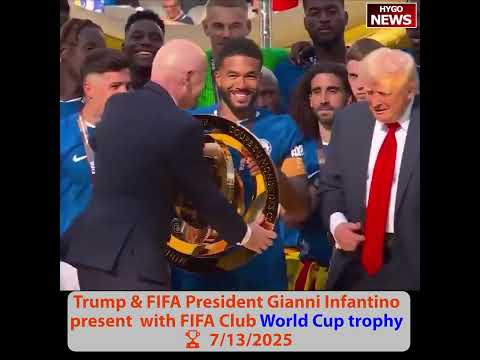
Trump & FIFA President FIFA Club World Cup trophy; a player named Pelé; Trump football vs soccer
Between the policy stories and the tragedies, a quieter, more personal side of the presidency surfaced at the FIFA Club World Cup final at MetLife Stadium in the Meadowlands. Chelsea beat their opponents for the 2025 title. President Trump attended alongside FIFA President Gianni Infantino, helped present the trophy, put medals on the Chelsea players, and sang along to the Star-Spangled Banner. Asked to name his personal greatest-of-all-time in the sport, Trump reached back decades to the New York Cosmos era: “Many years ago when I was young, they brought a player named Pelé to play … I came to watch Pelé and he was fantastic.” He recounted how the original Club World Cup trophy ended up permanently in the Oval Office (“We’re never going to pick it up. You can have it forever … We’re making a new one”), joked about America’s football vs. soccer nomenclature (“I’m not sure that change can be made very easily”), and — for a day — dropped most of the combative posture that defines most of his public appearances.
The GOAT Question
The sideline interviewer’s question was the one every international sport interview eventually asks. “Who is your goat, your greatest of all time? In this sport, you’re talking about not in another sport, in this sport.”
The clarification — “in this sport, not in another sport” — was necessary with Trump. Asked about greatest athletes in general, the president might have gone to golf, or to boxing, or to tennis. The interviewer was pinning him specifically to soccer.
“Well, I’ll tell you what, I want to give us all your goats. Go ahead.” The phrasing is the interviewer trying to keep the exchange moving. Trump then paused and reached for a specific memory.
”A Player Named Pelé”
The memory Trump chose was not a modern player. Not Messi, not Ronaldo, not Maradona. He went back four decades.
“Many years ago when I was young, they brought a player named Pelé to play. And he played for a team called the Cosmos and Steve Ross, a friend of mine, Warner Communications. He was the inspiration we had.”
That is a specific cultural memory. Pelé joined the New York Cosmos in 1975 as the centerpiece of the North American Soccer League’s push to establish professional soccer in the United States. Steve Ross, then-chairman of Warner Communications, was the Cosmos’ owner and the visionary behind the bet that American audiences could be taught to love soccer. The experiment didn’t immediately succeed at mass-market scale, but it left a lasting impression on the New York-area fans who actually attended the games.
“And this place was packed. It was an earlier version of this stadium, but right here in the meadowlands.” The Meadowlands complex has gone through multiple stadium generations — the original Giants Stadium, now replaced by MetLife Stadium. Trump was watching Pelé as a young real estate developer in the mid-1970s, at the original Meadowlands facility.
“And it was Pelé.” The name is its own sentence.
”I Don’t Want to Date Myself”
Trump acknowledged the generational gap between him and most of the current audience for the sport. “I don’t want to date myself, but that was a long time ago. I was a young guy and I came to watch Pelé and he was fantastic.”
“So I’d say probably I’ll go old fashioned. That’s like saying Babe Ruth, but I would say Pelé was so great.”
The Babe Ruth comparison is revealing. Trump is reaching for a reference American audiences will instantly understand — Ruth is the baseball equivalent of what Pelé is to soccer — and deploying it to bridge the cultural gap between a soccer-native audience and an American-sports-native one. Telling an American crowd “Pelé was so great” does not land the same way as telling them “that’s like saying Babe Ruth.” The analogy makes the claim translate.
The Trophy in the Oval Office
The moment that produced some of the best banter of the day was Trump’s explanation of how the FIFA Club World Cup trophy ended up living in the Oval Office. “FIFA has been so wonderful in this process,” the sideline reporter said. “And I know that you’ve had their trophy on your desk. Now it’s at the Trump Tower.”
Trump corrected that. “It’s in the oval.”
Then the backstory. “They said, could you hold this trophy for a little while? We put it in the Oval Office. And then I said, when are you going to pick up the trophy? He says, we’re never going to pick it up. You can have it forever in the Oval Office. We’re making a new one. And they actually made a new one. So that was quite exciting.”
That is a trophy diplomacy vignette. FIFA President Gianni Infantino, in effect, gave Trump the Club World Cup trophy — not as a temporary loan, but permanently — and commissioned a replacement. The gesture is substantial. FIFA does not give its trophies away as keepsakes. Doing so for the president of the United States, for display in the Oval Office during the run-up to the 2026 World Cup that the U.S. will co-host, is a coordinated diplomatic investment in the relationship.
”Football vs Soccer”
One of the more lighthearted exchanges concerned American sports nomenclature. “You know, Johnny’s a friend of mine. He’s done such a great job with the league and with soccer or they would call it football. But I guess we call it soccer. I’m not sure that change could be made very easily.”
“Johnny” — probably a reference to either an MLS league executive or an FA figure — is referred to as a friend. Trump’s concession that the “football vs soccer” nomenclature war is probably not winnable by fiat — “I’m not sure that change can be made very easily” — is a rare admission that even a president has limits.
“But it’s great to watch. And this is a little bit of an upset that we’re watching today. Isn’t it? No, surprising. So far it’s incredible.”
The “upset” framing — Chelsea winning what the administration apparently believed would be a more contested final — speaks to Trump actually engaging with the specifics of the match. The sideline reporter’s response — agreeing it is incredible — carried the flow.
The Commentary Audio
The transcript captures fragments of what appears to be commentary audio woven into the broadcast. “This is from everyone when it really mattered on the biggest stage. Yeah, both with and without the ball throughout this tournament, Luke. And special moments creating these opportunities for these players to become legends at Chelsea from now going forward.”
“Luke” is likely Chelsea’s Luke Harris or another Chelsea figure — the commentary cuts off mid-sentence. The texture is the broadcast professionalism bleeding into the sideline-interview audio, the ambient noise of a tournament final in full ceremonial wind-down.
The Trophy Presentation
The 2025 FIFA Club World Cup was, by any measure, a major event for American soccer. Held in the U.S. as a prelude to the 2026 World Cup hosted jointly by the United States, Mexico, and Canada, the tournament served as both a revenue event and a proof-of-concept for the infrastructure, operations, and cultural fit of major international soccer in American stadiums.
Chelsea winning the final at MetLife Stadium produced the ceremonial moment Trump and Infantino shared — the trophy presentation — which is one of the few ceremonial roles in global sport that a sitting U.S. president is typically not asked to fulfill. Trump’s active participation in the trophy handoff, coupled with FIFA’s donation of the original trophy to the Oval Office, signals the depth of the relationship the administration and FIFA have built in the run-up to 2026.
Chelsea Receive Medals
In addition to the trophy handoff, Trump personally presented medals to each Chelsea player. That is an unusual role for a president. Gold medals at soccer finals are normally presented by FIFA officials, federation presidents, or head-of-state hosts — rarely by the U.S. president, because U.S. soccer finals at this level are rarely attended by the president.
The medal-by-medal walk down the Chelsea lineup would have involved 20-plus one-on-one interactions: handshake, medal, brief exchange, next player. For the Chelsea squad, it is the kind of moment that becomes a career-long “the president put the medal on me” memory. For Trump, it is extended on-camera time with international athletes — a soft-power photo-op that accumulates dozens of individual interactions into a single ceremony.
The Star-Spangled Banner
A smaller-but-notable detail: the president sang along to the Star-Spangled Banner as it played before the match. Singing along at sporting events is common but not universal for presidents. Some do. Some don’t. Trump’s decision to sing audibly and visibly on camera fits his broader posture that public patriotism should be unambiguous and unapologetic.
For a cohort of attendees — the Chelsea squad, the opposing club, thousands of international fans — seeing the American president sing along to the anthem is the kind of image that communicates how seriously the sitting president treats the ceremonial dimension of the job.
The Day’s Texture
Against the week’s backdrop of Powell-vs.-Trump monetary fights, disappointed-Putin rhetoric, State Department layoffs, Texas flood recovery, and ICE operations in California, the FIFA day stood apart. It was a president at a stadium, watching soccer, remembering Pelé in the Meadowlands four decades ago, helping hand a trophy to Chelsea, putting medals around young athletes’ necks, and singing the anthem.
It is a reminder that presidential days contain multitudes. The same executive who this week threatened to revoke Rosie O’Donnell’s citizenship, argued Powell should quit, and voiced disappointment with Vladimir Putin, also spent a Sunday afternoon in a good mood at a soccer final, reminiscing about watching Pelé as a young man.
Both versions are Trump. Both are part of the second-term presidency. The trophy that now lives in the Oval Office is, in a small way, a physical object that marks this particular Sunday — a keepsake from a president who came to a stadium to enjoy the sport and stayed for the handoff.
Key Takeaways
- At the FIFA Club World Cup final at MetLife Stadium, Trump named Pelé as the sport’s GOAT, recalling “many years ago when I was young, they brought a player named Pelé to play … I came to watch Pelé and he was fantastic” at the original Meadowlands stadium.
- Trump revealed FIFA permanently gave the Club World Cup trophy to the Oval Office: “He says, ‘We’re never going to pick it up. You can have it forever in the Oval Office. We’re making a new one.’”
- On football vs. soccer: “They would call it football, but I guess we call it soccer. I’m not sure that change can be made very easily” — a rare Trump concession that some things resist presidential fiat.
- Chelsea won the 2025 FIFA Club World Cup in an upset that Trump engaged with actively, calling it “a little bit of an upset … surprising. So far it’s incredible.”
- Trump personally presented medals to each Chelsea player, helped Infantino with the trophy handoff, and sang the Star-Spangled Banner — an unusual depth of presidential ceremonial participation in a FIFA event.