 HYGO News
 Trump: fed police 30 day limit, need crime bill long-term extensions; George Strait Honors nominee
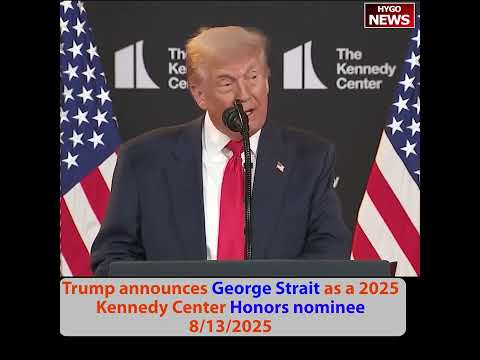
Trump: fed police 30 day limit, need crime bill long-term extensions; George Strait Honors nominee
Trump addressed the 30-day statutory limit on federal police takeover in DC with specific congressional strategy, announced country music legend George Strait as a 2025 Kennedy Center Honors nominee (with Trump himself serving as Kennedy Center Chairman), and commentators highlighted Trump’s innovative use of tariffs as negotiating tactics rather than just revenue generators. On DC federalization extensions: “We’re going to need a crime bill that we’re going to be putting in, and it’s going to pertain initially to D.C. … We’re going to be asking for extensions on that, long-term extensions, because you can’t have 30 days. 30 days is, that’s by the time you do it.” On the border precedent: “I never went to Congress for anything. I just said, close the border, and they closed the border.” On Strait: “Over an extraordinary four-decade career, George has sold more than 120 million records worldwide, amass 60 number one hits, and produced 33 platinum certified albums, more than any other living American.” On tariff innovation: “Tariffs have largely been used as two things, national security components or as revenue generators. He has now created a third category, which is we’re going to use it as a negotiation tactic. And he has the whole world spinning."
"30-Day Limit Unless Congress Acts”
The reporter’s question. “Your federalization of the police has a 30-day limit unless Congress acts to extend it. Are you talking to Congress about extending it or do you believe 30 days is sufficient?”
The legal framework. The DC federalization proceeded under the Home Rule Act’s emergency provisions, which permit the President to request MPD services for specific purposes. The emergency designation has a 30-day duration unless Congress passes legislation extending it or converting the authority to permanent form.
30 days is the clock. Congress has that window to act. Without congressional action, federal control over MPD reverts to the status quo ante.
”National Emergency” Alternative
Trump’s response. “Well, if it’s a national emergency, we can do it without Congress, but we expect to be just before Congress very quickly.”
“National emergency” is the alternative legal pathway. National emergencies provide expanded executive authority for specific time-limited periods. Declaration of a national emergency regarding DC crime could extend federal enforcement capacity beyond the 30-day Home Rule window without congressional action.
Trump is hedging. He expects to work through Congress. But if Congress fails to act, the national emergency declaration is available as a fallback. The threat — implicit rather than explicit — applies pressure on Congress to move quickly.
“We expect to be just before Congress very quickly.” That is Trump’s specific timeline commitment. Not “eventually.” Not “when it’s ready.” “Very quickly.” Legislation will be presented to Congress within days or weeks rather than months.
”Democrats Will Not Do Anything to Stop Crime”
“And again, we think the Democrats will not do anything to stop crime, but we think the Republicans will do it almost unanimously.”
That is Trump’s vote-count expectation. Democrats will vote against the crime bill uniformly. Republicans will vote for it nearly unanimously. The party-line split is expected.
If that expectation holds, the bill passes in the Senate only if Republicans have 50+ votes (with VP Vance breaking ties) — and only if no Democrats filibuster beyond the 60-vote threshold. Filibuster-proof legislation requires 60 votes, which Republicans do not have without Democratic crossover support.
The legislative path likely involves either:
- Reconciliation vehicle (avoiding filibuster)
- Amendment to must-pass legislation
- Pressure tactics producing a handful of Democratic crossover votes
- Procedural maneuvers reducing the effective 60-vote threshold
”Crime Bill … Initially to DC”
“So we’re going to need a crime bill that we’re going to be putting in, and it’s going to pertain initially to D.C. It’s almost, we’re going to use it as a very positive example.”
The specific scope. The crime bill will initially apply to DC. Other jurisdictions would be handled subsequently. DC is the pilot because:
- DC is a federal district under direct congressional authority
- DC has obvious crime problems producing bipartisan concern
- DC residents support federal intervention per polling
- DC’s MPD already requested federal support
“Very positive example” — DC’s crime reduction under federal intervention would serve as demonstration for potential future applications to other jurisdictions (Chicago, Baltimore, Philadelphia, etc.).
”Long-Term Extensions”
“We’re going to be asking for extensions on that, long-term extensions, because you can’t have 30 days. 30 days is, that’s by the time you do it.”
“30 days is by the time you do it.” That is Trump’s operational point. Setting up federal intervention, training the federal-MPD coordination, deploying personnel, establishing new procedures — all of that takes approximately 30 days. The actual operational period is barely beginning when the statutory window is closing.
“Long-term extensions.” Not merely extending 30 days by another 30 days. Substantially longer — potentially years. That would require specific congressional legislation granting extended authority.
The Border Precedent
Trump’s analogy. “We’re going to have this in good shape, and don’t forget, in the border, everyone said it would take years and you’d have to go back to Congress. I never went to Congress for anything. I just said, close the border, and they closed the border. And that was the end of it. I didn’t go back to Congress.”
That is Trump’s confidence-building reference. Biden-era border chaos. Trump’s January 2025 border executive orders and operational changes produced substantial reduction in illegal crossings within weeks. No congressional action was required. Administrative and operational changes — deployment, processing, deterrence — produced the results.
DC, in Trump’s framing, could follow a similar trajectory. Operational changes now. Legislative authority extending the operational changes later. The legislation codifies what the operations accomplish.
“I didn’t go back to Congress” is specific. The border did not require congressional legislation to achieve the operational improvement. The underlying legal authorities (enforcement discretion, personnel deployment, coordination with state/local) were sufficient.
”Don’t Want to Call National Emergency”
“I don’t want to call national emergency. If I have to, I will. I think the Republicans in Congress will approve this pretty much unanimously.”
That is Trump’s preferred sequence. Congress acts. Legislation provides extended authority. National emergency is not required.
But the national emergency is in reserve. If Congress delays — through Democratic obstruction, Senate filibuster, or simple procedural slowness — Trump will declare national emergency and proceed without congressional action.
That is specific pressure. Congress should act. Congress should act quickly. If Congress does not act, Trump acts unilaterally via emergency declaration. The choice for Congress: support legislation that creates political accountability or be bypassed entirely.
George Strait: Kennedy Center Honors
The event transition. “First is country music star, actor, and producer George Strait. Great. Over an extraordinary four-decade career, George has sold more than 120 million records worldwide, a mass 60 number one hits, wow, and produced 33 platinum certified albums, more than any other living American.”
George Strait’s career statistics. 120+ million records sold. 60 number-one hits. 33 platinum-certified albums. “More than any other living American.”
Strait is called the “King of Country” — the specific genre title that acknowledges his cultural and commercial dominance in country music since his 1981 debut. His consistency over four decades — maintaining chart-topping status across the evolution of country music — is historically exceptional.
“He’s beloved by hundreds of millions of people all over the world. He’s really something. And they call him the king of country, and we know him very well.”
Trump’s personal framing. Trump and Strait have mutual acquaintance. Strait has performed at various Trump-affiliated events over the years. The relationship is personal rather than merely ceremonial.
Trump as Kennedy Center Chairman
“Ladies and gentlemen, please welcome the president of the United States and the chairman of the board of the Kennedy Center, Donald J. Trump.”
The announcement language is specific. Trump is serving as Chairman of the Kennedy Center’s board — an institutional role he assumed earlier in 2025 as part of his arts-and-culture policy reshaping. That makes Trump both the President announcing the honorees and the Kennedy Center’s institutional leader determining them.
That dual role is unusual. Kennedy Center has historically been a bipartisan institution. Trump’s direct assumption of the chairman role shifts its governance explicitly under administration control. The honorees selected under Trump’s chairmanship reflect the administration’s cultural priorities.
George Strait Selection Significance
George Strait is not a politically contentious honoree. His country music legacy is universally acknowledged. His cultural impact is measurable and unambiguous. Selecting him for Kennedy Center Honors is not a political statement against Democrats.
But the selection itself reflects Trump’s cultural preferences. Country music as a core American art form worthy of the highest cultural recognition. Previous Kennedy Center Honors selections have included country artists occasionally — but the specific emphasis on country music traditions aligns with Trump’s cultural base.
Tariffs as “Third Category”
The panel discussion on Trump’s tariff innovation. “He wants what’s best for America. It’s not ideological. And he wants what’s best both for capital and labor. And he wants the market to succeed. He wants wages to go up. And look, you look at the trade deals. Only reason we got the trade deals, which are inarguably wins in victories across the board, whether it be Japan, Philippines, EU, I think we will see a very good China deal, I hope, in the next couple of months, is because you use tariffs as a way to bring people to the table.”
That is the commentator’s framing. Trade deals with Japan, Philippines, EU — all achieved. China deal expected. All of these were possible because tariffs created the negotiating leverage.
“Tariffs have largely been used as two things, national security, components, or as revenue generators. He has now created a third category, which is we’re going to use it as a negotiation tactic.”
That is the specific analytical insight. Two traditional tariff categories:
- National security (tariffs on strategic goods like steel, aluminum)
- Revenue generation (tariffs as federal income source)
Trump’s innovation: negotiation tactic. Tariffs as pressure mechanism to produce specific bilateral agreements. Not primarily for revenue. Not primarily for national security. Primarily for leverage.
“He has the whole world spinning, and they’re coming to the Oval Office wanting to get a deal done, wanting to come into the U.S. markets.”
That is the described operational effect. Countries globally seeking Oval Office meetings to negotiate tariff relief. The U.S. market access — the benefit countries want — is traded against specific Trump administration demands (tariffs, investment commitments, purchases of U.S. goods, etc.).
”The Inflation Just Wasn’t There”
“And he’s also recalibrated the way that we are financing the government. And a lot of the experts would say, hey, if you have any tariffs at all, and just to push back a little bit, it’s not just the 145 percent tariff. But they said, hey, if you have a 10 percent tariff, we’re going to see massive inflation. If you have a 20 percent, we’ve now had 90 days of tariffs in place across the board, and the report yesterday and the market responded, because the market doesn’t lie, the inflation just wasn’t there.”
That is the specific economic observation. Expert predictions about tariff-induced inflation have not materialized. 10% baseline tariffs + specific higher tariffs on particular countries (145% on some China-origin goods, etc.) — were predicted to produce substantial inflation. The July 2025 CPI data shows the opposite: inflation reducing, prices falling in multiple categories.
“The market doesn’t lie.” That is the commentator’s methodological point. Market prices — bond yields, equity valuations, currency rates — reflect the aggregate economic judgment of participants with money at stake. Those market signals show no inflation panic. The expert predictions were wrong.
“The structural inflation was not there.” Structural inflation is persistent, broad-based price increase. Post-tariff, the economy has not displayed structural inflation. Temporary tariff-induced price adjustments have been offset by other factors (lower energy costs, lower shipping costs, productivity improvements).
Three Interconnected Stories
DC federalization extension strategy (Congress, crime bill, national emergency as backup). George Strait Kennedy Center Honors (cultural institution governance). Tariff innovation analysis (third-category negotiation tactic producing economic results).
Each reflects a specific administration operational pattern. Legislative strategy backed by executive power alternatives. Cultural institution governance through direct administrative engagement. Economic policy innovation producing measurable results.
The cumulative effect demonstrates consistent operational approach across domains. Administration moves. Traditional constraints adapted or bypassed. Results produced. Criticism absorbed but not allowed to derail operations.
Key Takeaways
- Trump on DC federalization 30-day limit: “We’re going to need a crime bill … We’re going to be asking for extensions on that, long-term extensions, because you can’t have 30 days. 30 days is, that’s by the time you do it.”
- On the national emergency backup: “I don’t want to call national emergency. If I have to, I will. I think the Republicans in Congress will approve this pretty much unanimously.”
- The border precedent: “I never went to Congress for anything. I just said, close the border, and they closed the border. And that was the end of it.”
- Trump announcing George Strait as 2025 Kennedy Center Honors nominee: “Over an extraordinary four-decade career, George has sold more than 120 million records worldwide, amass 60 number one hits, and produced 33 platinum certified albums, more than any other living American.”
- On Trump’s tariff innovation: “He has now created a third category, which is we’re going to use it as a negotiation tactic. And he has the whole world spinning” — with inflation failing to materialize despite 90 days of tariffs.