 HYGO News
 Trump-Starmer Press Conference: EU's 20% VAT 'Not a Great Relationship'; Vance on UK Free Speech
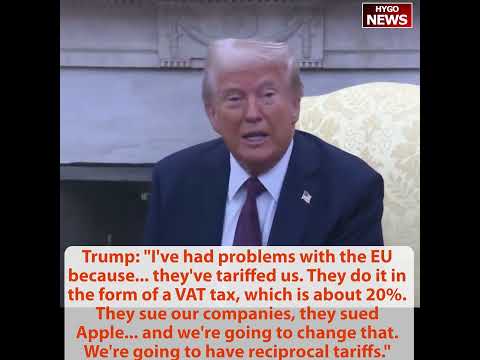
Trump-Starmer Press Conference: EU’s 20% VAT “Not a Great Relationship”; Vance on UK Free Speech
During the joint press conference with UK Prime Minister Keir Starmer on February 27, 2025, Trump delivered his most comprehensive critique of the European Union’s trade practices, citing the 20% VAT tax, lawsuits against Apple ($16-17 billion) and Google, and a $350 billion trade deficit. “I wouldn’t say it’s been such a great relationship,” Trump said of the EU, promising reciprocal tariffs. VP Vance was called to the stage to address free speech concerns, saying UK regulations “affect American technology companies and by extension American citizens.” Trump described his common ground with Starmer simply: “He loves his country and I love our country.” On Ukraine peace, Trump offered: “Trust and verify. I have confidence that if we make a deal, it’s going to hold."
"He Loves His Country and I Love Ours”
A reporter asked the obvious question given the political distance between a Republican president and a Labour prime minister: what was their common ground?
Trump’s answer cut through the ideological gap to something more fundamental. “I think I can say this because we’ve known each other now really for a little while. This is not our first meeting, as you know,” Trump said. “He loves his country and so do I. That’s our common theme. He loves his country and I love our country.”
He then placed the relationship in its broadest historical context. “We also have two countries that have gotten along for the longest period of time. Number one ally on each side,” Trump said. “We have good friends in Australia. We have a lot of good ones. But we’ve had a long-time relationship. A long time — hundreds of years.”
Trump concluded with characteristic directness: “And we like each other, frankly, and we like each other’s country. And we love our country. And I think that’s our common thread.”
The answer was effective because it acknowledged the political differences without dwelling on them. Trump was not pretending he and Starmer agreed on everything. He was saying that patriotism — each leader’s love for their own country — was a foundation strong enough to build a productive relationship on, regardless of partisan differences.
The EU Indictment: “Not a Great Relationship”
Trump then pivoted to the European Union, using the UK press conference as a platform to contrast the bilateral relationship with Britain against the adversarial dynamic with the EU.
“I’ve had problems with the EU,” Trump began. “They’ve tariffed us. They do it in the form of a VAT tax, which is about 20%. And many other taxes.”
He cited the EU’s legal actions against American companies. “They sued Apple. They got $16 or $17 billion, which was, I think, totally a ridiculous decision,” Trump said. “And they’re suing Google for a lot of money. They’re suing a lot of other companies.”
Trump listed the specific grievances. “We don’t like the way they’re treating our people. We don’t like the way they’re treating our companies,” he said. “They sell us cars. We don’t sell them cars. They don’t take our cars. They don’t take much of our agriculture.”
He quantified the imbalance: “And we have a deficit with them of about $350 billion.”
Then the blunt assessment: “So I wouldn’t say it’s been such a great relationship personally. But other people did because it’s politically correct to say that it’s been good, but it hasn’t been good.”
The statement was remarkable for its candor at a diplomatic event. Trump was saying publicly what many American trade officials had thought privately for decades: the EU-U.S. trade relationship was structurally unfair to America, and previous administrations had tolerated it because challenging the EU was considered diplomatically improper.
“And we’re going to change that,” Trump said. “We are going to have reciprocal tariffs. Whatever they charge us, we’re going to charge them.”
He explained why the policy had not been implemented during his first term. “For many years, I would have done that, but then all of a sudden we had COVID and we had other things to think about,” Trump said. “So it took me a little while to get that on.”
Vance on UK Free Speech: Called to the Stage
In an unusual moment, a reporter asked about VP Vance’s Munich Security Conference remarks criticizing UK free speech restrictions. Rather than answering himself, Trump invited Vance to respond directly.
“Well, I have an idea. We have the man right here. Come on. Let’s go, JD. Let’s put him on stage,” Trump said.
Vance delivered a measured but firm response. “Look, I said what I said, which is that we do have, of course, a special relationship with our friends in the UK and also with some of our European allies,” Vance said. “But we also know that there have been infringements on free speech that actually affect not just the British — of course, what the British do in their own country is up to them — but also affect American technology companies and by extension American citizens.”
He noted the issue would be addressed that day: “So that is something that we’ll talk about today at lunch.”
The exchange was diplomatically deft. Vance acknowledged British sovereignty over their own laws — “what the British do in their own country is up to them” — while maintaining the core American concern that UK speech regulations affected American companies and citizens. The framing made the issue one of extraterritorial impact rather than lecturing a sovereign ally about their domestic policies.
The fact that Trump called Vance to the stage rather than answering himself served a dual purpose. It demonstrated confidence in his vice president’s ability to handle delicate diplomatic questions, and it ensured that Vance could deliver the message in his own words rather than having it filtered through Trump’s more confrontational style.
”Trust and Verify”
A reporter asked Trump about his confidence in a potential Ukraine peace deal holding. Trump’s answer borrowed from Cold War diplomacy and added his own twist.
“Trust and verify. Let’s go with that,” Trump said, adapting Ronald Reagan’s famous “trust, but verify” formulation regarding arms control agreements with the Soviet Union.
He then offered a philosophical observation about human nature and negotiations. “And I think we both can be that way. You have to verify, because you never know what’s going to happen,” Trump said. “I know a lot of people that you would say no chance that they would ever deceive you, and they’re the worst people in the world. I know others that you would guarantee they would deceive you. And you know what? They’re 100% honorable. So you never know what you’re getting.”
He concluded with quiet confidence: “No, I have confidence that if we make a deal, it’s going to hold.”
The “trust and verify” formulation was significant because it placed the Ukraine peace process within the framework of great-power diplomacy. Just as Reagan had negotiated arms control agreements with the Soviet Union while maintaining robust verification mechanisms, Trump was signaling that any deal with Russia would include enforcement provisions that ensured compliance. Trust alone was insufficient; verification was essential.
The US-UK vs. US-EU Contrast
The press conference’s most effective rhetorical device was the implicit contrast between the warm US-UK relationship and the adversarial US-EU dynamic. By praising Starmer and Britain while attacking the EU at the same event, Trump was drawing a distinction between allies who traded fairly and allies who exploited the relationship.
The message to the UK was: you’re our number one ally, and we treat you accordingly. The message to the EU was: you’ve been taking advantage of us, and that’s ending. By delivering both messages simultaneously, Trump was incentivizing the UK to maintain its independent trade posture post-Brexit rather than aligning too closely with EU trade practices.
For Starmer, the arrangement was advantageous. Britain was being positioned as America’s preferred European partner — a status that came with economic opportunities (trade deals, investment) and diplomatic influence (a seat at the table on Ukraine, security, and other global issues). The price was willingness to address the free speech concerns Vance had raised and to maintain a trade relationship that the Trump administration considered fair.
Key Takeaways
- Trump described his common ground with Starmer simply: “He loves his country and I love our country” — calling it the foundation for a relationship between nations that had been allies “for hundreds of years.”
- He delivered his sharpest EU critique yet, citing the 20% VAT, lawsuits against Apple ($16-17B) and Google, a $350B deficit, and saying “I wouldn’t say it’s been such a great relationship.”
- VP Vance was called to the stage to address free speech, saying UK regulations “affect American technology companies and by extension American citizens,” while respecting that “what the British do in their own country is up to them.”
- On Ukraine peace, Trump offered “trust and verify” and said “I have confidence that if we make a deal, it’s going to hold.”
- Trump promised reciprocal tariffs on the EU: “Whatever they charge us, we’re going to charge them.”