 HYGO News
 Trump Signs Seafood EO: '80% of U.S. Seafood Is Imported -- We Have the Greatest Fishing in the World'; Restores Pacific Fishing Zones
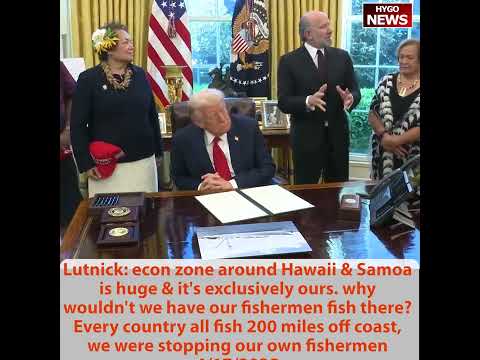
Trump Signs Seafood EO: “80% of U.S. Seafood Is Imported — We Have the Greatest Fishing in the World”; Restores Pacific Fishing Zones
President Trump signed an executive order to restore American seafood competitiveness in April 2025, highlighting the absurdity of America’s fishing situation: “About 80% of the seafood in the U.S. is imported. Imagine that. We import seafood, and we have the greatest coast fishing in the world.” Commerce Secretary Howard Lutnick expanded: “The economic zone around Hawaii and Samoa is huge and it’s exclusively ours. So why wouldn’t we have our fishermen fish there? Every country in the world, they all fish the 200 miles off their coast and we were stopping our own fishermen.” An American Samoan leader called the order “a wonderful gift” that returned “traditional fishing grounds taken away without even consulting our leaders and people."
"80% of Seafood Is Imported”
Trump opened the signing ceremony with a statistic that captured the absurdity of American economic self-sabotage.
“About 80% of the seafood in the U.S. is imported,” Trump said. “Imagine that. We import seafood, and we have the greatest coast fishing in the world.”
The number was staggering. The United States had more coastline than almost any country on Earth — stretching from Maine to Florida, from Texas to California, across Alaska’s vast Arctic and Pacific shores, and extending to Hawaii, American Samoa, Guam, and other Pacific territories. The exclusive economic zones around these territories encompassed millions of square miles of some of the richest fishing waters on the planet.
And yet, 80% of the seafood Americans consumed was imported.
The statistic was the fishing industry’s version of the antibiotic dependency Trump had cited on Liberation Day. Just as America had outsourced pharmaceutical production until it couldn’t make its own antibiotics, it had regulated its own fishing industry into irrelevance until it couldn’t feed itself from its own waters. Foreign competitors — many of them using subsidized fleets and lax environmental standards — had captured the American seafood market while American fishermen were drowning in regulations.
The Maine Lobster Problem
Trump provided a specific example that illustrated the broader dysfunction.
“So in Maine they do something similar,” Trump said. “I think it’s like 500 miles or something, some crazy thing. And Canada goes and they fish there. Other people fish there. Europe fishes there.”
He described the result: “You can’t get Maine lobsters because Maine — so Maine’s forced to go for days out to some other area. It’s not as good.”
Trump noted he had addressed this before: “I did it last time in Maine. And they undid it.”
He confirmed who had reversed it: “Biden undid it.”
He promised action: “We’ll have that on your desk next week, I promise.”
The Maine lobster situation was a microcosm of the entire American fishing crisis. Maine lobstermen — generational fishing families who had sustained their communities for centuries — were being regulated out of their own waters. Environmental restrictions, area closures ostensibly to protect marine species, and international fishing agreements had progressively shrunk the zones where American fishermen could operate.
Meanwhile, foreign fleets operated freely in waters that American fishermen were barred from. Canada, European nations, and others fished in areas adjacent to or even within traditional American fishing grounds. The Biden administration’s environmental policies had accelerated this dispossession, prioritizing theoretical conservation goals over the livelihoods of American workers and the food security of the American public.
Lutnick: “Every Country Fishes 200 Miles”
Commerce Secretary Howard Lutnick provided the economic and geographic context for the executive order.
“You just heard us — the economic zone around Hawaii and Samoa. It’s huge and it’s exclusively ours,” Lutnick said. “So why wouldn’t we have our fishermen fish there?”
He highlighted the absurdity: “I mean, imagine saying our own fishermen — every country in the world, they all fish the 200 miles off their coast and we were stopping our own fishermen from going off the coast. It’s totally the opposite of common sense.”
Lutnick connected the fishing order to Trump’s broader agenda: “That’s why President Trump has changed it.”
He addressed regulation: “Now let’s talk about regulation. If you’re not even going to let them fish, imagine the regulations that have been written to stop our fishermen from just surviving and thriving.”
He described the vision: “We have the greatest coast in the world with the greatest fishermen in the world and we need to let them do their great jobs, raise and catch your fish, bring them to our tables, have America have the greatest fish in the world, which we have.”
He added the trade dimension: “And then let them export to all these other countries, right? They stop us from exporting. That’s going to be over with your leadership and your trading policies.”
Lutnick delivered the conclusion: “We’re going to open all of these markets and we’re going to let our fishermen thrive and prosper and we are going to have lower cost fish, more of it, and the freshest fish in the world. And this is just common sense for the United States of America.”
The 200-mile exclusive economic zone was established under international law specifically to give coastal nations sovereignty over their adjacent waters. Every maritime nation in the world exploited this zone to support domestic fishing industries. America alone had voluntarily restricted its own fishermen from operating in its own waters — a decision that defied every principle of national economic interest.
American Samoa: “A Wonderful Gift”
An American Samoan leader provided an emotional reaction to the executive order’s restoration of Pacific fishing zones.
“Thank you so much for your awesome leadership and giving back to American Samoa what had been taken away from us without even consulting with our leaders and people at that time,” the leader said.
The leader quantified the scale: “He just one day just took away three Californias.”
The leader connected it to the broader moment: “And so this is such a wonderful gift to American Samoa and of course it’s also Holy Week beginning today and so thank you for returning to our indigenous people this wonderful gift of our traditional fishing grounds.”
The “three Californias” reference described the vast Pacific marine sanctuary that the Biden administration had designated around American Samoa — restricting commercial fishing in an area three times the size of California. The designation had been made without meaningful consultation with the indigenous Samoan people whose livelihoods depended on fishing those waters.
The irony was severe. An administration that constantly invoked indigenous rights and environmental justice had stripped an indigenous Pacific community of its traditional fishing grounds to satisfy environmental groups based thousands of miles away. Trump’s executive order returned those grounds to the people who had fished them for generations.
The Regulatory Burden
The seafood executive order addressed not just access to fishing zones but the regulatory burden that had made commercial fishing prohibitively expensive and bureaucratically complex.
American fishermen faced a gauntlet of federal, state, and international regulations — catch limits, area restrictions, gear requirements, reporting mandates, observer programs, and environmental impact assessments — that collectively made it cheaper to import fish from Southeast Asia than to catch it off the American coast.
The regulations were often justified on environmental grounds, but the practical effect was perverse. Instead of American fishermen catching fish sustainably in well-managed American waters, the demand was met by foreign operations with minimal environmental oversight. Fish caught by unregulated foreign fleets — sometimes using slave labor, always with less environmental accountability — replaced fish that American fishermen would have caught under the strictest standards in the world.
The executive order aimed to reduce this regulatory burden while maintaining genuine environmental protections. The distinction was between regulations that served a real conservation purpose and regulations that existed primarily to restrict American economic activity. The former would be maintained; the latter would be eliminated.
Key Takeaways
- Trump signed an EO to restore American seafood competitiveness, noting “80% of U.S. seafood is imported — we have the greatest coast fishing in the world.”
- Commerce Secretary Lutnick: “Every country fishes the 200 miles off their coast, and we were stopping our own fishermen. It’s the opposite of common sense.”
- Trump highlighted Maine lobster: “Canada fishes there, Europe fishes there. You can’t get Maine lobsters. I fixed it last time — Biden undid it.”
- An American Samoan leader thanked Trump for restoring “what had been taken away without consulting our leaders — he took away three Californias.”
- Lutnick’s vision: “Lower cost fish, more of it, and the freshest fish in the world. This is just common sense.”