 HYGO News
 Trump Signs Four Nuclear Executive Orders: Reinvigorate Industrial Base, Speed SMR Approval, Defense Production Act, Export Strategy; 'Gold Standard Science' EO Ends 'Policy Made on Back of Junk Science'; Auto-Pen Joke
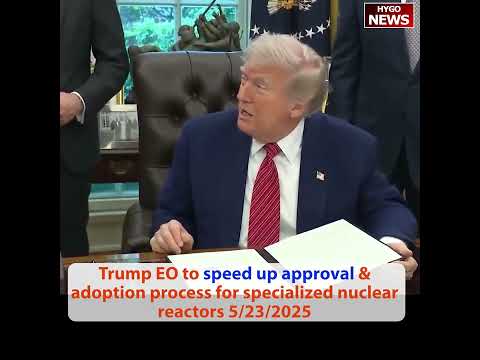
Trump Signs Four Nuclear Executive Orders: Reinvigorate Industrial Base, Speed SMR Approval, Defense Production Act, Export Strategy; “Gold Standard Science” EO Ends “Policy Made on Back of Junk Science”; Auto-Pen Joke
In May 2025, President Trump signed a suite of nuclear energy executive orders designed to revive American civilian nuclear power. The orders included: (1) reinvigorating the nuclear industrial base via Defense Production Act invocation to ensure fuel supplies; (2) speeding up approval for specialized Small Modular Reactors at defense and AI installations; (3) creating a special envoy position for nuclear technology exports; and (4) developing the nuclear sector workforce. He also signed the “Gold Standard Science” executive order: “One of the issues we’ve had in recent decades is that government policy has been made on the back of junk science, scientific studies and findings that have included conflicts of interest or scientific misconduct. The purpose of this executive order is to recenter policy making around gold standard science.” Trump included a characteristic quip about the Biden auto-pen controversy: “I’m just thinking, what about auto pens? Could I use an auto pen? What did [Biden] do? Did he have an auto pen at the desk?”
The Nuclear Industrial Base
The briefer explained the first executive order.
“Lastly, sir, we have an executive order on reinvigorating the nuclear industrial base,” the briefer said.
He identified the fundamental problem: “There are a number of core issues here, including the issue with fuel feedstock that one of the speakers mentioned before.”
He described the mechanism: “This executive order, among other actions, includes an invocation of the Defense Production Act in order to spur a closer collaboration with private industry to ensure that we have the fuel supplies we need for a modernized nuclear energy sector.”
The fuel supply issue was serious. American civilian nuclear reactors required enriched uranium, but American enrichment capacity had atrophied over decades. The major suppliers had become Russia (through Rosatom subsidiaries), France (Areva/Orano), and various other foreign suppliers. Russia had been the largest single supplier of enriched uranium to American reactors, a situation that had become politically untenable after Russia’s invasion of Ukraine.
Rebuilding American enrichment capacity would require:
- Construction of new enrichment facilities
- Development of new workforce with specialized skills
- Regulatory approvals for construction and operation
- Investment capital for the billions of dollars required
- Technical partnerships with allied nations
The Defense Production Act invocation was significant. The DPA gave the federal government authority to direct private industry to prioritize defense-related production, provide financial incentives, and compel cooperation. Originally passed during the Korean War, the DPA had become a tool for various strategic industrial policies. Using it for nuclear fuel production represented recognition that nuclear energy was strategic infrastructure, not just commercial industry.
The Workforce Issue
The briefer continued on workforce development.
“In addition to that, it includes crucial provisions relating to the development of a nuclear energy sector workforce and a number of other key building blocks to the overall nuclear industry that we’re trying to spur here,” the briefer said.
The nuclear workforce problem was acute. The American nuclear industry had been in decline since the 1979 Three Mile Island accident and the subsequent regulatory tightening. Very few new reactors had been built in subsequent decades. The existing workforce had aged; younger workers had pursued careers in other energy sectors.
By 2025, a revival of American nuclear energy would require:
- Training nuclear engineers (a pipeline that took 4-6 years)
- Developing nuclear construction expertise (largely lost)
- Building operating experience (only a few dozen reactors still operating)
- Creating regulatory familiarity (most regulators had limited experience with new builds)
- Establishing supply chains (which had atrophied with the industry)
Executive orders alone could not solve these problems, but they could provide direction, priority, and resources to begin addressing them.
SMRs at Defense and AI Installations
The briefer introduced the second executive order.
“The first executive order we have for you relates to the issue that Secretary Hegseth was speaking to, which is the need for incredible amounts of power at defense installations and also in AI-focused installations,” the briefer said.
He described the content: “What this executive order will do is speed up the approval and adoption process for specialized nuclear reactors at these sorts of sites.”
The AI data center power demand had become a critical bottleneck for American technological leadership. Major AI companies (OpenAI, Anthropic, Meta, Google, Microsoft, xAI) were building data centers requiring gigawatts of continuous, reliable power. Traditional grid infrastructure could not meet this demand without major new generation.
Small Modular Reactors (SMRs) offered a specific solution:
- Factory-built units requiring less site customization
- Smaller footprint than traditional nuclear plants
- Passive safety features reducing operator error risks
- Modular deployment allowing capacity scaling
- Dedicated power generation for specific facilities
American SMR development had been led by several companies (NuScale, X-energy, Terrestrial Energy, Westinghouse). The Nuclear Regulatory Commission had begun approving SMR designs, with NuScale having received initial approval in 2023. But deployment had been slow due to regulatory complexity, investor hesitation, and utility conservatism.
Trump’s executive order would:
- Accelerate NRC approval processes for SMRs
- Create favorable regulatory framework for defense and AI applications
- Provide federal financial support for initial deployments
- Coordinate with Department of Energy on fuel supply
- Align with Department of Defense on installation needs
Fuel Supply Coordination
The briefer continued on the integrated approach.
“It also involves the Department of Energy making available the necessary fuel stock,” the briefer said.
The Department of Energy controlled America’s strategic nuclear materials, including enriched uranium and specialized fuel assemblies. Making this available for commercial reactors was a significant policy choice. Historically, DOE had maintained strict separation between defense nuclear programs and civilian nuclear industry. The Trump order would enable at least some material transfer for urgent commercial needs.
The Export Strategy
The briefer described the global dimension.
“It also creates a special envoy position and a strategy around nuclear technology export,” the briefer said, “the idea being that we can grow American industry on the back of foreign purchasers who are interested in this sort of technology as well.”
The nuclear export market was strategically important. Countries around the world were evaluating nuclear options:
- European countries facing energy security concerns post-Ukraine war
- Asian countries seeking low-carbon base load power
- Middle Eastern countries diversifying from oil
- African countries with growing power demand
- Latin American countries with limited alternatives
If American companies could capture significant market share in these international markets, American nuclear capability would be strengthened through scale economics. Conversely, if Chinese or Russian companies dominated international markets, American nuclear would be further marginalized.
The “special envoy” position would coordinate American nuclear exports across multiple agencies: State (diplomatic relations), Commerce (export regulations), Energy (technical support), Defense (security review), and Treasury (financing support). This coordinated approach was needed to compete against state-owned Chinese and Russian nuclear industries that could deploy their full national resources for export deals.
The Auto-Pen Joke
Trump inserted a characteristic comedic moment.
“I’m just thinking, as you say, that I just said, what about auto pens?” Trump said. “Could I use an auto pen? What did Mike do? Did he have an auto pen at the desk?”
The auto-pen reference was to the ongoing controversy about Biden’s use of mechanical signature devices. By this point in May 2025, evidence had mounted that Biden had not personally signed many documents bearing his signature. The question of whether auto-pen signatures were constitutionally legitimate for presidential actions had become a serious legal and political question.
Trump’s riff on “could I use an auto pen” was self-aware comedy. He had been personally signing documents throughout his presidency. The contrast with Biden’s alleged auto-pen use was the underlying joke.
Someone responded: “Nuclear power? No, he didn’t do it. He used nuclear power. He didn’t do events like this, I guess.”
Trump continued the joke: “Otherwise, you’ll look at the other side of the room, have an auto pen.”
The joke captured the absurdity of the Biden situation. A president who needed to sign documents as significant as nuclear energy executive orders could not do so through mechanical device. The solemnity and importance of such signings required personal presidential engagement — which Biden had apparently been unable to provide for many major documents during his presidency.
”Gold Standard Science”
The fifth executive order addressed scientific integrity.
“Here it is. Phase one, very big phase, very important phase,” the briefer said. “This executive order is entitled Restoring Gold Standard Science.”
He described the problem: “One of the issues that we’ve had in recent decades is that government policy has been made on the back of junk science, scientific studies and findings that have included conflicts of interest or scientific misconduct.”
He described the purpose: “The purpose of this executive order is to recenter policy making around gold standard science, scientific efforts that have followed appropriate scientific methods that don’t include those sorts of conflicts of interest.”
He described the transparency requirement: “And to ensure that when departments and agencies are relying on scientific studies to promulgate rules, to promulgate regulations, that the science that they’re relying on is highly reliable and available to the public.”
The Gold Standard Science executive order addressed a genuine concern about federal policy-making. Over recent decades, major federal regulations had been based on scientific studies that had various problems:
Undisclosed conflicts of interest: Studies funded by parties with financial interests in regulatory outcomes, where researchers had not disclosed relationships.
Reproducibility failures: Studies that had not been replicated by independent researchers, particularly in fields with known reproducibility problems (psychology, nutrition science, environmental epidemiology).
Methodological problems: Studies using weak statistical methods, inadequate sample sizes, or inappropriate analytical techniques.
Non-public data: Studies whose underlying data had never been publicly released, preventing independent verification.
Cherry-picked evidence: Regulatory decisions that emphasized supportive studies while ignoring contradictory evidence.
Advocacy rather than science: Studies designed to advance particular policy positions rather than investigate objective questions.
The Trump administration’s approach was to require that federal policy decisions cite scientific studies meeting specific quality standards:
- Disclosed conflicts of interest
- Public availability of underlying data
- Replication by independent researchers
- Publication in high-quality peer-reviewed journals
- Consistency with accumulated scientific evidence
This was consistent with broader reform of federal scientific processes that Republicans had advocated for years. The “secret science” rule that the Trump EPA had attempted in its first term (later reversed by Biden) had addressed similar concerns about policy relying on unavailable data.
The Junk Science Issue
The “junk science” framing was politically charged but substantively justified. Various high-profile examples had demonstrated federal regulatory reliance on problematic science:
EPA environmental regulations: Various Clean Air Act regulations had been based on specific studies whose underlying data EPA had refused to release, citing “confidentiality” of patient records. Whether the data could have been appropriately anonymized and released was contested. The result was that regulations imposing billions in economic costs had been justified by studies that could not be independently verified.
FDA drug approvals: Various FDA drug approvals had relied on industry-funded studies with conflicts of interest. When independent studies emerged contradicting approval claims, the original approvals had often not been revisited.
CDC vaccine studies: Studies on vaccine safety had various methodological problems and undisclosed conflicts. The MAHA agenda included re-examining vaccine safety claims with more rigorous methodology.
USDA dietary guidelines: Federal dietary guidelines had been based partly on industry-influenced science, particularly regarding saturated fat, cholesterol, and carbohydrate recommendations. Subsequent research had called many of these recommendations into question.
Climate science: While the basic climate physics were well-established, various specific policy-relevant claims (attribution of specific extreme weather events, specific economic damage estimates, specific tipping points) relied on studies with varying quality.
Trump’s Gold Standard Science framework would require that future federal policy-making address these concerns by citing only properly conducted, publicly verifiable, independently replicated science.
Key Takeaways
- Four nuclear executive orders: Industrial base revival, SMR approval acceleration, Defense Production Act for fuel, nuclear export strategy.
- Defense Production Act invoked to ensure fuel supplies for “modernized nuclear energy sector.”
- SMRs targeted for defense installations and AI data centers needing gigawatts of reliable power.
- Gold Standard Science EO: “Policy has been made on the back of junk science with conflicts of interest and scientific misconduct.”
- Trump’s auto-pen joke: “Could I use an auto pen? What did [Biden] do? Did he have an auto pen at the desk?”